Vegetable Doneness
Whole Roasted Cauliflower Tender-Core Doneness
Also: roasted cauliflower, cauli steak doneness, whole baked cauliflower
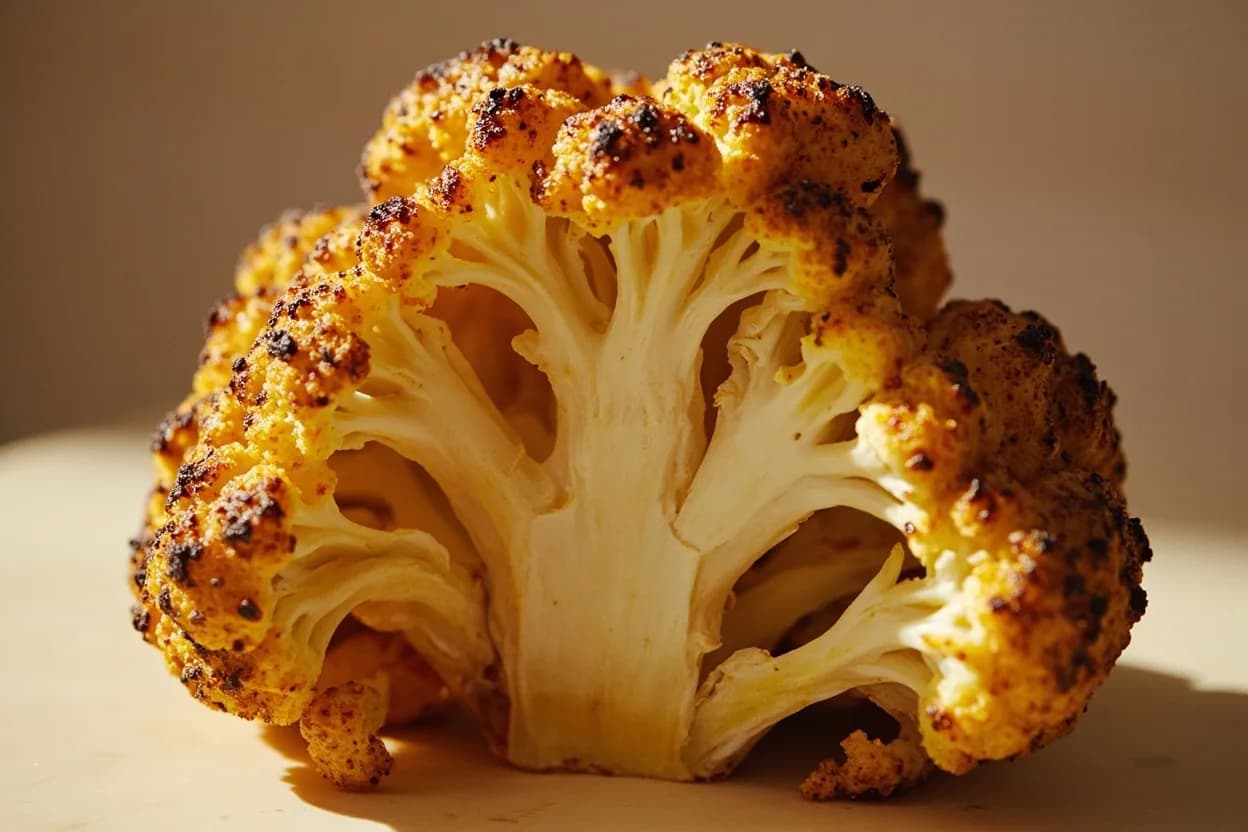
A probe or skewer enters the dense core with zero resistance, confirming pectin has fully broken down throughout — the exterior already caramelized deep amber, typically after 60–75 minutes at 200°C.
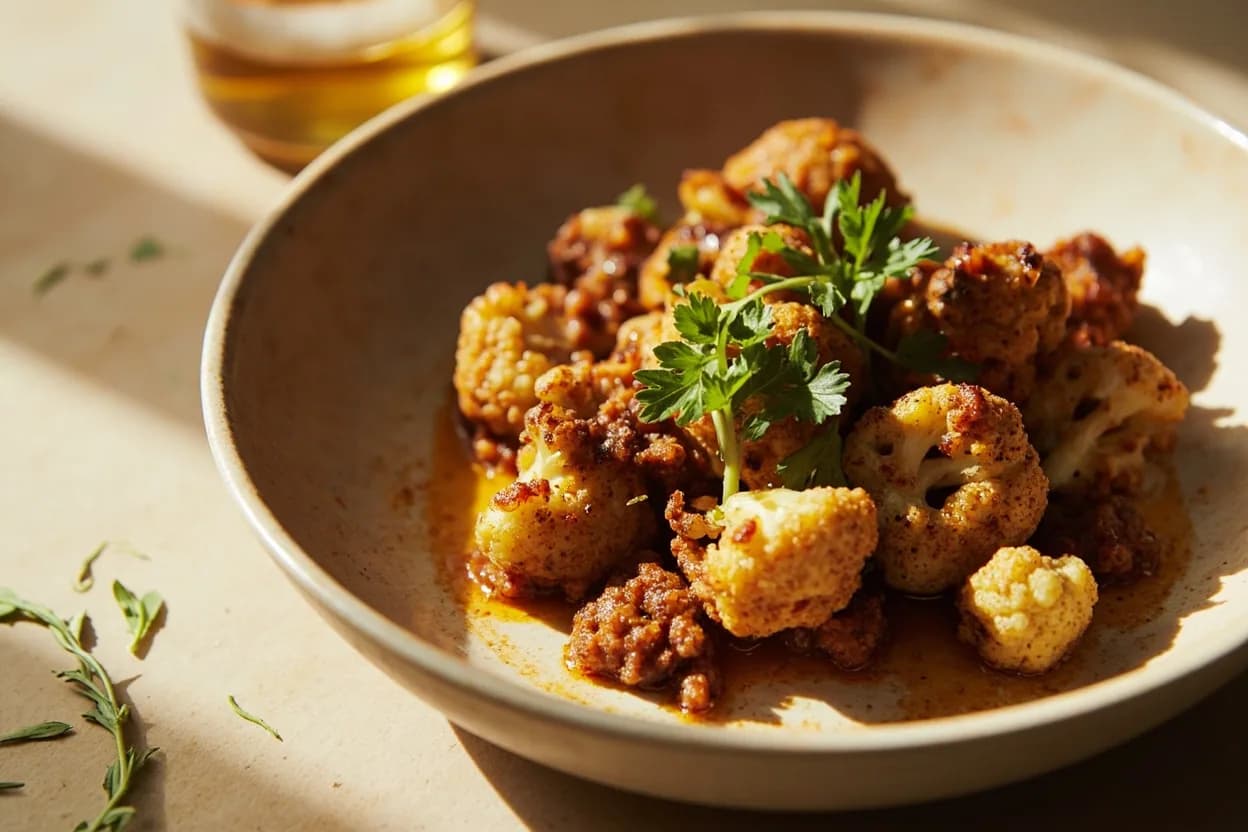
A whole roasted cauliflower presents a unique doneness challenge: the tight floret clusters and dense core conduct heat slowly, while the exterior browns rapidly. True doneness requires the core — the thickest, densest part — to reach full tenderness, not merely the outer florets. This means the stalk and inner stem must soften completely, requiring sustained oven time at high heat (190–220°C). The exterior will be deep golden-to-dark amber and slightly charred at tips; the interior should yield to a probe or cake tester with no fibrous resistance at all.
In photos

What happens
Cauliflower is dense with tightly packed glucosinolate-rich florets and a starchy core. During roasting, surface moisture evaporates rapidly, triggering Maillard browning on exposed florets at around 140°C surface temperature. Meanwhile, heat penetrates slowly toward the core. Pectin in cell walls begins to break down above 70°C; complete softening of dense core tissue requires sustained temperature above 85–90°C for several minutes. The glucosinolates (the sulfurous compounds responsible for raw cauliflower's bite) hydrolyze during cooking, producing sweeter, nuttier flavors. The caramelization of natural sugars in the florets creates the characteristic nutty-sweet crust. At full doneness, the core temperature is typically 88–93°C.
What to look for
- Exterior: deep amber to golden-brown caramelization across most of the head; floret tips may be lightly charred
- Visual shrinkage: the head loses 20–30% of its volume as moisture evaporates
- A probe or thin skewer inserted at the very center meets no resistance — glides through like softened butter
- Sweet, nutty, slightly caramel aroma — raw sulfurous notes completely absent
- The base (cut stem end) should feel soft when pressed with the tip of a knife
How to check
- Skewer test: insert a thin metal skewer or cake tester through the top into the core — no resistance means done; any springback or firm spot means continue roasting
- Thermometer: insert probe thermometer into the geometric center of the core; target 88–93°C (190–200°F)
- Wobble test: pick up the whole cauliflower with tongs — it should feel noticeably heavier and softer than raw; the head may begin to sag or spread
- Base press: press the base of the stalk firmly with a finger or knife tip — should yield easily
- Time check: at 200°C (400°F) conventional oven, 60–75 minutes is typical for a medium (800 g–1 kg) head; large heads up to 90 minutes
Carryover & resting
Whole roasted cauliflower retains heat in its dense core for 5–10 minutes after removal from the oven. If the very center is just barely tender when probed, a 5-minute rest tented loosely with foil will complete the final softening. Do not over-tent — trapped steam will soften the caramelized crust.
The science behind it
- Pectin degradation
Cell-wall softening requires sustained heat above 80–85°C; the dense core demands longer cooking time than outer florets
Browning on exterior florets from ~140°C surface temperature creates nutty, caramel flavor
- Glucosinolate hydrolysis
Heat breaks down raw sulfur compounds, replacing them with sweeter roasted notes
- Par-boiling method
Pre-boiling whole cauliflower 8–10 minutes before roasting dramatically reduces oven time and ensures even core doneness
- Cauliflower steak
1.5–2 cm slices through the head sear to tender-core doneness in 8–10 minutes per side in a skillet
Appears in
References
- 1.Plenty More — Yotam Ottolenghi (Ten Speed Press, 2014)
- 2.The Vegetarian Flavor Bible — Karen Page (Little, Brown, 2014)
- 3.The Food Lab — J. Kenji López-Alt (W. W. Norton, 2015)
- 4.Six Seasons — Joshua McFadden (Artisan, 2017)
Confidence: high
Notes
Par-boiling dramatically improves even cooking
Many restaurant preparations par-boil the whole cauliflower in heavily salted water for 8–10 minutes before roasting. This softens the core while the exterior remains firm, so subsequent high-heat roasting can focus on browning rather than cooking through. The result: deep exterior caramelization achieved before the delicate florets overcook. This is the preferred technique in most professional kitchens.
Oil matters for crust quality
Rub every crevice with a fat that can tolerate 200°C+ without smoking excessively. Olive oil mixed with clarified butter, or refined avocado oil, produce better crust than extra-virgin olive oil alone (which can turn bitter at extended high heat). Work oil under the outer leaves and into crevices between florets for even browning across the surface.