Cookware
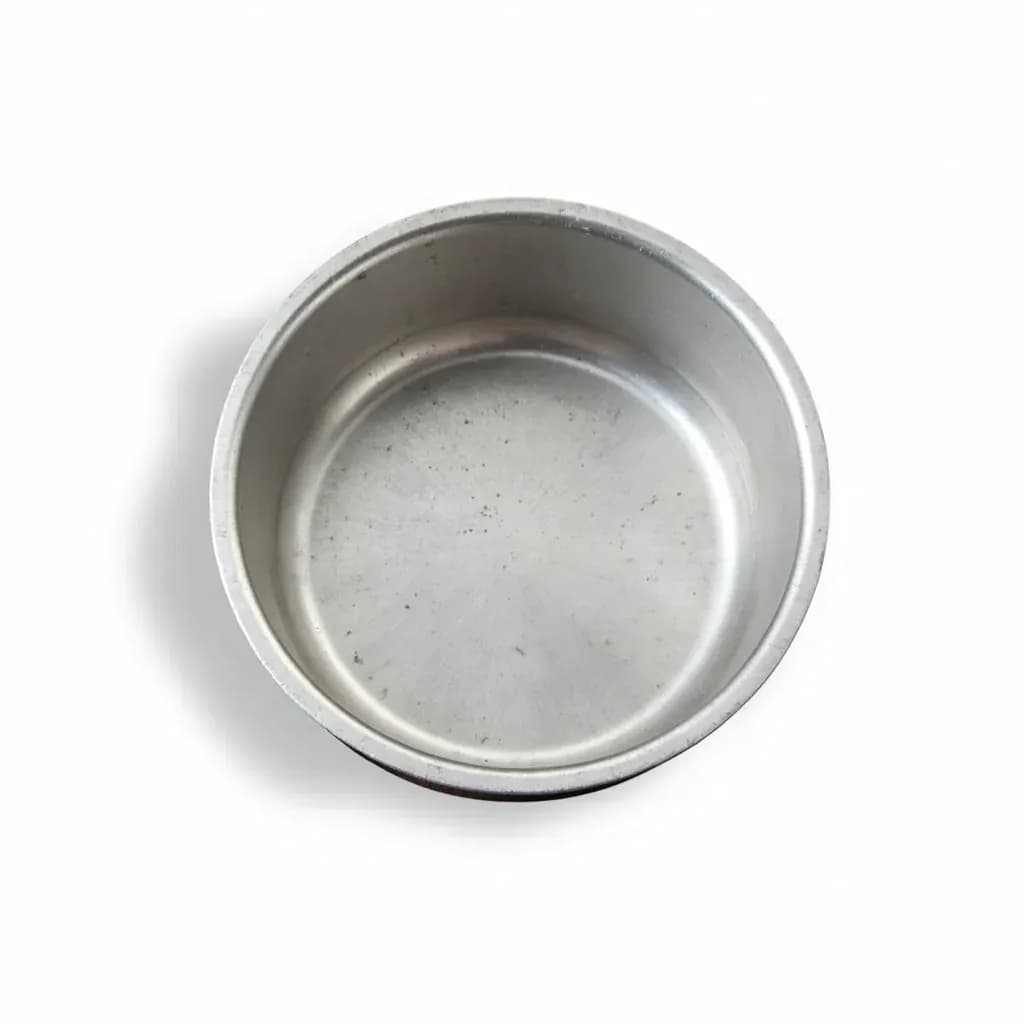
Aluminum Cooking Pot
Lightweight, fast-heating aluminum pot used worldwide for everyday boiling and stewing.
An aluminum cooking pot is a lightweight, highly conductive vessel that heats quickly and evenly, making it a staple for everyday cooking across much of the world. It is used for boiling rice, simmering stews, and cooking large batches, and in East Africa the form is known as a sufuria. Plain aluminum can react with very acidic foods, so anodized or coated versions are often preferred for tomato- or citrus-heavy dishes.
Aluminum is the workhorse metal of the professional kitchen, prized above all for the way it moves heat. Pure aluminum conducts roughly fifteen times faster than stainless steel and about five times faster than cast iron, so a pot of stock comes to a simmer in a fraction of the time, and temperature changes at the dial register almost instantly on the food. At about one-third the weight of steel, a 20-quart aluminum stockpot is something a cook can actually lift one-handed — a real ergonomic advantage in a busy line or a home kitchen hauling water to the sink.
The trade-off is reactivity. Bare aluminum is an active metal that readily dissolves in acidic ingredients (tomatoes, citrus, wine, vinegar) and strongly alkaline ones (lye-dipped pretzels, beans cooked in hard water), leaching a faintly metallic taste and leaving food looking grayish at the edges. For neutral-pH work — water, stock, plain pasta, blanching, canning, brewing — plain aluminum is excellent, inexpensive, and practically indestructible. The food industry has answered the reactivity problem with two durable solutions: hard-anodizing, which thickens aluminum's natural oxide layer into a hard, non-reactive surface, and stainless-steel cladding, which sandwiches an aluminum core between layers of inert 18/10 stainless to give the best of both metals.
Aluminum cookware became practical in the late nineteenth century after the Hall–Héroult process (1886) made bulk refining affordable, and by the mid-twentieth century it had largely replaced copper and tinned iron in restaurant kitchens. Today's cookware market treats aluminum less as a single material than as a family: stamped sheet for cheap utility pots, heavy castings for Dutch ovens and roasters, hard-anodized surfaces for everyday sauté work, and fully clad multi-ply cookware for serious all-purpose cooking.
Alternatives
Types & varieties
Lightest and cheapest; the classic restaurant stockpot. Reactive with acids and alkalies; not for long simmers of tomato, wine, or citrus.
Electrochemically treated to grow a thick, hard oxide layer. Non-reactive, dark gray, durable, and an excellent anchor for nonstick coatings. Brought to consumer cookware by Calphalon in the 1960s.
Thick-walled, sand- or die-cast; heavier than stamped but retains heat better, resists warping, and is common for Dutch ovens and country-kitchen roasters.
Aluminum core sandwiched between layers of 18/10 stainless steel. Inert cooking surface, induction-compatible when the base is magnetic, and the premium choice for sauce work.
Stamped from sheet stock; thin, very lightweight, inexpensive. The standard utility stockpot and commercial pasta cooker.
Aluminum body lined with PTFE (Teflon-type) or ceramic nonstick. Convenient for milk-based sauces, polenta, eggs, and reheating; coatings limit high-heat use and have a finite lifespan.
Why cooks choose aluminum
Three properties explain aluminum's enduring dominance in both restaurant and home kitchens:
• Speed. Because aluminum conducts heat so efficiently, water reaches a boil and stocks reach a simmer far faster than in stainless or cast iron. In a production kitchen that adds up to real labor savings; at home it means less waiting around. • Responsiveness. When you turn the burner down, an aluminum pot cools almost as quickly as it heated. This makes it forgiving for delicate work — custards, beurre blanc, fish poaches — and easier to recover from a scorch before the food tastes burned. • Weight. A 12-quart stainless stockpot weighs roughly 8 to 10 pounds empty; the aluminum equivalent is closer to 4. For anyone hauling water to a canning station or moving a pasta pot to the sink, that difference matters.
The reactivity problem — and how cookware solves it
Bare aluminum is not a passive metal. When it meets acidic or alkaline food, a small amount of aluminum ions migrate into the dish. The visible result is sometimes a gray cast on pale foods (poached pears, cauliflower); the taste result is a faint metallic note that becomes unpleasant with prolonged contact. Three engineering solutions have made aluminum practical for any recipe:
• Hard-anodizing. The aluminum is submerged in an acid bath and electrified, converting the surface into a thick, glassy aluminum-oxide layer. This is essentially the same compound as corundum, the mineral form of aluminum oxide whose gem variety is sapphire. The layer is hard, non-reactive, and an ideal substrate for nonstick coatings — though it is not truly nonstick on its own. • Stainless cladding. A sheet of aluminum is sandwiched between layers of 18/10 stainless, often 3-ply (stainless–aluminum–stainless) or 5-ply with additional conductive layers. The cooking surface is fully inert stainless; the conductive core does the heat work. • Nonstick and ceramic linings. A polymer or sol-gel coating seals the aluminum from the food. These are the most convenient options for eggs, dairy, and sticky reductions, but coatings scratch and degrade, especially above 400 °F or with metal utensils.
For neutral-pH cooking — water, stock, plain grains, blanched vegetables, canning — bare aluminum is still hard to beat on cost and performance.
Care, cleaning, and repair
Aluminum asks for slightly more attention than stainless but repays it with decades of service.
• Hand-wash with a soft sponge, warm water, and a mild detergent. Dishwasher detergents are strongly alkaline and will oxidize bare aluminum to a dull gray or black in a few cycles. • Remove mineral deposits and light discoloration by simmering a solution of 2–3 tablespoons of cream of tartar (or the juice of one lemon) per quart of water for 10 minutes, then scrubbing gently with a nylon pad. • Restore shine with barkeeper's friend or a paste of cream of tartar and water; avoid steel wool on bare surfaces, which leaves iron filings that rust and stain. • Replace a pot that has warped badly (the bottom no longer sits flat on a burner) or has deep pitting that harbors residue; most surface discoloration is purely cosmetic and safe to keep cooking with.
Common uses
Tips & pitfalls
- Match the pot to the burner — a small flame under a wide pot wastes energy and can scorch the handles while barely heating the food.
- Use medium heat; aluminum's high conductivity makes high burner settings redundant and can warp thin-gauge walls or fuse nonstick coatings.
- Add salt to water only after it boils — salt in cold water can pit and discolor bare aluminum.
- Reserve bare aluminum for neutral-pH cooking; switch to anodized or stainless-clad pots for tomato sauce, wine reductions, and citrus curds.
- Hand-wash rather than running through the dishwasher; alkaline detergents oxidize bare aluminum and turn it dull gray or black.
- To remove white mineral deposits or gray oxidation, simmer 2–3 tablespoons of cream of tartar or lemon juice per quart of water, then scrub gently with a nylon pad.
- Never preheat an empty aluminum pot on high — the thin metal can warp, discolor, or damage a nonstick interior in minutes.
- For induction cooking, choose a model with a magnetic stainless-steel base plate; bare aluminum will not register on an induction burner.
Good to know
- Material
- Aluminum, typically 1100 (pure), 3003 (manganese alloy), or 6061 (magnesium-silicon) series
- Thermal conductivity
- ~237 W/m·K — roughly 15× faster than stainless steel and 5× faster than cast iron
- Density
- ~2.7 g/cm³ — about one-third the weight of steel, one-quarter that of cast iron
- Typical gauge
- 1–3 mm for stamped pots; 4–8 mm for heavy-duty restaurant stock
- Surface treatments
- Plain mill finish, hard-anodized, PTFE or ceramic nonstick, stainless-clad, or ceramic-lined
- Acid reactivity
- Reacts with foods below pH 4 and above pH 9, leaching metal and producing off-flavors
- Dishwasher safe
- No for bare aluminum — alkaline detergents oxidize and darken the surface
- Induction compatible
- Only with a magnetic stainless-steel base plate bonded to the bottom
Also called
aluminum-pot · aluminum-cooking-pot · aluminium-pot · aluminium-cooking-pot · large-aluminum-pot · cast-aluminum-cauldron · heavy-aluminium-pot · aluminum-stockpot · sufuria
Related

Steamer
Gentle moist heat that keeps vegetables, fish, and dumplings tender

Frying Pan
Shallow sloped pan for frying, sautéing, and quick sears

Saucepan
Tall, straight-sided pot for sauces, grains, and small batches

Sauté Pan
Wide straight-sided pan with room to brown and braise

Dutch Oven
Heavy lidded pot that turns tough cuts tender over hours

Stock Pot
Tall, roomy pot for stocks, pasta, and big-batch cooking

Wok
High-sided bowl pan built for blistering-hot stir-fries

Griddle
Flat, broad surface for pancakes, smash burgers, and breakfast