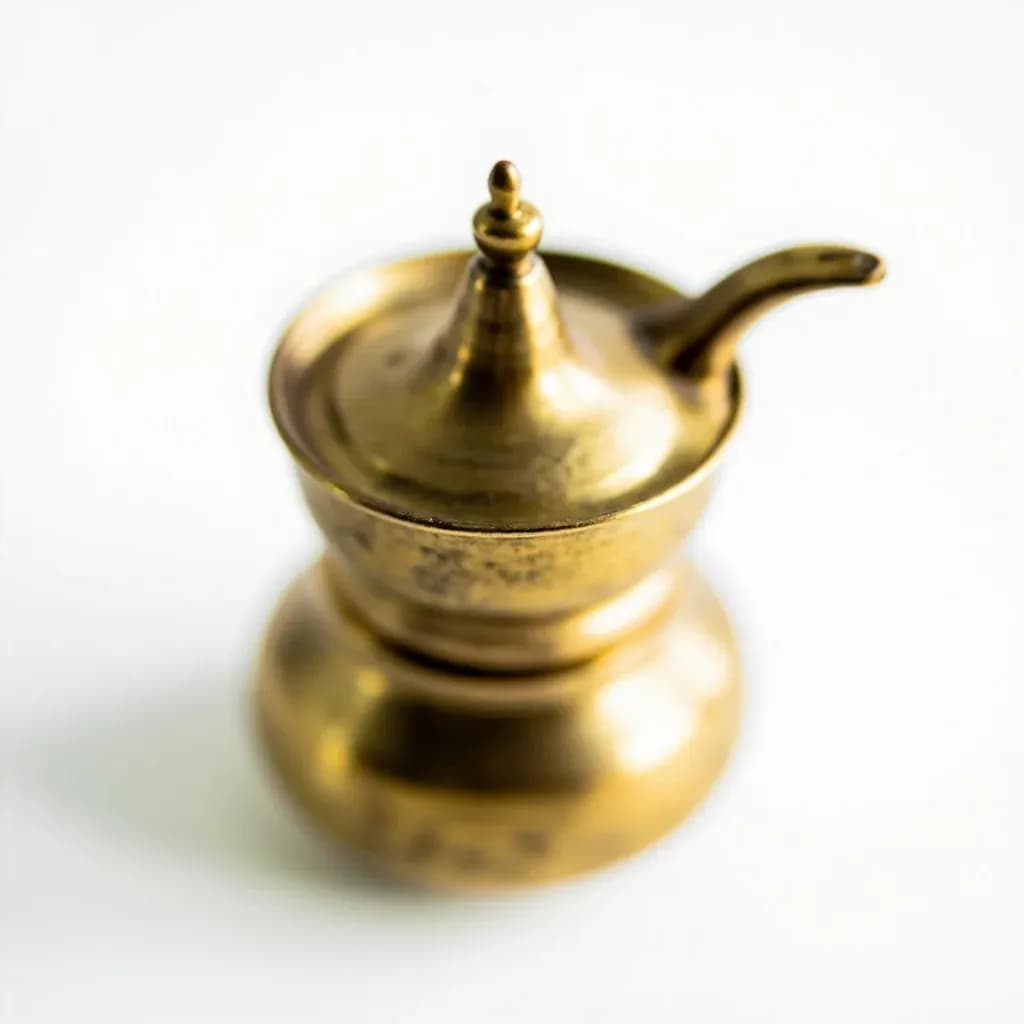
Cookware
Arabic Coffee Pot (Dallah)
A long-spouted Middle Eastern pot for brewing and serving lightly roasted, cardamom-spiced Arabic coffee.
A dallah is a traditional brass or stainless long-necked, beak-spouted pot used across the Arabian Peninsula to brew and serve qahwa, a pale, cardamom-scented Arabic coffee. The coffee is simmered with spices and poured from the dallah into small handleless cups (finjan) as a gesture of hospitality. Its curved spout and domed lid are iconic enough to appear on regional currency and emblems.
The dallah is the iconic coffee pot of the Arabian Peninsula: a lidded vessel with a single vertical handle and a long, gracefully curved spout, built to brew and serve Arabic coffee (gahwa or qahwa) in a single pour. Its silhouette is recognizable from Yemen to the Gulf, and its presence on a tray signals hospitality as clearly as the coffee inside. The same pot goes on the heat, comes to the table, and performs the long-pour from height that fills a row of small finjans — a ritual inscribed by UNESCO in 2015 as 'Arabic coffee, a symbol of generosity.'
The spout is the engineering. Its narrow exit meters a thin, steady stream; its long, curving neck shapes the flow so it lands cleanly in a finjan from a raised height; and the shoulder of the pot is broad enough to hold a working air gap above the liquid, and that gap is what controls the pour — fill past it and the coffee burps out in gulps. Traditional materials — copper, brass, silver — give the dallah its thermal character: quick response on the burner and steady heat through long gatherings. Modern stainless versions trade some of that character for dishwasher safety and induction compatibility.
The dallah is not interchangeable with the Turkish ibrik (cezve). An ibrik is a wide-mouthed, short-lipped cup for ultra-fine, sugar-included Turkish coffee brought to a foam and pulled off the heat. A dallah is a closed, lidded pot for a coarser, cardamom-forward brew that simmers once and settles. Brewing Turkish coffee in a dallah clogs the spout; brewing Arabic coffee in an ibrik leaves you pouring grounds into the cup. The spout is what makes the dallah the right tool for this particular coffee.
Alternatives
Types & varieties
Plump, rounded belly with a pronounced shoulder; often engraved with geometric or calligraphic bands; the most widely exported style.
Taller, more elongated body with a longer neck; spout often has a sharper upward curve.
Smaller, often stove-top; frequently plain or only lightly chased; paired with Yemeni's very light-roast tradition.
Slender profile with a high-arching spout; sometimes paired with a separate infuser for whole cardamom pods.
Lighter, smaller, sometimes with a palm-fiber or wooden lid; designed for portability and quick low-heat pours.
Heavily chased silver or silver-gilt, sometimes with a hinged base that conceals incense; intended for display, not daily brewing.
Mirror-polished food-grade stainless steel; dishwasher-safe and induction-ready when the base is magnetic, but lacks the thermal mass of copper.
The Spout's Pouring Geometry
In Saudi and Kuwaiti styles the spout often has a pronounced upward curve, which slows the pour and adds theater; in Omani styles the arch tends to be higher and slimmer. The handle, set opposite the spout, is what keeps the brewer's hand safely off the hot body; the spout itself is built for pour control, not hand clearance. The narrow exit meters coffee into a thin stream that lands in a finjan without splashing, and the long, curving neck shapes that stream so it can be poured from a raised height — the gesture that turns service into ceremony.
Choosing a Material
Copper heats fastest and most evenly, which suits the gentle simmer Arabic coffee prefers, and most traditionalists will not brew in anything else. Brass is heavier and more decorative, holding heat longer but responding more slowly to changes at the burner. Silver is neutral in flavor and ceremonial in appearance, though it requires regular polishing and is rarely used over high heat in daily brewing. Stainless steel is durable, dishwasher-safe, and the only traditional-style option that works on induction natively — but only when the base is a bonded magnetic plate — and it lacks the thermal mass of the older metals, cooling quickly once off the flame.
Dallah vs. Ibrik
The two pots are easy to confuse in a photograph and completely different in use. An ibrik is a wide-mouthed, short-lipped brass or copper cup for Turkish coffee: ultra-fine grind, sugar stirred in before brewing, brought to a foam and pulled off the heat, the process often repeated. A dallah is a closed, lidded pot with a long curved spout for Arabic coffee: coarser grind, no sugar, whole or crushed cardamom, simmered once and left to settle. Brewing Turkish coffee in a dallah packs the spout with silt; brewing Arabic coffee in an ibrik leaves grounds in the cup. If the coffee is dark, sugary, and foamed, reach for the ibrik; if it is light, cardamom-led, and poured clear, reach for the dallah.
Common uses
Tips & pitfalls
- Hand-wash only — dishwasher detergent strips lacquer and dulls chased brass and silver.
- Never fill above the base of the spout; the air pocket above the liquid is what controls a smooth, even pour.
- Use a coarse or medium grind of Arabica; fine Turkish grind clogs the long spout and over-extracts bitter tannins.
- Bring water to a full boil first, then add coffee and crushed cardamom, then drop to a bare simmer — boiling hard after dosing scorches the brew.
- Let the pot rest off-heat for 5–10 minutes so grounds settle, then decant gently without tilting past the spout's well.
- For induction, choose a stainless dallah with a flat magnetic base; traditional copper and brass will not work without an induction interface disc.
- Season a new copper or brass dallah with a few rounds of plain boiling water and discarded cardamom husks to remove any metallic taste.
- Never leave brewed coffee in the dallah overnight; the oils tarnish the interior and stale cardamom clings to the metal.
Good to know
- Also called
- Dallah (دلة); Dallah arabiyya; Yemeni form is often called rakweh
- Origin
- Arabian Peninsula; design continuous since the pre-Islamic era, with most surviving examples from the 18th–20th centuries
- Primary use
- Brewing and serving Arabic coffee (gahwa / qahwa)
- Typical capacity
- Small single-serve (~150–300 ml) up to family-size (~1–2 L); tourist pieces commonly ~500 ml
- Distinguishing feature
- Long, often swan-neck or beak-shaped curved spout with no drip lip; interior curve is engineered to pour a thin stream from height
- Pairing vessel
- Finjan — a small handleless cup of ~30–60 ml
- Cultural status
- Inscribed on UNESCO's Representative List of the Intangible Cultural Heritage of Humanity in 2015 as 'Arabic coffee, a symbol of generosity'
- Traditional / modern materials
- Copper, brass, or silver (traditional); stainless steel and aluminum (modern, including magnetic-base induction versions)
Also called
coffee-dallah · Dallah · Arabic Coffee Dallah
Related

Steamer
Gentle moist heat that keeps vegetables, fish, and dumplings tender

Frying Pan
Shallow sloped pan for frying, sautéing, and quick sears

Saucepan
Tall, straight-sided pot for sauces, grains, and small batches

Sauté Pan
Wide straight-sided pan with room to brown and braise

Dutch Oven
Heavy lidded pot that turns tough cuts tender over hours

Stock Pot
Tall, roomy pot for stocks, pasta, and big-batch cooking

Wok
High-sided bowl pan built for blistering-hot stir-fries

Griddle
Flat, broad surface for pancakes, smash burgers, and breakfast