Cookware
Asparagus Pot (Spargeltopf)
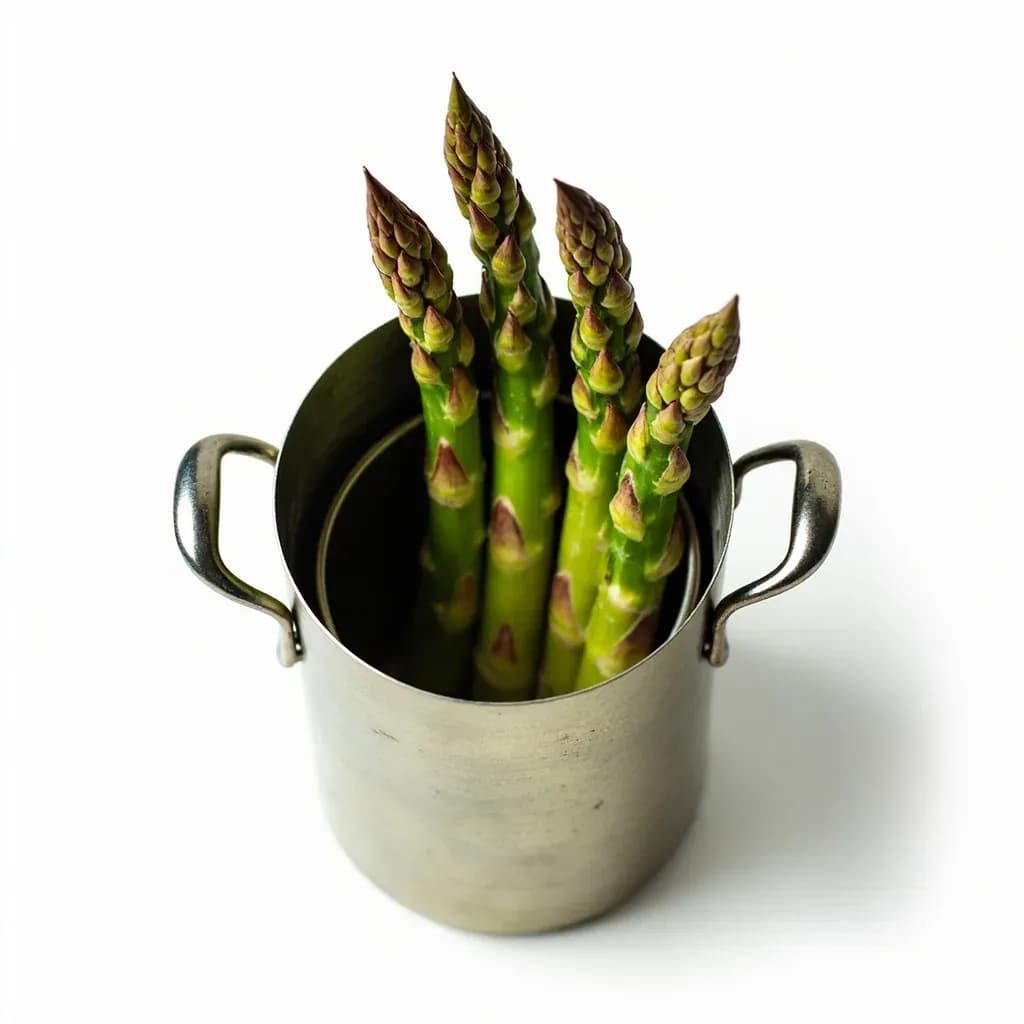
A tall narrow pot that cooks asparagus standing upright with a lift-out basket.
An asparagus pot, or Spargeltopf, is a tall slender pot designed to hold asparagus spears vertically in a perforated insert. The tender tips steam in the rising vapor while the tougher stem ends boil in the water below, so the whole spear cooks evenly. The lift-out basket lets the cook drain the delicate spears without breaking them.
A Spargeltopf is a purpose-built tall, narrow stockpot with a perforated inner basket designed to cook asparagus vertically. The geometry is the whole point: spears stand on their trimmed ends in just a few centimeters of simmering water, while their tender tips ride above the waterline and cook in the rising steam. That two-zone environment — direct boiling for the tough, fibrous stems and gentle steaming for the delicate buds — is exactly what asparagus needs, and it is awkward or impossible to replicate in a standard wide pot without constant fiddling.
The tool is most associated with German, Austrian, and Alsatian kitchens, where white Spargel is a seasonal ritual from roughly mid-April through St. John's Day on June 24, and where a blue-speckled enameled Spargeltopf is as much a sign of spring as a preserving pot is of autumn. The inner basket has long handles that rest across the pot's rim, so the cook can lift the entire bundle out in one motion to stop the cooking instantly and drain without tipping. A fitted lid traps steam around the exposed tips, shortening cook time and keeping them plump rather than shriveled.
A Spargeltopf is not a generalist tool, and that is its strength. It does one job and does it well: roughly 500 g to 2 kg of asparagus at a time, evenly cooked, with no babysitting. Modern stainless versions work on induction; older enameled steel versions are gas- and electric-friendly. For anyone who cooks asparagus more than two or three times a year, the dedicated basket pays for itself in texture and consistency.
Alternatives
Types & varieties
The classic German look, matching traditional milk pans and preserving pots; durable and inexpensive, but not induction-compatible.
A cleaner, more modern take on the traditional style with the same construction; shows wear and chipping more visibly than blue.
Contemporary versions from Fissler, Silit, and Kuhn Rikon; induction-ready, heavier, and more durable long-term.
Lighter and heats quickly, but uncommon and not induction-compatible unless clad in a magnetic base.
A perforated silicone basket that fits inside a regular tall stockpot; a good space-saving alternative for small kitchens, though it lacks the rim-resting handles that make draining one-handed.
A specialty appliance pairing an internal heating element with a vertical steaming chamber; rare in home kitchens, more common for buffet and restaurant service.
The geometry of the upright cook
Most asparagus-cooking problems come from treating spears as if they were uniform. They are not: the lower third is woody and fibrous, the upper third is tender and sweet, and a single spear can go from crisp to mushy in two minutes. A wide, shallow pot either submerges the delicate tips (waterlogging them and leaching flavor) or leaves the stem ends above the waterline (where they never soften). The Spargeltopf solves this by turning the problem sideways. Cut ends sit in actively boiling water; tips sit in saturated steam at roughly the same temperature but with gentler heat transfer. Both zones finish at the same time, with no rotation or partial-coverage tricks required. The rim-resting basket then removes the spears from heat in a single lift, which is the other half of the design: instant draining is what prevents the residual carryover cooking that ruins asparagus in any vessel.
Sizing and buying
Most home cooks should think in terms of kilograms of asparagus per cook, not liters of pot capacity. A 16 cm diameter model holds about 500 g comfortably and suits one or two people; a 20–22 cm model is the most versatile family size at roughly 1–1.5 kg. The largest 24 cm versions approach 2 kg and need a wider burner. Tall, narrow shapes are deliberate: a short, wide pot defeats the upright-cooking principle. Match the basket to the pot from the same maker if possible; aftermarket baskets rarely sit at the right height for clean rim-resting.
- 16 cm (≈500 g): solo cook or couple
- 20–22 cm (≈1–1.5 kg): family workhorse
- 24 cm (≈2 kg): entertaining and batch cooking
- Verify rim-handle clearance: the basket handles must reach the pot rim while the basket itself clears the bottom
Common uses
Tips & pitfalls
- Fill the pot with only enough water to cover the lower third of the spears — about 3–5 cm for a full load. Tips should never touch the water; they cook in steam.
- Salt the water generously (about 1 tablespoon per liter) and add a teaspoon of sugar and a squeeze of lemon for white asparagus, which brightens the otherwise flat flavor.
- Trim the woody ends flat before standing the bundle up; this gives every spear uniform contact with the water and removes the toughest fiber in one cut.
- Bring the water to a boil with the lid on, then drop to a steady simmer once the basket goes in. A hard rolling boil muddies the water and can batter the exposed tips.
- Stand the thickest spears in the center and thinner ones around the edge; the geometry evens out the cook rate between core and perimeter.
- Test doneness by lifting a spear with tongs and bending it: it should yield with a slight snap, not flop. Overcooked asparagus goes mushy within a minute or two.
- Lift the basket straight out by its rim handles and let it rest on the pot edge to drain instantly — this is the single biggest advantage of the design and the step most often skipped.
- Don't leave cooked asparagus sitting in the basket on the counter in a hot kitchen; the residual heat continues to cook the tips. Drain and serve within a few minutes, or shock briefly in cold water for a cold preparation.
Good to know
- German name
- Spargeltopf
- Origin
- Germany, Austria, and the Alsace region
- Typical dimensions
- 16–24 cm (6.5–9.5 in) diameter, 20–30 cm (8–12 in) tall
- Capacity
- Roughly 500 g to 2 kg of asparagus, depending on size
- Traditional material
- Enameled steel, often in blue or blue-and-white speckle finishes
- Key feature
- Perforated inner basket with rim-resting handles for one-motion lifting and draining
- Typical cook time
- About 8–15 minutes once water returns to a boil, depending on spear thickness
- Lid
- Usually included; traps steam around the exposed tips above the waterline
Also called
asparagus-pot · Spargeltopf · Asparagus Steamer
Related

Steamer
Gentle moist heat that keeps vegetables, fish, and dumplings tender

Frying Pan
Shallow sloped pan for frying, sautéing, and quick sears

Saucepan
Tall, straight-sided pot for sauces, grains, and small batches

Sauté Pan
Wide straight-sided pan with room to brown and braise

Dutch Oven
Heavy lidded pot that turns tough cuts tender over hours

Stock Pot
Tall, roomy pot for stocks, pasta, and big-batch cooking

Wok
High-sided bowl pan built for blistering-hot stir-fries

Griddle
Flat, broad surface for pancakes, smash burgers, and breakfast