Cookware
Bain-Marie
Hot-water bath that gently heats or holds delicate foods without scorching.
A bain-marie is a water-bath setup where a container of food sits in a larger vessel of hot water, providing gentle, indirect heat. It is used to melt chocolate, cook custards and sauces, and keep prepared foods warm without scorching or curdling. In professional kitchens, a steam-table bain-marie holds sauces and sides at serving temperature during service.
A bain-marie is a hot-water bath used to heat food gently and indirectly. In its classic form, an upper pan or bowl sits over, not in, a lower pot of simmering water, so the contents of the upper vessel are warmed by steam and conducted heat rather than direct contact with a flame or hot metal. Because water at atmospheric pressure cannot exceed 100 °C / 212 °F, the bain-marie is self-limiting: even an inattentive cook cannot push the temperature higher, which is exactly why the device exists.
The technique is what makes delicate preparations possible. Egg-yolk emulsions curdle above roughly 70 °C; chocolate seizes when it overheats; custards and terrines crack on top when their edges set before the centers cook through. A bain-marie sidesteps every one of those problems by providing a buffer of hot water between the heat source and the food. The trade-off is that you give up speed and any chance of browning — you cannot sear, fry, or caramelize in one — in exchange for a kind of thermal gentleness no open flame can match.
The name comes from Mary the Jewess, a 1st–3rd-century alchemist of Alexandria credited with the kerotakis, a double-vessel heater that is the direct ancestor of the modern double boiler. The term travelled from the alchemical workshop into French professional cookery, and the bain-marie became a standard of pastry and sauce work. Today it remains the go-to tool for tempering eggs, melting chocolate, and baking custards, while its precision descendant — the sous-vide circulator — handles long, low-temperature cooking in modern restaurant kitchens.
Alternatives
Types & varieties
Two nested pans: a lower pot of simmering water and an upper, snug-fitting pan that sits in the steam, not in the water.
A heatproof glass or metal bowl set over a pot of simmering water — the most common home substitute.
A flat, shallow pan of warm water on the stove or in a steam table, used to hold finished sauces at service temperature without direct flame.
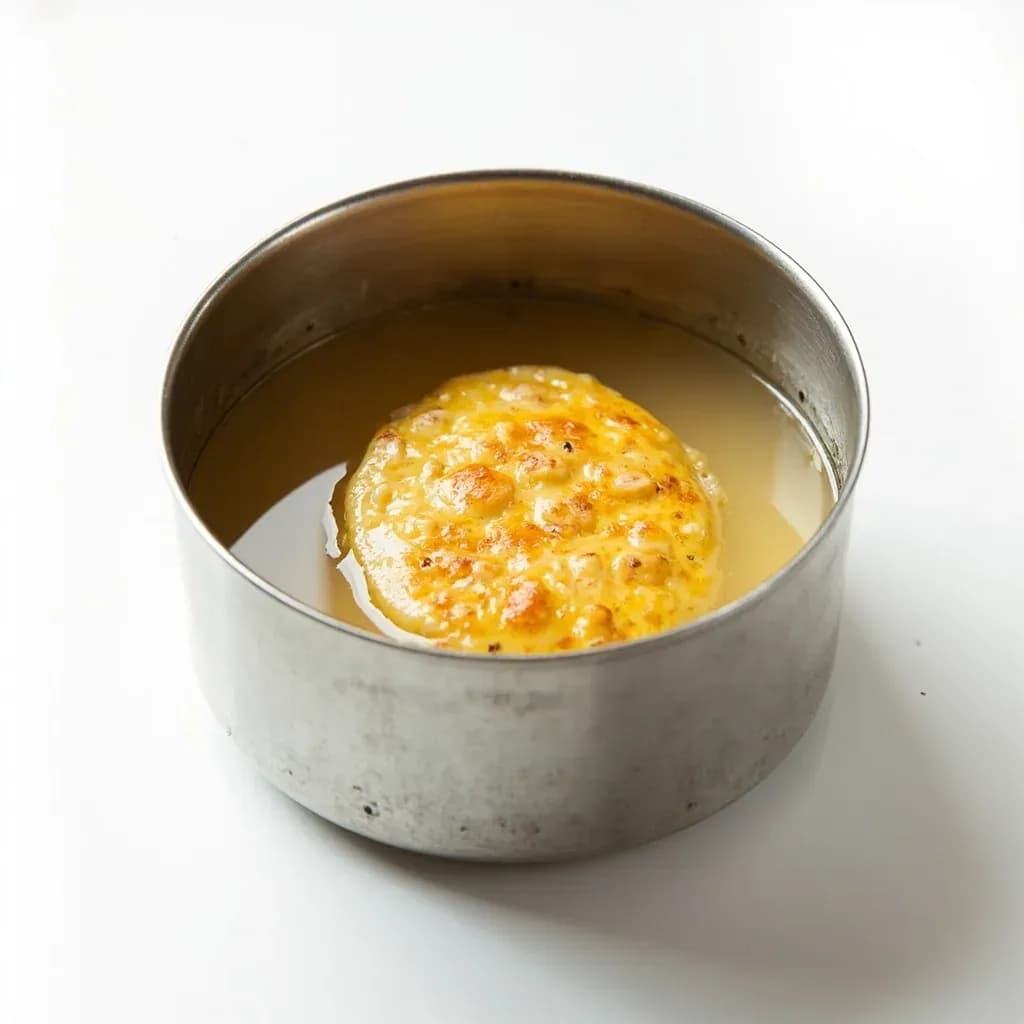
Custards, terrines, pâtés en croûte, and cheesecakes baked inside a roasting pan or hotel pan filled with hot water; in pastry texts this is what 'au bain-marie' usually means.
Small dedicated insert, often with a flared rim, sized for a single bowl of chocolate; sometimes paired with a scraper to keep the bowl off the bottom.
Countertop holding unit with a heated well of water beneath hotel pans, used to keep sauces, purées, and cooked vegetables warm during service.
Modern precision version: a thermostatically controlled immersion circulator holding any pot of water within ±0.1 °C of target.
Materials and heat transfer
The pan you choose changes how the bain-marie behaves. Copper, the classic French material, conducts heat quickly and evenly, which is ideal when you need a butter sauce to mount smoothly but unforgiving if your attention drifts. Stainless steel behaves similarly but responds a little more slowly, which most cooks find easier to manage. Heatproof glass is the gentlest option — it heats slowly and unevenly, so chocolate melts with very little risk of localized scorching, but a glass bowl will also take longer to bring a sabayon to ribbon stage. Enameled steel and ceramic fall between glass and metal. The rule of thumb: the better the conductor, the more you need to stir and the more carefully you need to control the burner beneath.
The two meanings of bain-marie
The phrase covers two distinct setups that share one principle. On the stove, it means a double boiler for emulsions, chocolate, and gentle reductions. In the oven, it means a roasting pan of hot water surrounding custards and terrines as they bake. Cooks sometimes confuse the two; the equipment differs, but the underlying idea — water as a thermal buffer that caps your maximum temperature — is the same.
Common mistakes and quick fixes
- Water touching the upper pan: the spot directly above the waterline overheats and can curdle eggs or scorch chocolate. Fix by lifting the insert, reducing the water level, or switching to a wider bowl that bridges the pot's rim.
- Boiling rather than simmering: a rolling boil spits water droplets into the upper pan and makes heat transfer too aggressive, scalding the contents the moment they thicken. Drop the burner the moment you see more than a lazy bubble.
- A drop of water in melted chocolate: it seizes the chocolate into a stiff paste. Use a dry bowl, dry utensils, and avoid the splash zone when you stir.
- Letting the oven bath dry out: custards crack and overcook the moment the water evaporates below the level of the molds. Top up with hot water from a kettle during long bakes.
- Pulling the bowl too late: a sabayon or hollandaise can pass from perfect to scrambled in seconds once it climbs past 75 °C. Pull it off the heat at the first sign of heavy steam.
Common uses
Tips & pitfalls
- Keep the water at a bare simmer, not a rolling boil — vigorous bubbling spits steam into the upper pan and can curdle egg mixtures or seize chocolate.
- The bottom of the upper pan or bowl should hover above the water, ideally sitting in the steam; if it touches the water, the mixture will overheat locally.
- Stir almost constantly when melting chocolate, and never let even a drop of water into the bowl — it will seize on contact.
- For oven water baths, pour very hot (not boiling) water into the roasting pan after the custards are set in the oven so you do not splash them; pull the rack out halfway to do this safely.
- Maintain a consistent water level in long cooks: top up with hot water from a kettle so you do not drop the bath temperature mid-bake.
- Use a thermometer clipped to the side of the pot for delicate emulsions; aim for 60–65 °C / 140–150 °F in the upper pan when mounting butter sauces.
- For sabayon, the bowl should feel hot to the hand but never uncomfortably so; pull it off the heat the moment the foam ribbons when you lift the whisk.
- Do not try to fry or sear in a bain-marie — its entire purpose is gentle, indirect heat under 100 °C; reach for direct heat instead.
- A large, deep skillet with a couple of centimetres of simmering water makes a useful improvised bain-marie for oddly shaped bowls that won't bridge a saucepan.
Good to know
- Origin
- Named for Mary the Jewess (Maria Hebraea), a 1st–3rd-century alchemist of Hellenistic Alexandria, who is credited with the kerotakis, a double-vessel heater that is the direct ancestor of the modern bain-marie.
- Also called
- Double boiler (US/UK English), baño de María (Spanish), bagnomaria (Italian).
- Principle
- Indirect, gentle heat: steam and hot water transfer heat well below the open-flame maximum, so delicate mixtures never exceed roughly 100 °C / 212 °F.
- Typical water temp
- Bare simmer, 85–95 °C / 185–203 °F; reduced to 60–70 °C / 140–160 °F for chocolate and very egg-rich mixtures.
- Common materials
- Stainless steel (most professional inserts), copper (classic French), heatproof glass (Pyrex-type bowls), enameled steel, ceramic.
- Oven water-bath depth
- For custards and terrines, hot water is poured to reach roughly halfway up the sides of the molds — typically 2.5–4 cm / 1–1½ in deep in the roasting pan.
- Stability
- A properly maintained bain-marie can hold a sauce or chocolate within roughly ±2 °C of target for an hour or more with occasional stirring.
Also called
bain-marie · water-bath · steam-table · double-boiler
Related

Steamer
Gentle moist heat that keeps vegetables, fish, and dumplings tender

Frying Pan
Shallow sloped pan for frying, sautéing, and quick sears

Saucepan
Tall, straight-sided pot for sauces, grains, and small batches

Sauté Pan
Wide straight-sided pan with room to brown and braise

Dutch Oven
Heavy lidded pot that turns tough cuts tender over hours

Stock Pot
Tall, roomy pot for stocks, pasta, and big-batch cooking

Wok
High-sided bowl pan built for blistering-hot stir-fries

Griddle
Flat, broad surface for pancakes, smash burgers, and breakfast