Cookware
Bamboo Cooking Tube
A hollow bamboo segment used to steam or roast rice and food over fire.
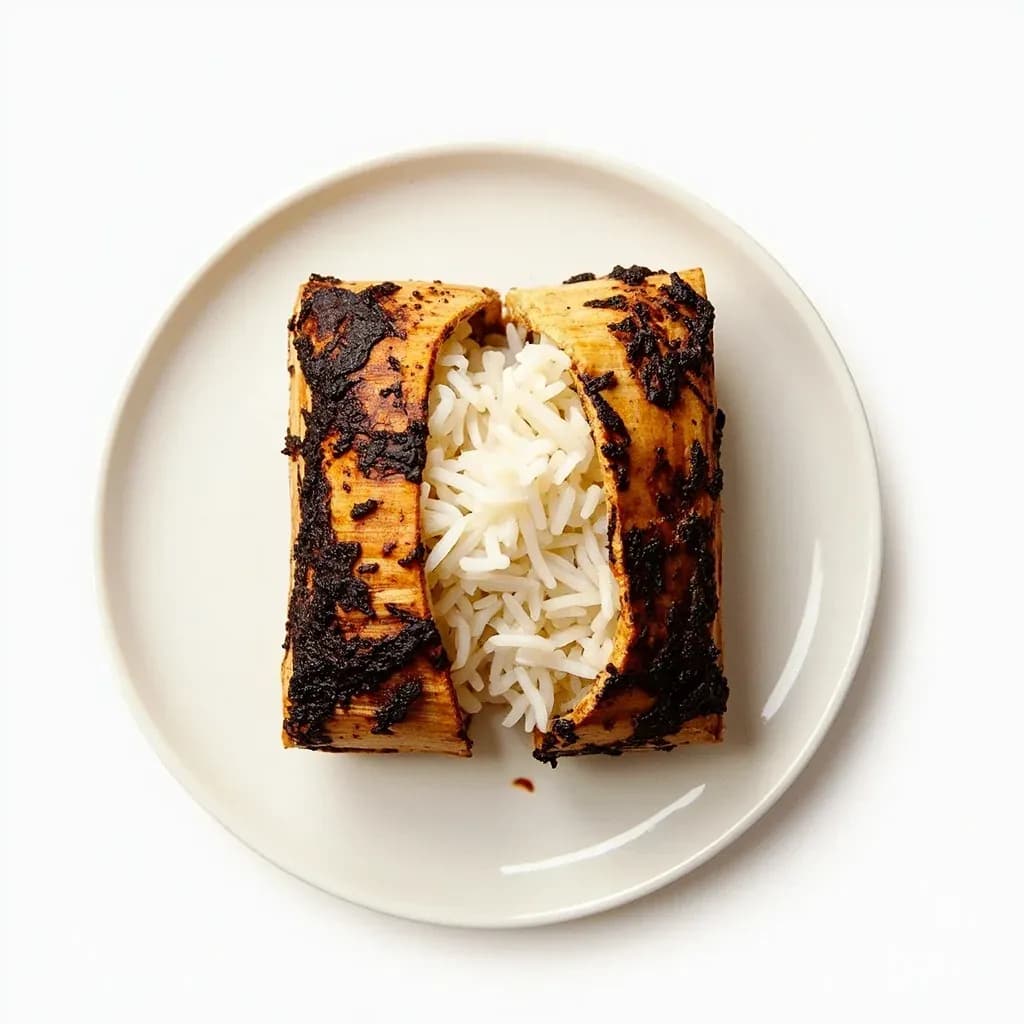
A bamboo cooking tube is a section of green bamboo sealed at one node and used as a natural cooking vessel over an open fire. Rice, often with coconut or beans, or other ingredients are packed inside and roasted or steamed until the bamboo's moisture and aroma flavor the food. Common in Southeast Asian and Indigenous cooking, the charred tube is split open to serve, lending a faint smoky-grassy scent.
The bamboo cooking tube is at once a pot, a flavoring agent, and a serving vessel — a single fresh internode of large-diameter bamboo with its natural solid node left intact at one end to act as the closed base. The opposite end is left open, packed with rice and aromatics, then sealed with banana leaves before the tube is laid across a bed of coals and rotated until the outer wall chars and the contents steam inside their woody shell. The combination of a thick, water-rich green wall, a banana-leaf liner, and slow radiant heat produces a dense, faintly sweet, grassy rice that no metal pot can replicate.
In practice the tube is best understood as a vessel-plus-technique pairing: the live bamboo contributes internal moisture and a subtle resinous aroma while shielding the rice from direct flame, and the leaves both prevent sticking and add a toasted note of their own. The tube is single-use — the outer wall scorches and cracks during the 30–60 minute cook — so once the rice is done the cook scores the length of the bamboo with a cleaver, splits it open, and serves the loaf directly from the split shell.
Alternatives
Types & varieties
Malay and Indonesian preparation of glutinous rice and coconut milk with a pinch of salt, roasted in bamboo lined with banana leaves; tied to Hari Raya, harvest festivals, and roadside stalls.
Thai and Lao sweet preparation — glutinous rice, coconut milk, and palm sugar, often studded with black beans, taro, or banana; sold as a street snack and temple offering.
Northern Vietnamese sticky rice cooked in bamboo, frequently served with sesame salt, grilled pork, or sausage in the highlands around Sapa and the Northwest.
Yunnan and Guangxi version, especially among the Dai, Hani, Lahu, and Zhuang peoples; rice cooked with cured ham, mushrooms, peanuts, or chilies, sometimes steamed as well as roasted.
Burmese and Shan regional variants using glutinous rice or rice flour in bamboo with coconut or sesame.
Adapting the technique at home
True bamboo tubes require a fresh-cut, large-diameter culm, which most home cooks outside Asia cannot easily source. The technique still translates — same ratio of rice to coconut milk, same banana-leaf lining — into a few workable stand-ins that approximate the texture if not the exact flavor.
- Sugar-cane stalk sections, sealed at both ends with banana leaf and pinned with a toothpick, give a similar sweet, woody edge and can go straight onto a grill or into a covered pan.
- Banana-leaf cylinders folded into a tube and tied at both ends, then set on a wire rack over simmering water, work as a makeshift steamer and capture most of the aromatic profile.
- Thick cardboard tubes (the kind used as formwork for concrete) lined with banana leaf and rotated over a grill can stand in for bamboo in a pinch, though they char faster and need a watchful eye.
- For the rice itself, glutinous (sticky) rice is essential: long-grain rice stays too loose, dries out against the leaf, and never forms the dense, sliceable loaf that defines the dish.
The flavor you cannot fake
Aluminum-foil packets and oven-baked banana-leaf parcels can match the coconut-milk richness and the smoky char, but they miss the gently resinous, faintly sweet note that live bamboo contributes as its water content steams back into the rice during the long roast. The leaf lining matters too: a metal pot lined with leaf still tastes like a metal pot lined with leaf, while a thick green wall of bamboo lined with leaf produces a softer, more rounded aroma with a grassy edge. If you are cooking the dish for its own sake rather than as a curiosity, it is worth sourcing a fresh culm from an Asian grocer, a bamboo specialist, or a friend's garden — and committing to single-use, since the charred shell cannot be cleaned or reused.
Common uses
Tips & pitfalls
- Use only fresh-cut, green bamboo — dry or cured bamboo will split, burn through, or impart a sour taste.
- Soak glutinous rice 2–4 hours (or overnight) before packing so it cooks evenly inside the dense tube.
- Always line the cavity with banana leaves; without them the rice fuses to the inner wall and the bamboo flavor turns acrid.
- Do not overfill — rice expands as it absorbs liquid and steam; leave roughly 2–3 cm of headspace.
- Seal the open end with a tight plug of banana leaves, then wrap with a fresh leaf or wire to keep it secure.
- Roast over low, steady coals rather than open flame; rotate the tube every 5–10 minutes so the wood chars evenly without igniting.
- If the exterior is charring too fast, brush water onto the outside or move the tube to a cooler zone of the fire.
- Test doneness by tilting and listening for liquid sloshing, or by piercing the rice through the side wall near the base.
- To open, score lengthwise with a heavy cleaver along a natural seam and split with the back of the knife — do not hammer straight down, the tube will shatter.
- Use the tube once and discard; the charred shell cannot be cleaned and will leach soot on reheating.
Good to know
- Origin
- Used across South, Southeast, and East Asia — notably in Yunnan and Guangxi (China), Thailand, Laos, Vietnam, Malaysia, and Indonesia.
- Material
- Fresh (green), thick-walled bamboo, typically large-diameter clumping species such as Bambusa or Dendrocalamus.
- Construction
- A single internode cut to length, with the natural solid node left intact at one end as a closed base; the opposite end is open and sealed during cooking.
- Typical dimensions
- 5–10 cm internal diameter, 20–40 cm long; wall thickness roughly 5–10 mm.
- Lining
- Almost always lined with banana leaves, both to prevent sticking and to impart aroma.
- Cooking method
- Slow-roasted over an open wood or charcoal fire, turned continuously; occasionally steamed in a larger pot.
- Typical cook time
- 30–60 minutes, depending on tube diameter, rice quantity, and fire intensity.
- Service
- Served hot, split open lengthwise with a cleaver and eaten directly from the bamboo shell.
- Reusability
- Single-use; the outer wall chars and cracks during cooking.
- Flavor imparted
- A mild, faintly sweet, grassy aroma from the fresh bamboo and a subtle toasted note from the leaves.
Also called
bamboo-tube · Bamboo Rice Tube · Bamboo Steaming Tube
Related

Steamer
Gentle moist heat that keeps vegetables, fish, and dumplings tender

Frying Pan
Shallow sloped pan for frying, sautéing, and quick sears

Saucepan
Tall, straight-sided pot for sauces, grains, and small batches

Sauté Pan
Wide straight-sided pan with room to brown and braise

Dutch Oven
Heavy lidded pot that turns tough cuts tender over hours

Stock Pot
Tall, roomy pot for stocks, pasta, and big-batch cooking

Wok
High-sided bowl pan built for blistering-hot stir-fries

Griddle
Flat, broad surface for pancakes, smash burgers, and breakfast