Knives & Cutting
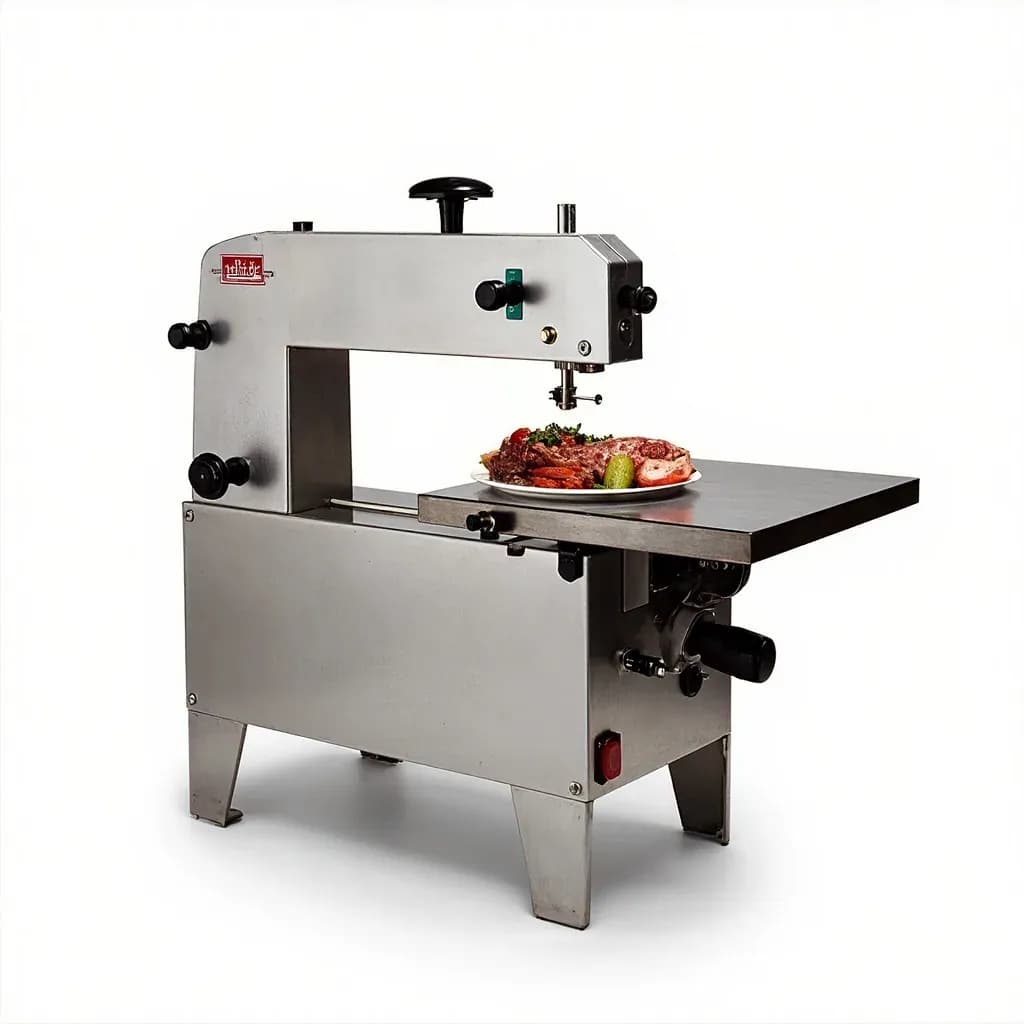
Meat Band Saw
A powered saw with a continuous blade for cutting frozen meat and through bone.
A meat band saw is a powered machine with a continuous toothed blade looped over two wheels, used by butchers to cut through bone, frozen meat, and large carcass sections. The operator guides the meat into the blade using a sliding table and a push plate (pusher) to keep hands clear and make even cuts like bone-in chops and cross-cut shanks. It does in seconds what would take heavy, dangerous work with a cleaver.
A meat band saw is a powered, continuous-loop saw that runs a flexible blade around two wheels, with the exposed span passing vertically through a stainless worktable. The blade does what no knife can do cleanly: shears through frozen blocks of meat, slices cleanly through bone, and resaws whole primals into uniform portions at speed. For any kitchen that breaks down whole animals, buys primals frozen, or produces bone-in cuts in volume, the band saw is the single biggest time-saver on the fabrication table.
The machine is judged by two specs — wheel diameter, which sets the throat height and the largest piece it can accept, and blade length, which determines which replacements you must stock. A 14" floor model with a 124" loop is the butcher-shop standard; a 10–12" countertop unit with a 64–82" loop fits behind a restaurant pass. Beyond those numbers, the choice that matters day to day is tooth count: a coarse 3-TPI skip-tooth or butcher-tooth blade for frozen and bone, and a 4–6-TPI finer-tooth blade for fresh boneless meat. Mismatched teeth strip, wander, and burn the meat.
A band saw is not a substitute for a knife. The kerf is wider, the cut is rougher on soft tissue, and the saw cannot follow a seam or trim silverskin. Its value is consistency and speed on jobs a knife either cannot do — frozen primals, dense shank bone, splitting a side — or does slowly and unevenly, like portioning a strip loin into matching steaks. In a home kitchen it is impractical; commercially it is regulated by local meat-handling and HACCP-style sanitation codes.
Alternatives
Types & varieties
14" wheels, larger motor, taller clearance, and bigger tables; the standard for butcher shops and meat plants.
Compact 8–12" wheel models for restaurants, grocery back rooms, and charcuterie stations.
Wider throat, reinforced frame, and coarse-tooth (3 TPI) blades built for cutting hard-frozen (-10 to 0°F / -23 to -18°C) blocks.
Smaller table and finer-tooth blades; sometimes a dedicated variant in retail fish and poultry counters.
Tuned with a butcher-tooth blade for chops, racks, and shanks; emphasizes clean bone cuts rather than yield from boneless primals.
Matching the Blade to the Job
Blade choice has more effect on cut quality than any other variable on a meat band saw. The two specs to watch are teeth per inch (TPI) and blade width; together they decide whether the blade cuts frozen bone, fresh primals, or anything in between.
- 3 TPI skip-tooth: the workhorse for frozen blocks and bone-in work. Deep gullets clear chips and bone dust so the teeth don't bind in hard material.
- 4 TPI: a middle ground for fresh bone-in cuts like racks, ribeye bones, and pork chops — fast, with a clean kerf.
- 6 TPI or finer: for fresh, boneless primals like strip loin, tenderloin, and whole cured muscles. Finer teeth leave a smoother face on the steak.
- Narrow blades (3/8" / 10 mm) track through curves and frozen blocks more easily; wider blades (5/8–3/4" / 16–19 mm) stay straighter on long, straight resaw cuts.
- Replace the blade at the first sign of wandering, smoke, or a rough kerf — a dull blade is more dangerous than a sharp one because it forces the operator to push harder.
Daily Cleaning and Maintenance
Bone dust and fat residue are the enemies of blade life and food safety. A consistent end-of-day routine keeps cuts clean and the machine in spec.
- After each use: brush bone dust from the wheels, scrape fat from the table and throat plate, and wipe the blade with a food-safe sanitizer.
- Daily full teardown: remove the table, scraper, blade, and wheel covers; wash, rinse, sanitize, and air-dry all food-contact parts — many jurisdictions require this under HACCP plans.
- Blade tension: check with the machine off. Over-tensioning snaps blades; under-tensioning lets the blade track off the wheels and wander in the cut.
- Track and alignment: verify the blade rides centered on the wheel crowns and the guides sit just clear of the teeth. Misalignment shortens blade life and produces angled cuts.
- Keep a spare blade on hand — swapping is faster than resharpening during a busy service, and most foodservice blades are replaced rather than re-sharpened.
Common uses
Tips & pitfalls
- Always use the supplied meat pusher or a wooden block; never feed meat with bare hands closer than 3–4" from the blade.
- Match TPI to the job: 3 TPI for frozen or bone, 4–6 TPI for fresh boneless meat; mismatched TPI causes tooth strippage and wandering cuts.
- Temper frozen meat to about -10 to 0°F (-23 to -18°C) before cutting — too hard shatters teeth, too soft gums the blade and drags fat into the kerf.
- Let the saw do the work; forcing the cut generates heat that dulls teeth and burns the meat surface.
- Clean the blade, scrapers, and wheels after every use — bone dust and fat residue shorten blade life and harbor bacteria.
- Reset blade tension only with the machine off; over-tensioning snaps blades, under-tensioning lets the blade track off the wheels.
- Wear a cut-resistant glove on the non-pushing hand to keep the trailing hand clear of the blade.
Good to know
- Tool type
- Powered continuous-loop band saw designed for raw and frozen meat, poultry, and bone.
- Wheel diameters
- 8", 10", 12", and 14"; floor models in butcher shops and meat plants are typically 14".
- Tooth count (TPI)
- 3 TPI skip-tooth or butcher-tooth for frozen meat and bone; 4–6 TPI for fresh, boneless meat.
- Blade speed
- Roughly 800–1,500 ft/min (240–460 m/min) for most meat applications.
- Cutting height
- About 7–11" clearance under the upper blade guide on common foodservice models.
- Safety features
- Blade wheel covers, upper blade guard, door/interlock switches, brake, and a hand-held meat pusher.
- Construction
- Stainless steel or anodized aluminum head, stainless table, food-grade pulleys; designed for washdown cleaning.
- Origin
- Continuous-band metal sawing dates to an 1809 English patent by William Newberry; meat-specific designs became standard in butcheries from the early 20th century.
Also called
Bandsaw Push Plate · Bandsaw Pusher · Butcher Band Saw · Meat Bandsaw
Related

Knife
The fundamental cutting tool every kitchen is built around

Chef's Knife
The do-everything blade for chopping, slicing, and mincing

Paring Knife
Small, nimble blade for peeling and detailed in-hand work

Serrated Knife
Saw-toothed blade that slices crusty bread without crushing

Cleaver
Heavy broad blade for chopping through bone and bulk prep

Cutting Board
The stable surface every cut starts on

Mandoline
Adjustable blade for paper-thin, perfectly even slices

Kitchen Shears
Heavy-duty scissors for poultry, herbs, and packaging