Knives & Cutting
Bone Chopper / Cleaver
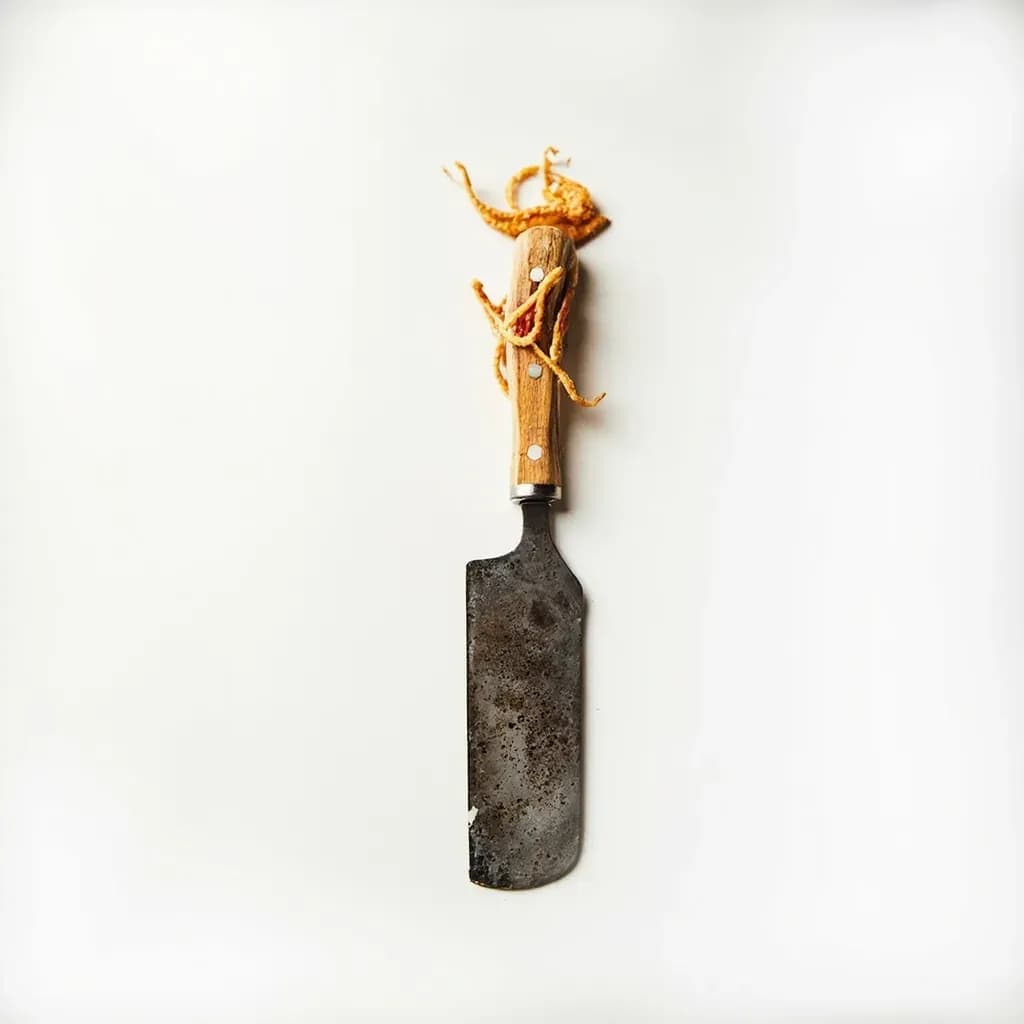
A heavy thick-spined cleaver for chopping through bones, joints, and tough cuts of meat.
A bone cleaver is a thick, heavy-bladed knife built to chop through bone, cartilage, and dense joints with the force of its weight. Unlike a thin vegetable cleaver, its robust spine and wedge edge withstand impact against poultry, ribs, and pork bones. It is used to portion bone-in cuts, crack joints, and break down whole carcasses on a sturdy block.
A bone cleaver — also called a bone chopper or, in Chinese butchery, a zhongdao (中刀) — is a heavy, thick-spined knife built to drive through bone, joint, and dense connective tissue rather than slice through flesh. The defining feature is the spine: at 4–6 mm thick at the heel, it acts simultaneously as a wedge and a hammer, absorbing the impact that would chip a thinner blade. The trade-off is real: the geometry is far less acute than a chef's knife (roughly 20–25° per side) and the edge is ground for impact resistance rather than clean slicing, so a bone cleaver feels clumsy when used for vegetable work and a chef's knife feels fragile the moment you ask it to split a femur.
What makes the tool useful is its weight distribution. Most of the mass sits forward of the bolster, so a raised-and-released stroke lands the heel of the blade with surprising authority. Skilled users let gravity do the work; muscle-driven chops throw off accuracy, tire the wrist, and increase the risk of glancing off the bone. The tall, rectangular or trapezoidal profile also gives the blade a long, straight edge that doubles as a scraper and a flat side that can crush aromatics under the heel of the palm.
In a serious home kitchen or small butcher shop, a single good bone cleaver covers tasks that would otherwise require a hacksaw, a mallet, or a frustrated hack with a chef's knife: splitting chicken through the keel, portioning ribs, breaking down primal cuts, and cracking coconuts or squash. It is not an everyday knife — but the moment you need to break bone cleanly, nothing else does the job.
Alternatives
Types & varieties
The thick-spined counterpart to the cai dao; rectangular blade, very heavy spine, used to split pork spine, ribs, and frozen meat. Distinct from the thin cai dao vegetable cleaver.
Trapezoidal blade, often slightly curved at the heel, with a heavy bolster-forward weight distribution; the classic American and European meat-cleaver silhouette.
Often German or Solingen-made, slightly thinner than Chinese bone cleavers but still spine-forged for chops and small bone work; a common home-kitchen pick.
Japanese market versions of the Chinese bone cleaver; tall, rectangular, designed for splitting poultry and pork bones in yakitori and ramen prep.
Even heavier variant used to split larger bones and, traditionally, heads and trotters; mostly seen in commercial Chinese butchery.
Lighter 12–16 oz version aimed at home cooks; handles poultry, small ribs, and squash but not dense beef femur or frozen blocks.
Bone cleaver vs. vegetable cleaver
The single most common point of confusion in a Western kitchen is the Chinese cai dao, a thin, light, all-purpose cleaver used for slicing cabbage, scooping chopped food, and trimming meat. A bone cleaver is a different tool entirely. The cai dao weighs around 8–12 oz and rides on a thin spine of 1–2 mm; the bone cleaver weighs two to three times as much with a spine three to four times as thick. Buying a cai dao and expecting it to split a chicken is a quick route to a snapped tip; buying a bone cleaver and trying to do precision vegetable work is a route to bruised produce and a sore wrist. If you cook whole birds or buy primal cuts, you want the heavy one. If you cook mostly vegetables and boneless proteins, you want the light one.
- Cai dao (vegetable cleaver): 8–12 oz, 1–2 mm spine, all-purpose slicing and scooping.
- Bone cleaver (zhongdao): 1.5–3 lb, 4–6 mm spine, dedicated to bone and dense material.
- Japanese deba: single-bevel, heavier than a slicer but designed for fish breakdown, not thick bone.
Choosing a weight
Weight is the single most important decision when buying a bone cleaver, and it should match the work and the cook. A 12–16 oz light cleaver is enough for a home cook who breaks down a chicken or two a month and wants to portion pork ribs. A 2 lb mid-weight is the everyday workhorse for someone butchering whole fish, game birds, and primal pork or lamb regularly. Anything over 2.5 lb is a commercial tool: it makes light work of beef femur and frozen meat but tires a home cook within minutes and is genuinely dangerous in a small kitchen with low ceilings. Test the swing in the store — a comfortable cleaver is one you can raise to shoulder height and release cleanly without reaching.
- 12–16 oz: home cooks, poultry, small ribs, squash.
- ~2 lb: serious home and prosumer use; pork shoulder, lamb, whole birds.
- 2.5–3 lb+: commercial butchery, dense bone, frozen blocks.
Care and rust prevention
Carbon-steel bone cleavers hold an edge beautifully but rust within hours if left wet. The two habits that protect the tool are immediate drying after washing and a thin film of food-grade mineral oil on the blade before storage. Stainless versions are more forgiving but still benefit from drying; pooled water at the bolster is the most common place rust begins. Hone on a ceramic rod before each session rather than waiting for the edge to dull, because a polished micro-bevel survives bone impact far better than a freshly ground, fragile one. Deep sharpening belongs on a 1000-grit whetstone followed by 4000, and should happen only a few times a year.
- Wash by hand, dry immediately, oil lightly before storage.
- Hone often, sharpen rarely; pull-through sharpeners will crack the edge.
- Store on a magnetic strip, in a block, or in a saya; never loose in a drawer.
- Retire any cutting board with deep grooves — they deflect the cleaver and shatter bone unpredictably.
Common uses
Tips & pitfalls
- Let the weight do the work: raise the cleaver and let gravity drop it; muscle-driven chops throw off accuracy and tire the wrist.
- Strike perpendicular to the bone — angled hits glance off and send fragments flying.
- Use the heel of the blade (near the bolster) for the densest bones; the tip is thinner and more prone to chipping.
- For poultry, aim for the joint rather than the bone — locate the gap with the tip, then commit in one clean stroke with the heel.
- Never twist the blade mid-cut; cleavers are designed to be driven straight through, not levered. If the blade sticks partway, withdraw cleanly and reposition rather than prying — prying bends the spine and can snap the tip.
- To crush aromatics, lay the flat on top of the garlic or ginger and press down with the heel of your palm rather than striking — quieter, safer, and more controlled.
- Hone lightly and often with a ceramic rod; a polished micro-bevel holds up to bone impact far better than a freshly ground, fragile edge.
Good to know
- Origin
- Thick-spined butchery cleavers evolved in Chinese and European meat trades over centuries; the modern heavy Western butcher's cleaver was standardized in industrial slaughterhouses of the late 19th and early 20th centuries.
- Typical weight
- 1.5–2.5 lb (0.7–1.1 kg) for home and prosumer models; commercial Chinese bone cleavers can reach 3 lb (1.4 kg) or more.
- Blade length
- 6–9 in (15–23 cm) standard; some Asian heavy cleavers run 8–10 in (20–25 cm).
- Blade height
- 3–4 in (7.5–10 cm), giving a tall rectangular or trapezoidal profile.
- Spine thickness
- 4–6 mm at the heel — the defining feature, and what separates it from a thin vegetable cleaver.
- Edge geometry
- Roughly 20–25° per side (40–50° inclusive); built for impact resistance, not slicing finesse.
- Common blade materials
- High-carbon steel (5Cr15MoV, 4Cr13, white #2), stainless, or forged spring steel; full-tang construction is standard.
- Cutting board pairing
- End-grain hardwood (maple, walnut) or thick food-grade HDPE plastic. Never glass, marble, or ceramic tile.
- Sharpening
- Whetstone (1000/4000 grit) or a file guided along the bevel; pull-through sharpeners strip metal and can crack the edge.
- Storage
- Magnetic strip, in-block slot, or saya/blade guard — never loose in a drawer where the edge contacts other metal.
Also called
Bone Cleaver · Bone Chopper · Heavy Cleaver · Meat Cleaver
Related

Knife
The fundamental cutting tool every kitchen is built around

Chef's Knife
The do-everything blade for chopping, slicing, and mincing

Paring Knife
Small, nimble blade for peeling and detailed in-hand work

Serrated Knife
Saw-toothed blade that slices crusty bread without crushing

Cleaver
Heavy broad blade for chopping through bone and bulk prep

Cutting Board
The stable surface every cut starts on

Mandoline
Adjustable blade for paper-thin, perfectly even slices

Kitchen Shears
Heavy-duty scissors for poultry, herbs, and packaging