Knives & Cutting
Bone Saw
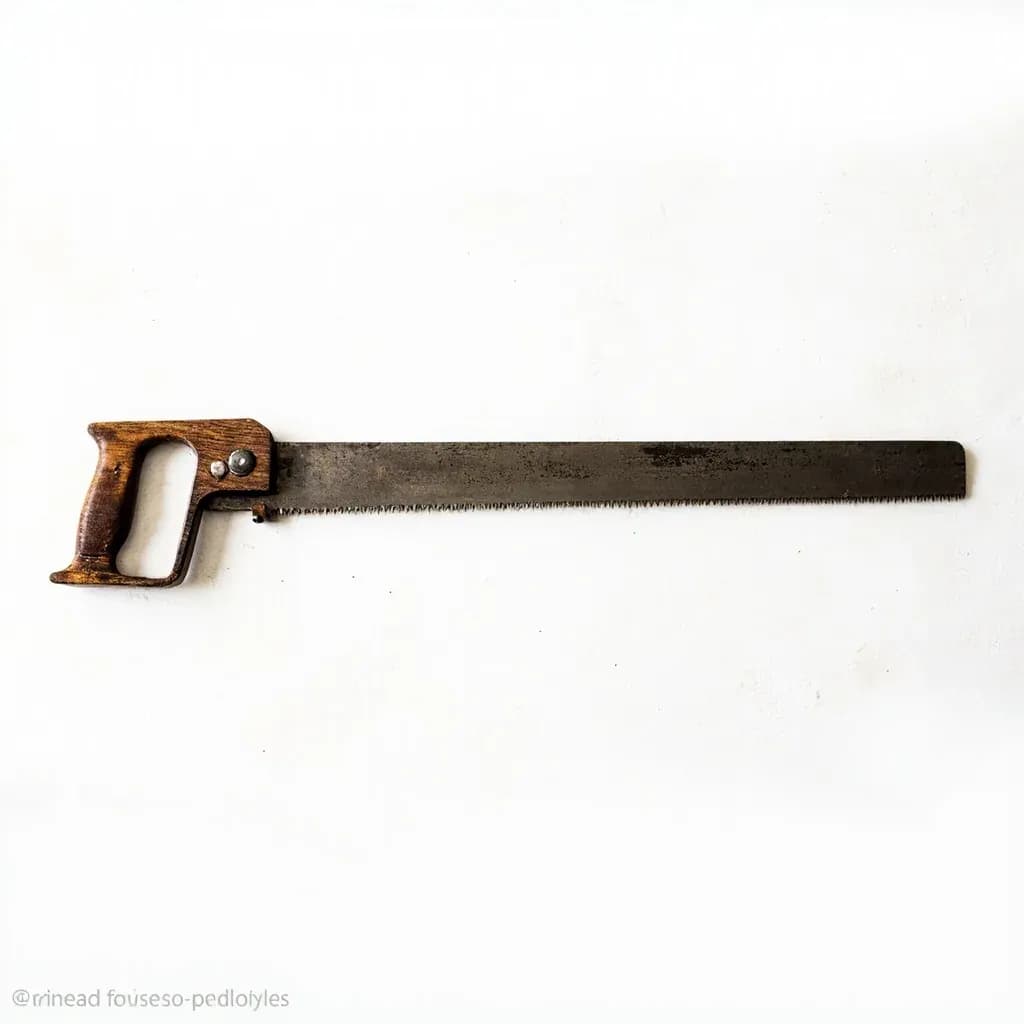
A handsaw with a coarse toothed blade for cutting through bone in butchery.
A bone saw is a rigid-frame handsaw fitted with a coarse, sharp-toothed blade made to cut cleanly through bone. Butchers use it to split carcasses, cut bone-in roasts and steaks, and section ribs where a cleaver would crush or splinter the bone. The fine teeth leave a smooth cut surface and reduce bone fragments in the meat.
A bone saw is a handsaw purpose-built for parting raw or frozen bone, cartilage, and the joints that hold a carcass together. Its defining feature is a coarse, hardened blade — typically stainless or high-carbon steel — with teeth that are alternately bent to the left and right, a geometry called the 'set.' That bend widens the kerf (the slot the cut leaves behind) past the thickness of the blade itself, which lets bone dust and fragments escape instead of packing into the cut and stalling the saw. The blade is mounted in a rigid frame, a folding handle, or a fixed pistol grip, and it is worked with long, steady push-pull strokes rather than the chopping motion of a cleaver.
The saw earns its place in a kitchen because knives and cleavers, however heavy, have a hard limit: dense cortical bone and frozen meat will deflect or chip a thin edge. A bone saw chews through what a blade cannot bite, from a beef chine bone to the spine of a whole fish. In a home kitchen it is an occasional, specialist tool — a single 200–250 mm fixed-blade saw covers most jobs from breaking down a rack of lamb to portioning a frozen block of stew meat. In a butcher shop it is part of the daily kit, used to split carcasses down the backbone before the knife work even begins.
In the hand, a good bone saw feels unhurried. The weight of the blade and frame does most of the work; you guide, you do not push. The trade-off for that power is finish: a bone saw leaves a rougher, dustier surface than a knife cut, and the tooth gullets are harder to clean than a smooth blade. Treat it as a dedicated tool for the parts of butchery that no knife can reach, and keep a boning knife and a cleaver close by for the surrounding work.
Alternatives
Types & varieties
Sturdy C-shaped frame with a replaceable blade; the classic shop saw for splitting carcasses and large joints.
Compact saw that pivots into the handle for storage; favored in small home kitchens and field dressing.
Single rigid blade with a pistol or straight grip; the common home and Asian-market butcher's saw.
Higher-TPI blade (around 7–10) for portioning semi-frozen meat, whole fish, and smoked sides without tearing the flesh.
Low-TPI blade (3–4) for thick cortical bone; cuts fast but leaves a rougher surface.
Motorized saw used in butcher shops and meat processing plants; not a home kitchen tool.
Tooth geometry and why it matters
The 'set' of the teeth is the single engineering detail that separates a working bone saw from a frustrated cook. Each tooth is hammered or ground so it bends slightly outward from the blade body — one to the left, the next to the right, alternating down the row. The result is a kerf noticeably wider than the blade thickness, which gives the dust and shards somewhere to go. A saw without a proper set will bind almost immediately in dense bone, and forcing it only chips teeth. Tooth count then decides the finish: a coarse 3–4 TPI blade chews through a beef shank in a few strokes but leaves a ragged cut; a 7–10 TPI blade moves more slowly but parts semi-frozen meat or a fish spine with a cleaner face. Match the tooth to the job rather than trying to make one blade do everything.
When to use a saw, and when to use a knife or cleaver
The saw is a specialist, not a replacement. Reach for it when the work is the bone itself; reach for something else when the work is the meat around the bone.
- Bone saw: splitting a carcass down the chine, portioning a frozen block, cutting a rack into individual chops, removing a fish head.
- Boning knife: tracing along ribs and joints, freeing meat from the shoulder, trimming silver skin — anywhere the cut follows the bone-to-meat seam.
- Cleaver: cracking through a single bone (a chicken sternum or pork rib) in a portioned cut, or splitting a softer bone like a flat of beef short rib by hand.
- Heavy chef's knife: anything that does not involve bone at all — it is the wrong tool here and a bone saw is overkill.
Hygiene and care
Bone saws are harder to clean than smooth-bladed knives because the tooth gullets trap dust, fat, and protein. A few habits keep the tool sanitary and long-lived.
- Hand wash in hot, soapy water with a stiff brush, then rinse and dry immediately — bone saws should never sit wet.
- Wipe the blade with a food-safe sanitizer between tasks to prevent cross-contamination between raw proteins.
- Oil the blade lightly with food-grade mineral oil after drying to prevent rust, especially on high-carbon steel.
- Replace, do not sharpen, most blades: sharpening set teeth is a specialist job and almost always more expensive than a fresh blade.
- Consider dedicating one saw to fish, one to red meat, and one to poultry if you process a lot — it sidesteps the deepest cleaning the saw will ever need.
Common uses
Tips & pitfalls
- Let the saw do the work — long, even push-pull strokes with only light downward pressure; forcing the blade bends it and snaps teeth.
- Secure the item on a non-slip board or in a butcher's vise before cutting; a moving bone is the single most common cause of slips and injuries.
- Match tooth count to the job: 3–4 TPI for thick bone, 7–10 TPI for semi-frozen meat, fish, and any cut where finish matters.
- Mark the cut line with a knife score or strip of butcher's paper first; bone dust hides pencil marks within a stroke or two.
- Wear a cut-resistant glove on the guiding (non-sawing) hand; bone saws can bind and jump suddenly.
- If the blade binds, stop, back off, and restart from the existing kerf — never twist the saw sideways to free it.
- Do not use a wood saw on bone: its tooth geometry, temper, and finish are wrong, and the blade is not food-safe.
- Replace blades rather than sharpening them; set teeth are difficult to restore and a new blade costs less than the time spent trying.
Good to know
- Also called
- Butcher's saw, meat saw, hand bone saw
- Typical blade length
- 10–25 cm (4–10 in) for handheld kitchen models; 40–60 cm for heavy butchery saws
- Teeth per inch
- Roughly 3–4 TPI for thick bone; 7–10 TPI for semi-frozen meat and fish
- Blade material
- Stainless or high-carbon steel, with a thicker spine to resist flexing
- Handle
- Hardwood, polymer, or riveted full-tang steel
- Mechanism
- Manual push-pull; alternately set teeth widen the kerf and clear bone dust
- Working temperature
- Effective on bone at 3–5 °C and on hard-frozen meat at –18 °C and below
- Maintenance
- Hand wash, dry immediately, oil the blade; most butcher's saws use replaceable blades rather than resharpened ones
Also called
Hand Meat Saw · Meat Saw · Butcher Saw
Related

Knife
The fundamental cutting tool every kitchen is built around

Chef's Knife
The do-everything blade for chopping, slicing, and mincing

Paring Knife
Small, nimble blade for peeling and detailed in-hand work

Serrated Knife
Saw-toothed blade that slices crusty bread without crushing

Cleaver
Heavy broad blade for chopping through bone and bulk prep

Cutting Board
The stable surface every cut starts on

Mandoline
Adjustable blade for paper-thin, perfectly even slices

Kitchen Shears
Heavy-duty scissors for poultry, herbs, and packaging