Knives & Cutting
Boti (Curved Cutting Blade)
A floor-mounted curved Bengali blade you cut against while seated, freeing both hands.
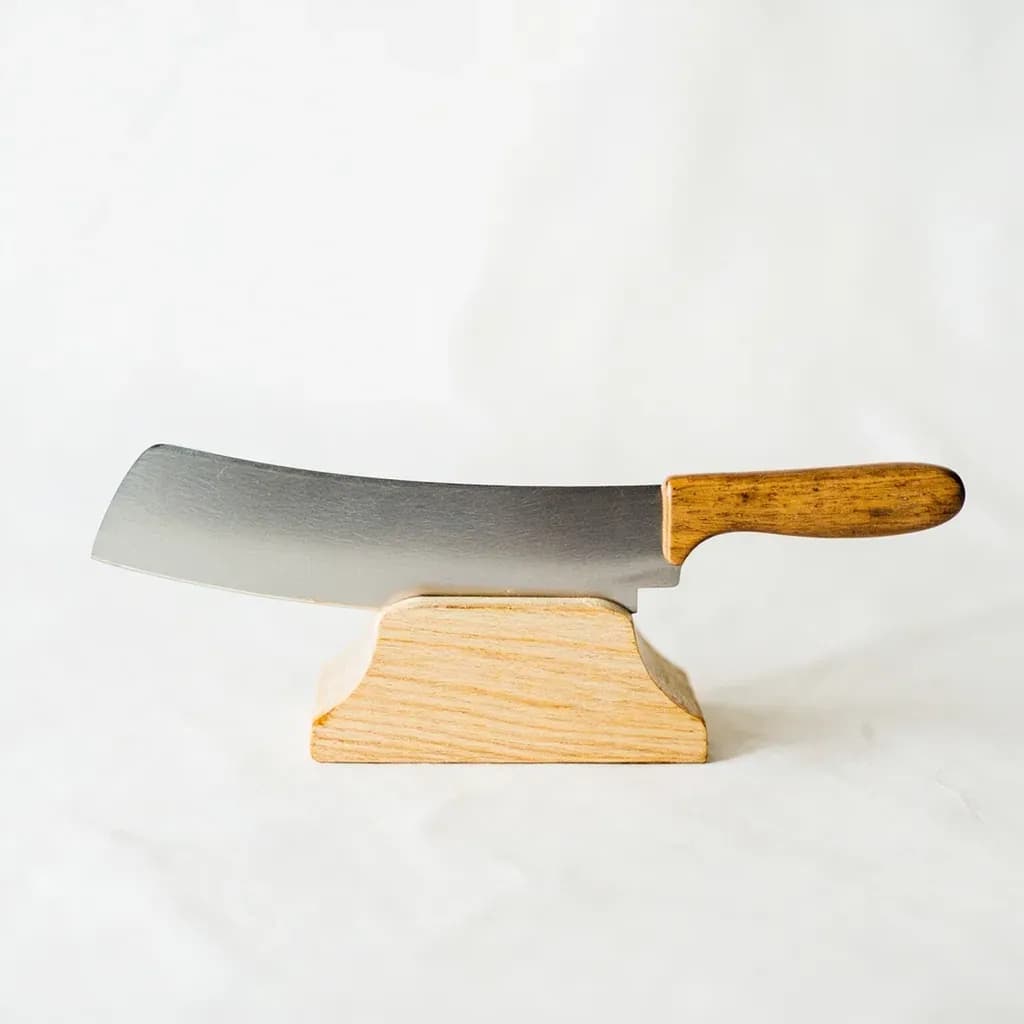
A boti (also bonti) is a traditional South Asian, especially Bengali, cutting tool: a sharp curved blade fixed upright to a wooden or metal base on the floor. The cook sits, steadies the base with a foot, and pulls vegetables, fish, or meat against the stationary edge with both hands. It excels at filleting fish and slicing through tough produce with great control and speed.
The boti is a traditional Bengali cutting tool that is less a knife than a fixed cutting station: a broad, crescent-shaped steel blade riveted upright into a heavy wooden plank, designed to sit on the floor and be used by a cook seated cross-legged. Because the blade is anchored to a base, neither hand has to hold a tool or steady the food against a cutting board — both remain free to grip, rotate, and feed the ingredient across the curved edge. This makes the boti exceptionally efficient for the high-volume, repetitive chopping that defines Bengali cooking, from fine mincing of onion, garlic, and ginger to rapid portioning of whole fish.
What separates the boti from any knife-and-board setup is the cutting geometry. The blade is fixed, vertical, and gently curved along its length, so a single long pulling motion — drawing the food toward the body and across the inside of the curve — produces an even slice without the rocking, board-clattering rhythm of a Western chef's knife. The cook uses body weight and thigh pressure to anchor the base, then works with a smooth, continuous flow that an experienced user can sustain at remarkable speed. It rewards practice: the first few sessions feel awkward and dangerous, but the rhythm becomes second nature, and cuts are notably cleaner and more uniform than hand-held knife work on a flat board.
The tool remains the backbone of rural Bengali and Bangladeshi kitchens, fish markets, and mishti (sweet) shops, where it has no real equal for its intended jobs. In modern urban kitchens it has largely given way to a nakiri or santoku for vegetables and a deba for fish, but the boti persists wherever the floor-seated cooking tradition survives, and a generation of Bengali cooks still consider it the most comfortable, controllable cutting tool they have ever used.
Alternatives
Types & varieties
Larger-bladed version sized for butchering and portioning whole fish; standard in fish markets and in households that buy whole rohu, katla, or ilish daily
Smaller household-scale version for everyday vegetables; occasionally sold as a tabletop variant in modern cookware shops
Variant used in Bengali mishti dokan for slicing and portioning sweets such as sandesh, naru, and barfi with clean, uniform edges
Heavy, oversized floor-mounted blade used by market vendors for rapid, high-volume chopping of vegetables and fish
How the Cutting Motion Works
The boti is designed around a single principle: the blade stays still and the food moves. The cook anchors the wooden base between the thighs or against the floor, then grips the ingredient with fingertips curled under in a claw grip. The cutting stroke is a long, level pull — drawing the food toward the body and across the inside curve of the blade in one smooth sweep, rather than pressing down. The full length of the curve is used for long slices through fish, eggplant, or pointed gourd; the tip area is used for fine mincing of onion, garlic, and ginger. Body weight and thigh pressure keep the base immobile, which is what allows the motion to be so fast and repetitive without the tool walking across the floor.
Choosing Between Sizes and Weights
A boti is not one tool but a small family, and the right one depends on the job. Lighter blades with a thinner profile suit vegetable work — they move cleanly through onions and herbs without bruising. Heavier, thicker blades are built for fish and sweet-shop work, where the mass of the steel helps drive through bone, scales, and dense milk-solid confections. Household cooks who buy whole fish regularly tend to favor a macher-boti–sized blade; pure vegetable cooks and smaller households do better with a sobji-boti.
Care and Maintenance
The blade and the base age differently and need different attention. The steel is sharpened on a standard whetstone, ideally at the same angle as the factory edge, and wiped with a thin film of mustard oil after use on carbon-steel versions to prevent rust. The wooden base is the more vulnerable part: it must be dried thoroughly after washing, kept out of standing water, and occasionally rubbed with edible oil to keep the grain from drying and splitting. Loose rivets are the most common failure and can usually be re-seated with a hammer and a punch.
Common uses
Tips & pitfalls
- Sit with the base wedged firmly between or under the thighs and place a rug or mat underneath to stop the plank from sliding on smooth floors.
- Use a claw grip with fingertips curled under, and feed the food across the blade in a steady pulling motion rather than pressing straight down.
- Use the full length of the curve for long, sweeping cuts on fish and large vegetables; switch to the tip area for fine mincing of onion, garlic, and ginger.
- Keep the blade sharp — a dull boti crushes rather than slices, producing ragged cuts and is the most common cause of cut fingers.
- Dry the wooden base completely after washing; trapped moisture swells the grain, splits the wood, and gradually loosens the rivets holding the blade.
- Practice on forgiving ingredients like cabbage or bottle gourd before moving to fish — they let you learn the rhythm and grip without the risk of slipping onto bone.
- Avoid twisting the food against the blade; a clean single-direction pull gives cleaner cuts and prevents the ingredient from skidding onto the hand.
- After use, wipe a carbon-steel blade with a cloth lightly oiled with mustard oil to prevent rust, and store the whole tool in a dry place.
Good to know
- Origin
- Bengal (West Bengal and Bangladesh); a traditional kitchen tool in Bengali households for centuries
- Form
- Large crescent- or U-shaped steel blade riveted upright into a flat, heavy hardwood plank
- Posture
- Floor-mounted; the cook sits on the floor with the base wedged between or under the thighs
- Hand use
- Both hands remain free to hold, rotate, and feed the food — neither anchors the tool nor steadies the ingredient on a board
- Material
- Carbon or stainless steel blade; seasoned hardwood base, typically teak, mango, or shimul wood
- Typical size
- Blade roughly 25–40 cm long; base 30–45 cm long, broad and heavy enough to resist sliding
- Maintenance
- Blade sharpened on a whetstone; wooden base kept dry and occasionally oiled to prevent splitting and loose rivets
Also called
bonti · bothi · dao
Related

Knife
The fundamental cutting tool every kitchen is built around

Chef's Knife
The do-everything blade for chopping, slicing, and mincing

Paring Knife
Small, nimble blade for peeling and detailed in-hand work

Serrated Knife
Saw-toothed blade that slices crusty bread without crushing

Cleaver
Heavy broad blade for chopping through bone and bulk prep

Cutting Board
The stable surface every cut starts on

Mandoline
Adjustable blade for paper-thin, perfectly even slices

Kitchen Shears
Heavy-duty scissors for poultry, herbs, and packaging