Baking & Pastry
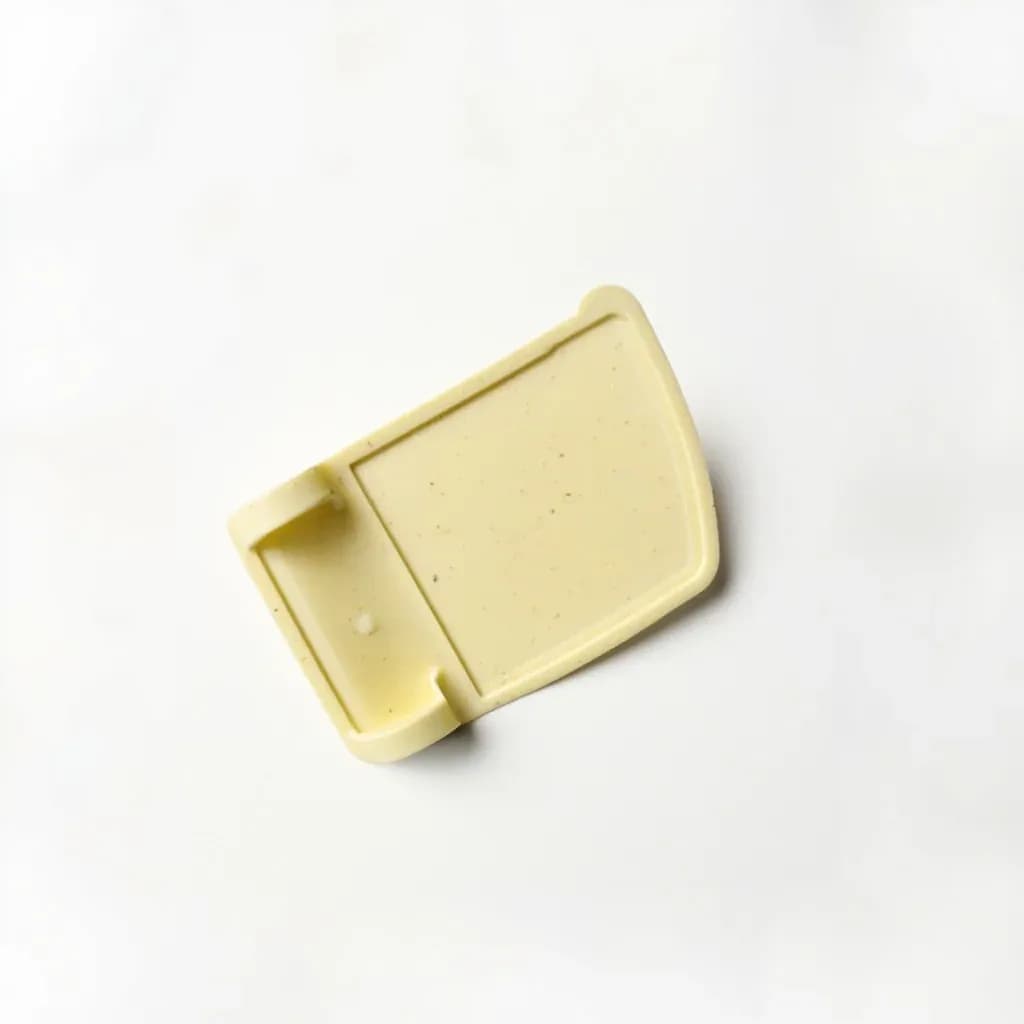
Plastic Bowl Scraper
Flat flexible blade for scraping dough from bowls and dividing and shaping it.
A bowl scraper is a flat, flexible piece of plastic, usually with one curved and one straight edge, used to clean dough and batter from the sides of a bowl. Bakers also use it to lift, fold, divide, and shape sticky dough on the counter without it clinging to their hands. The curved edge hugs the bowl's interior while the straight edge cuts and portions.
The plastic bowl scraper is a flat, semi-flexible blade molded from food-grade polypropylene or a similar rigid-but-pliable polymer, designed to do three jobs at once: clear the inside of a mixing bowl, lift dough or batter cleanly, and portion or fold on the fly. Its defining feature is the soft give in the blade, which lets the long edge curl against the curve of a bowl wall and recover residue a rigid utensil leaves behind. The classic American form — a white rectangle with rounded corners, often still called generically a "Rubbermaid spatula" — became standard equipment in commercial and home kitchens over the second half of the twentieth century, while in German-speaking kitchens the equivalent tool, the Teigschaber or Teigkarte, tends to be more rigid with a squared leading edge optimized for cutting and lifting stiff doughs.
A bowl scraper earns its place between the whisk and the wooden spoon. A whisk aerates; a wooden spoon moves heavy dough but leaves a film behind; a metal bench scraper cuts dough on a flat surface but cannot follow a bowl's curve. The bowl scraper is the tool for that awkward middle territory — the wet, sticky last third of a cake batter, the slack bagel dough clinging to a stainless bowl, the ganache you want to lift cleanly into a piping bag. Its flexibility is the whole point: press the long edge flat against the bowl wall, rotate, and the dough comes away in a single sheet rather than being smeared back into the same spot.
Used well, it also reduces waste. Home bakers routinely throw out the tablespoon or two of batter, frosting, or dough that a spoon leaves clinging to the bowl, and a flexible scraper recovers most of that. The straight edge doubles as a portioning guide when you need to divide a dough by eye, and a clean sweep of the scraper across a pan of batter before baking gives a level surface that no spoon can match.
Alternatives
Types & varieties
The standard flexible plastic rectangle with rounded corners — the iconic American form popularized in commercial kitchens mid-twentieth century.
A thinner, more pliable version that bends easily to follow bowl walls; well suited to thin batters, custards, and frostings.
A more rigid, sharply curved plastic scraper with a squared-off leading edge; designed to cut and lift stiff doughs such as bread, marzipan, and firm pastry.
Identical shapes produced in multiple colors for commercial kitchens to separate tasks by allergen or food category.
A smaller version, roughly 10–12 cm (4–5 in) long, useful for spice jars, small mixing cups, and detail work.
A hybrid with a rigid handle on one long edge and a flat flexible blade on the working edge; performs light bench work as well as bowl scraping.
Bowl scraper vs. bench scraper
The two tools look similar and are sometimes confused, but they are built for different surfaces. A bench scraper (also called a dough cutter) is a rigid, often metal or stiff-plastic rectangle with a handle along one edge; it is designed to cut dough, lift it off a flat work surface, and scrape a bench clean. A bowl scraper is a flexible, handleless plastic blade whose only job is to follow a curved interior. Use a bench scraper to portion dough on the counter; reach for a bowl scraper when the dough is still in the bowl or when the residue is clinging to a curve that a rigid edge cannot match.
Choosing the right flexibility
Match the scraper to the dough rather than buying one for everything. Stiff, well-developed bread dough, pizza dough, and dense cookie doughs push back against a floppy blade — a stiffer scraper or a German-style Teigschaber with a squared leading edge will lift them cleanly without bending back on itself. Thin cake batters, pancake batter, pastry cream, ganache, and whipped frosting sit at the other end of the spectrum: a more flexible blade conforms to the bowl wall and gathers them in a single sweep. Many experienced bakers keep two scrapers — a firm one for bread and a pliable one for batters — and never mix the jobs.
Care, cleaning, and replacement
A bowl scraper is one of the cheapest tools in the kitchen and one of the easiest to overlook until it fails. Inspect it periodically for hairline cracks, deep stains, or a warped edge; any of these harbor bacteria and reduce the very flexibility the tool is bought for. Polypropylene softens well below stovetop and oven temperatures, so leave the scraper off hot surfaces and never use it to stir a hot pan. Most versions are top-rack dishwasher safe; a quick rinse and a wipe is usually enough between uses, and a replacement costs only a few dollars when the old one finally goes.
Common uses
Tips & pitfalls
- Hold the scraper with the long straight edge flush against the bowl wall and rotate the bowl (or the scraper) so the blade clears in one or two passes; going over the same patch repeatedly just smears residue back into place.
- Keep at least two scrapers on hand — a stiffer one for heavy bread doughs and a more flexible one for cake batters and custards — and use each for the job it suits.
- Replace the scraper the moment it develops hairline cracks, deep stains, or a warped edge; these harbor bacteria and the loss of flexibility makes the tool more smear than scrape.
- Take color-coding seriously at home as well as in a pro kitchen: a yellow scraper for raw poultry and a green one for produce is a small habit that prevents real cross-contamination.
- The flexible edge will get into the rounded base and corners of a bowl that a rigid bench scraper or wooden spoon cannot reach — that is the whole reason the tool exists.
- Do not substitute a rubber spatula when you actually need a bowl scraper: the rubber edge is too soft to push stiff dough, and the plastic scraper's edge is too firm to fold whipped egg whites gently.
- To portion dough evenly, weigh the total mass, divide by the number of portions, and use the scraper's straight edge to cut and transfer each piece — the cut is cleaner than a spoon and faster than a knife.
- Avoid leaving the scraper resting on a hot stovetop, in a hot pan, or near an open flame; even food-grade polypropylene softens well below normal cooking temperatures and will warp permanently.
Good to know
- Also called
- Dough scraper, plastic scraper, scraper spatula, bowl knife (German: Teigschaber or Teigkarte)
- Material
- Food-grade plastic, most commonly polypropylene or a similar rigid-but-flexible polymer
- Standard size
- Approximately 15–20 cm (6–8 in) long by 7–10 cm (3–4 in) wide
- Construction
- Usually one-piece molded; some versions have a slight thumb-grip or textured edge
- Flexibility
- Semi-flexible so the edge conforms to the curve of a bowl wall
- Heat tolerance
- Moderate; not intended for use on hot pans, hot stovetops, or over direct flame
- Dishwasher safe
- Yes in most cases, with top-rack placement recommended for commercial dishwashers
- Color-coding
- Available in many colors for HACCP and allergen-separation systems in professional kitchens
Also called
Dough Scraper · Plastic Scraper
Related

Muffin Pan
Multi-cup pan for muffins, cupcakes, and egg bites

Bundt Pan
Fluted ring mold for showstopping cakes with a center hole

Springform Pan
Latch-release pan that frees delicate cakes without flipping

Pie Dish
Sloped round dish for crisp-bottomed pies and quiches

Tart Pan
Fluted pan with a pop-out base for clean-edged tarts

Rolling Pin
Rolls dough into even sheets for pastry and bread

Pastry Brush
Brushes on egg wash, glaze, butter, and marinades

Bench Scraper
Flat blade that divides dough and clears your work surface