Knives & Cutting
Bread Knife
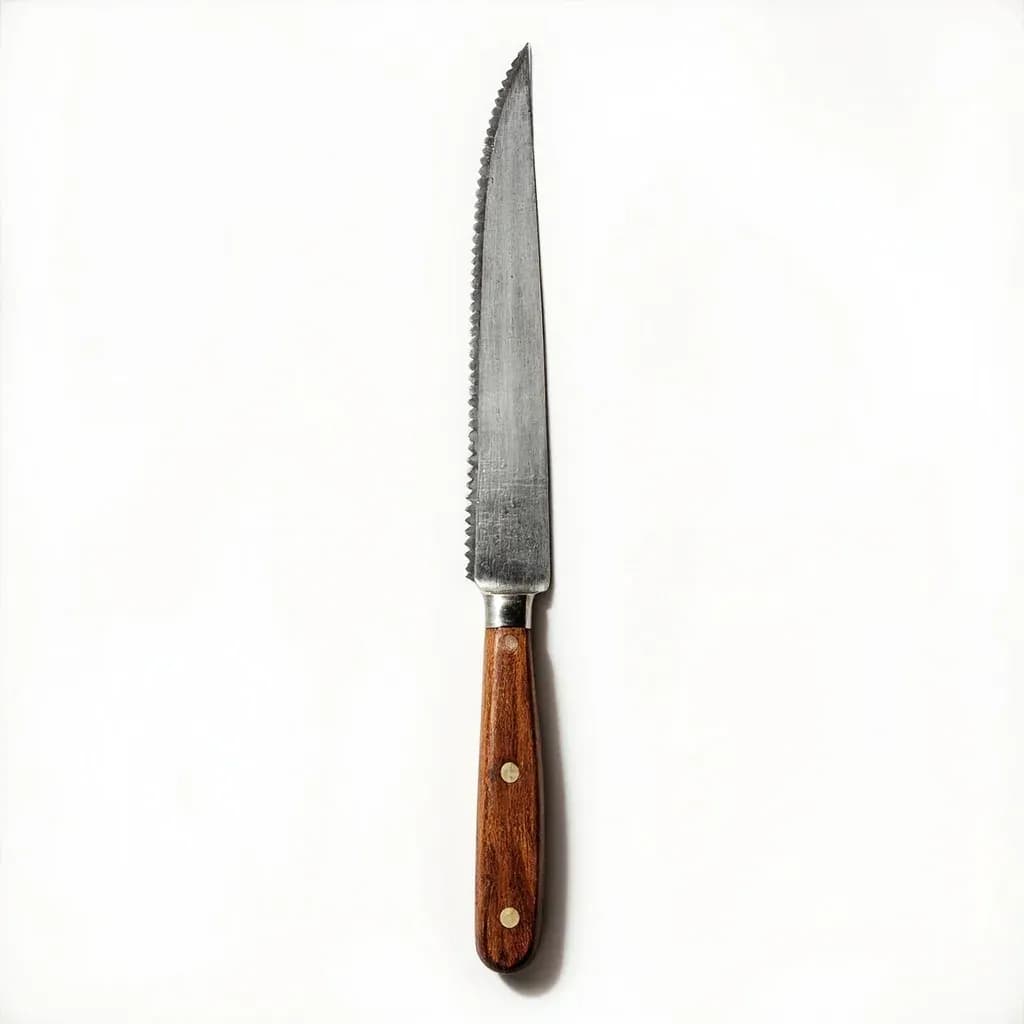
A long serrated blade that saws cleanly through crusty bread without crushing the crumb.
A bread knife has a long blade with deep serrations that grip and slice through hard crusts and soft interiors using a sawing motion instead of downward pressure. It is the right tool for loaves, baguettes, and bagels, and also tackles delicate tasks like layering cakes and slicing ripe tomatoes. The serrated edge holds up well between sharpenings since the points contact the board less than a straight edge.
A bread knife is the only knife that solves the bread problem: how to pass cleanly through a crust that resists and a crumb that compresses. Its long blade is lined with sharp points (serrations) or rounded hollows (scallops) that concentrate force at tiny contact patches. Each point pierces the crust where a flat edge would skate across it, while the valleys between the teeth carry a fresh, unworn cutting edge past the food. The result is a sawing cut that parts a sourdough boule into neat slices rather than mashing it into crumbs.
The geometry also explains why a bread knife feels perpetually sharp. On a straight-edged blade, every cut drags the same line of steel across the board, dulling it steadily. On a serrated blade, the working edges sit recessed between the teeth and rarely touch anything; only the tips dull, and even then the blade keeps cutting well past the point where a chef's knife would feel spent. That is why a good bread knife often outlasts several straight-edged knives between sharpenings — and why its apparent dullness is misleading.
Among specialty knives, this is one of the first worth owning after a chef's knife and a paring knife. It earns its drawer space not only for bread but for layer cakes, ripe tomatoes, tough-rinded melons, and terrines, anywhere a straight edge would crush or tear.
Alternatives
Types & varieties
Long straight blade with a continuous serrated edge; the everyday workhorse for loaves and cakes.
Handle dropped below the blade plane so knuckles and the heel of the hand clear the board and the loaf; favored in bakeries and by taller cooks.
Rounded hollows instead of pointed teeth; cuts soft sandwich loaves and tender cakes with less tearing.
Alternating tall and short teeth or a sinusoidal wave; many makers claim longer edge retention than single-serrated designs.
Often a Western shape in VG-10 or similar steels, sometimes with finer, denser teeth for cleaner cuts on soft crumb.
Short 6–8-inch variant with fine serrations; sized for layer cakes and génoise where a long blade is clumsy.
Zirconia blade that stays sharp very long but is brittle and unforgiving if twisted, dropped, or used on hard material.
Serrated vs. scalloped: choosing an edge
The two edge styles look similar but behave differently. A pointed-tooth serration is aggressive: the tips bite hard into thick, chewy crusts like a well-developed sourdough or a twice-baked schiacciata. That bite is exactly what you want when the crust would otherwise deflect a flat edge. A scalloped, or Granton-style, edge replaces the points with rounded hollows; it parts food by wedging rather than piercing. That makes it gentler on delicate crumbs — tender brioche, soft sandwich loaves, sponge and chiffon cakes — where aggressive teeth would shred the interior. Many cooks keep one of each: a standard serrated knife for crusty loaves and a scalloped or cake knife for soft breads and pastry.
- Pointed teeth: best for thick, chewy crusts where piercing matters most.
- Scalloped hollows: best for soft crumb and tender cake where tearing matters most.
- Cake knives (6–8 in) offer more control on tiered cakes than full-size blades.
- Offset handles are ergonomic, not decorative — they clear knuckles and let the elbow drop naturally on long slicing runs.
How to sharpen a serrated blade
A serrated knife cannot be honed on a flat whetstone the way a chef's knife can, because the stone never reaches the recessed edges between the teeth. The correct tool is a tapered ceramic or diamond rod, or a purpose-made serrated-knife sharpener with a guide that fits the scallops. Draw the rod through each valley at the original angle of the teeth, usually 12–17 degrees, using the same number of strokes per tooth so the edge stays even. Most home cooks need to do this only every year or two; the recessed edges stay protected and rarely need attention.
- Use a tapered rod sized to the scallops, not a flat stone.
- Match the original angle of the teeth; do not try to re-profile.
- Count your strokes per tooth to keep the edge even across the blade.
- Resist the temptation to file the points flat — that destroys the geometry.
- If the tips are bent or chipped, a professional sharpening service is faster and safer than a DIY fix.
Common uses
Tips & pitfalls
- Let the teeth do the work: a light, even sawing motion with almost no downward pressure produces the cleanest slices. Pressing straight down is the most common mistake and crushes the crumb.
- Curl your guiding hand into a claw well back from the cut, or rest the loaf cut-side down so the second half of each slice does not tear as the blade exits.
- Keep the blade perpendicular to the board; angling the knife lengthens the cut and rips the crust unevenly.
- Do not saw through frozen food, bones, or very hard winter squash — the teeth are designed for crust, not impact, and will chip or bend.
- Sharpen only with a tapered rod or diamond-hone serrated sharpener; rebeveling by hand on a whetstone is impractical for most cooks.
- Hand wash and towel-dry promptly. Dishwasher detergents and jostling round off the fine serration tips within a handful of cycles.
- Store in a block, on a magnetic strip, or in a blade guard. A bent serration point is harder to repair than a dulled straight edge.
- Start the cut on a round boule with the tip of the blade rather than the middle; the tip gives you control before the teeth engage the crust.
- For very crusty sourdough, mist the crust lightly with water and wait a minute before slicing — a slightly softened crust parts far more cleanly with less drag.
Good to know
- Typical blade length
- 8–10 inches (20–25 cm); larger loaves call for 11–12-inch blades
- Edge style
- Serrated (pointed teeth) or scalloped (rounded hollows, Granton-style on the cutting edge)
- Common blade material
- High-carbon stainless steel; ceramic versions exist but chip easily
- Construction
- Forged or stamped; full-tang and partial-tang models both common
- Handle offset
- Standard (inline) or offset (handle set below the blade plane)
- Origin
- Long serrated blades evolved from 19th-century butchers' and bread saws; the modern Western form took shape through 20th-century German and Japanese cutlery makers
- Tooth count
- Roughly 8–12 teeth per inch on Western models; finer on Japanese-style designs
- Sharpening
- Requires a tapered rod or diamond-coated sharpener fitted between serrations; whetstones cannot reach the valleys
- Care
- Hand wash and towel-dry; dishwasher detergents round off the fine tooth tips within a few cycles
Also called
Brotmesser · Serrated Knife
Related

Knife
The fundamental cutting tool every kitchen is built around

Chef's Knife
The do-everything blade for chopping, slicing, and mincing

Paring Knife
Small, nimble blade for peeling and detailed in-hand work

Serrated Knife
Saw-toothed blade that slices crusty bread without crushing

Cleaver
Heavy broad blade for chopping through bone and bulk prep

Cutting Board
The stable surface every cut starts on

Mandoline
Adjustable blade for paper-thin, perfectly even slices

Kitchen Shears
Heavy-duty scissors for poultry, herbs, and packaging