Knives & Cutting
Breaking Knife (Cimeter)
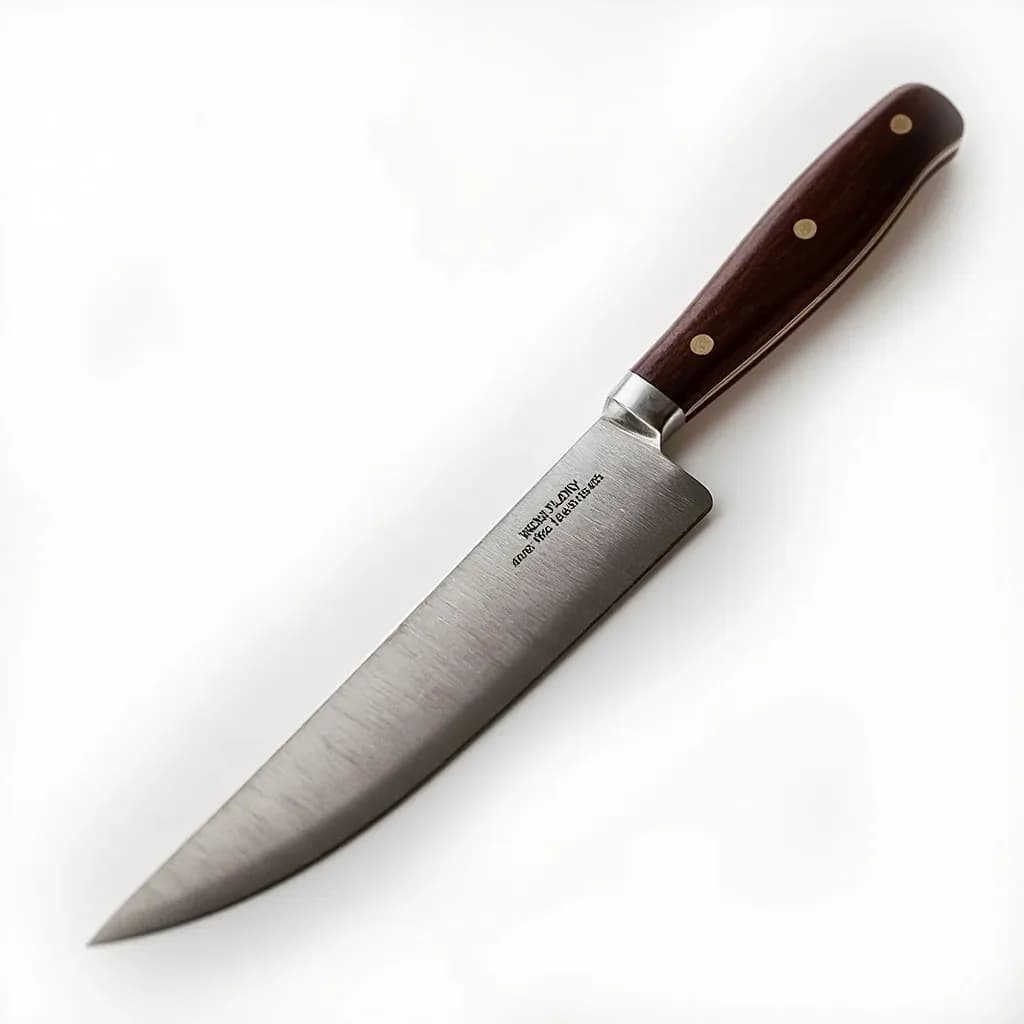
A long curved-blade knife for breaking down primal cuts and trimming large pieces of meat.
A breaking knife, or cimeter, has a long, upward-curving blade that ends in a pointed tip, built for cutting through large primal sections of meat. The sweeping curve lets a butcher slice in long strokes to separate muscles, trim fat, and portion steaks and roasts. It handles big cuts that a smaller chef's knife cannot manage in a single pass.
The breaking knife — also called a cimeter, cimitar, scimitar, or butcher's scimitar — is the workhorse of the cutting room, built for taking a large primal down to retail portions in a single, sweeping pass. Its defining feature is a long, deep-bellied curve inspired by the Middle Eastern scimitar sword, and that curve is not decorative: it lets the edge track along the natural seams between fat and muscle, separating tissue with far less tearing than a cleaver or chef's knife would produce on the same job. A 10- or 12-inch blade gives the butcher enough travel to complete long strokes without lifting the knife, which means cleaner cut faces, less shredded protein, and better yield on expensive primals like ribeye rolls, loins, and whole briskets.
Unlike a slicing knife, which is long and thin for portioning cooked roasts across the grain, a breaking knife is stiffer and taller through the spine, with the muscular belly forward of center where most of the cutting work happens. The motion is a long pull-stroke, almost a draw cut, with the tip riding up and the heel of the curve doing the heavy separating. It is not a chopper and not a utility knife; in the hands of a trained cook it replaces several less-suited tools and makes quick, controlled work of chores that would otherwise require a saw, a cleaver, and a fair amount of muscle.
Alternatives
Types & varieties
10–12" plain-edge cimeter; the workhorse for rib, chuck, and loin breakdown.
Hollow scallops along the blade reduce drag and keep meat from clinging during long slicing passes.
Thinner, more flexible blade for trim work and peeling silver skin off primals.
Stiffer, taller blade for power cuts through dense muscle and thick fat caps.
Tapered point for getting between bones (such as separating rib bones) and detailed seam work.
How the curve does the work
On a standard chef's knife the belly is shallow and the tip is the focal point; on a breaking knife the deepest part of the curve sits well forward, which is the section that contacts the meat through a long, pulling stroke. As you draw the knife toward you with the tip slightly elevated, the belly lays flat against the cut face and a long section of edge is engaged at once. That sustained contact is why a cimeter separates a brisket flat from the point or lifts a ribeye cap in one or two strokes, where a chef's knife would require repeated short cuts and leave a ragged, bruised surface.
- Deep belly forward of center = long edge contact per stroke.
- Pull-stroke motion, not downward pressure, drives the cut.
- Tip rides up and out of the meat; the curve does the separating.
- Cleaner cut face = better moisture retention and presentation on retail cuts.
Breaking knife vs. slicing knife vs. cleaver
These three are often lumped together but live in different parts of the kitchen. The cimeter sits between them: longer and more curved than a chef's knife, shorter and stiffer than a slicing or brisket knife, and far more refined than a cleaver. Knowing which one to reach for saves time and protects the edge.
- Slicing knife: long, thin, flexible; for portioning cooked roasts across the grain.
- Cimeter / breaking knife: tall, stiff, deep-bellied; for breaking raw primals along seams.
- Cleaver: heavy, short, thick spine; for bone, frozen blocks, and brute force.
- Boning knife: narrow, pointed, often flexible; for working around individual bones.
Choosing the right size and weight
Most cooks who buy a cimeter should start with a 10-inch model: long enough for brisket and rib work, short enough to control. A 12-inch is faster on very large primals like full loins or whole beef rib sections, but it demands board space and a confident hand. Heavier blades with taller spines are better for power work through dense chuck and shank; slimmer, more flexible profiles are better for trim and silver-skin work where control matters more than force.
Common uses
Tips & pitfalls
- Use a long, pulling stroke that follows the belly of the curve; let the geometry do the work rather than pressing straight down.
- Hone the edge with a steel before every use — the curve dulls faster than a chef's knife because of the long edge contact per stroke.
- Do not use the breaking knife on bone; reach for a boning knife or cleaver instead to avoid chipping the long, thin tip.
- Sharpen on a long-blade sharpener (belt sander or long whetstone) so the contact matches the curved profile; short pull-through sharpeners are awkward on a 10–12" blade.
- Pair the knife with a board at least 18" deep so the blade stays on the surface through the full stroke and the tip never has to hang off the edge.
- Keep the tip up and let the curve track along the natural seam of fat and muscle rather than forcing it through dense tissue.
- Store in a knife guard, sleeve, or block slot — the long blade and sharp tip are easily damaged and dangerous when loose in a drawer.
- In commercial kitchens, choose an NSF-listed polymer-handled version; wood handles crack under constant sanitation cycles.
Good to know
- Also known as
- Cimeter, cimitar, scimitar, butcher's scimitar
- Typical blade length
- 8–12 inches (20–30 cm); 10" and 12" are most common
- Blade shape
- Long, deep-bellied curve resembling a scimitar sword, with the belly forward of center
- Edge type
- Plain edge standard; granton (hollow-ground scallops) available to reduce drag and sticking
- Steel
- Usually high-carbon stainless for edge retention and stain resistance during long cutting sessions
- Origin of name
- From the Middle Eastern/Indian scimitar sword, referencing the curved silhouette
- Handle styles
- Wood (traditional, retail butchery) or NSF-rated polymer (commercial kitchens)
- Primary use
- Breaking down primal and sub-primal cuts of beef, pork, and lamb
- Skill level
- Intermediate to advanced; designed for trained butchers and cooks
Also called
Cimeter Knife · Scimitar Knife · Cimeter (Scimitar) Knife · Breaking Knife
Related

Knife
The fundamental cutting tool every kitchen is built around

Chef's Knife
The do-everything blade for chopping, slicing, and mincing

Paring Knife
Small, nimble blade for peeling and detailed in-hand work

Serrated Knife
Saw-toothed blade that slices crusty bread without crushing

Cleaver
Heavy broad blade for chopping through bone and bulk prep

Cutting Board
The stable surface every cut starts on

Mandoline
Adjustable blade for paper-thin, perfectly even slices

Kitchen Shears
Heavy-duty scissors for poultry, herbs, and packaging