Cookware
Brew Kettle (Boil Kettle)
A large stainless pot used to boil wort when brewing beer at home.
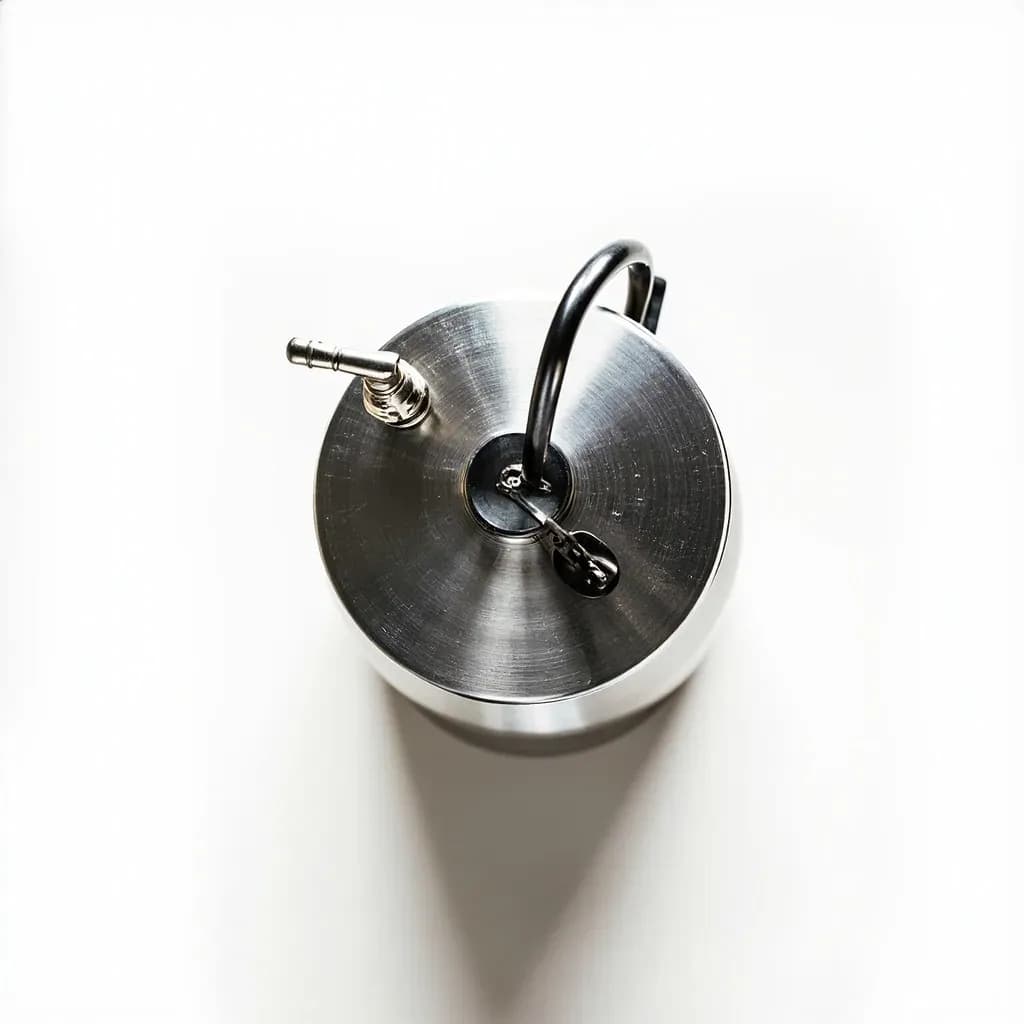
A brew kettle is a tall, heavy-bottomed stainless steel pot, often fitted with a spigot and thermometer, used to boil the sugary wort during beer brewing. Hops are added at timed intervals during the rolling boil to set bitterness and aroma. Larger kettles include volume markings and a ball valve to make transferring hot wort cleaner and safer.
The brew kettle — also called a boil kettle, and in older brewing literature simply the kettle — is the dedicated vessel in which wort is brought to a rolling boil during beer making. At first glance it is little more than a large stainless pot, but the features that mark a true brew kettle (welded ball valves, sanitary tri-clamp fittings, interior volume graduations, and a domed lid) exist because the vessel must survive a 60–90 minute rolling boil, foaming hot break, and sustained contact with mildly acidic hops. Unlike a stockpot, a brew kettle is built to be drained rather than poured, and to be sanitized rather than merely washed.
Sizing is the most consequential decision a brewer makes. The working rule is to buy a kettle roughly 1.5× the size of the finished batch: a 5-gallon (19 L) batch therefore wants an 8–10 gallon (30–38 L) pot, because grain absorption during the mash claims about 0.1 gallon per pound of grain, evaporation removes 10–15% per hour of boiling, and trub and chiller dead-space consume the rest. Extract brewers who top off with water can get away with a smaller pot, but anyone stepping into all-grain brewing needs that headroom — fill above 70–80% of capacity and you will spend the entire afternoon fighting boil-overs.
Material is the second decision. Stainless steel, typically 304/18-8 grade, is the modern homebrewing standard because it is non-reactive with hop tannins, indifferent to mildly acidic wort, and easy to sanitize. Aluminum reacts with hops and pits over time, copper requires constant polishing and is now rare in home setups, and enameled steel chips at the rim and rusts. Pro-grade kettles use 1.2–1.5 mm stainless or reinforced tri-ply bases for even heating on induction or high-BTU gas; entry-level pots often run 0.8–1 mm and work fine on a propane burner with occasional stirring.
Alternatives
Types & varieties
Plain stainless pot with no valve; the cheapest option, fine for extract brewing where wort is poured or pumped out by hand.
Welded ball valve at the bottom for transferring wort; essentially required for all-grain brewing so trub and hop debris stay behind.
Bulkhead fitting accepts a sanitary 1.5" tri-clamp for attaching plate chillers, counterflow chillers, or pumps; standard on mid- to high-end setups.
Analog dial or digital probe mounted through the side wall; useful for tracking mash tun conversions and post-boil chill temperatures.
Double-walled or foam-insulated to hold temperature during long boils or when the kettle is being used as a hot liquor tank.
Modified or sold with a perforated basket that contains pellet hops, keeping loose hop debris out of the trub and fermentor.
Built-in electric heating element (1500–5500 W) and PID controller; popular for indoor and apartment brewing where an open flame is not an option.
Sizing and Capacity
Work the sizing math before you buy, because a kettle that is too small is useless and one that is too large simply costs more propane to heat. A 5-gallon finished batch from an all-grain brew typically requires starting with about 6.5–7 gallons (24.5–26.5 L) of wort in the kettle after the sparge, and you will lose roughly 0.5–1 gallon per hour to evaporation across a 60–90 minute boil. Add another quart or two of dead loss in the kettle, trub, and chiller, and the kettle itself needs to be at least 8 gallons for that 5-gallon batch. Brewers chasing 10-gallon batches should look at 15-gallon kettles, and so on. The most widely sold consumer-grade models — Bayou Classic's 8- and 10-gallon 'homebrew' kettles — have become an industry default because they hit that sweet spot for the most common batch sizes, while higher-end options from Spike Brewing, Ss Brewtech, Blichmann, Anvil Brewing, and Polar Ware serve brewers willing to pay for welded fittings and thicker steel.
- Extract brewers can stretch a 5-gallon pot for a 5-gallon batch by topping off with water after the boil.
- All-grain brewers should plan on roughly 1 gallon of kettle capacity for every 0.6–0.7 gallons of finished beer.
- A 60-minute boil can shed a full gallon or more to evaporation alone, so always size the kettle to finished-batch output, not pre-boil volume.
Care, Cleaning, and Common Mistakes
A stainless brew kettle will outlast the brewer if it is cleaned correctly and a few recurring mistakes are avoided. Caramelized sugars and hop resins respond well to a long overnight soak in PBW (Powdered Brewery Wash) or a hot caustic soda solution; both rinse away cleanly and leave no flavor residue. Chlorine bleach should never be used on stainless — it pits the surface over time and can leave off-flavors in the next batch. After cleaning, store the kettle dry with the lid cracked so residual moisture does not sit against the steel.
- Do not seal the lid during a vigorous boil. A pressure spike can lift the lid or push liquid out the vent; crack the lid or rely on the built-in vent hole.
- Cleaning and sanitizing are two separate steps: PBW is a percarbonate-based cleaner used to remove organic residue, while Star San is a no-rinse acid sanitizer used afterward. The two are not interchangeable.
- Dry the kettle upside down on a towel after cleaning to prevent water spots and slow any surface oxidation at weld points.
Common uses
Tips & pitfalls
- Never fill above roughly 70–80% of capacity at the start of the boil — the hot break foams aggressively and boil-overs are the single most common mess in brewing.
- Add Fermcap or a similar silicone antifoam at the start of the boil to suppress blow-off; do not use cooking oil, which will leave a film that is hard to clean and can affect head retention.
- After one or two brews, measure your actual evaporation rate (volume in versus volume out) and write it on the kettle with a paint pen so you can pre-boil to a calculated target every time.
- Avoid aluminum kettles: they react with hop tannins to produce off-flavors and pit quickly. If aluminum is all you have, use it only for short, extract brews that transfer out quickly.
- A domed lid comes to a boil noticeably faster than a flat lid and reduces loss of hop oils to the steam.
- Clean caramelized residue by soaking overnight in PBW or a hot caustic soda solution; never use chlorine bleach on stainless, as it pits the surface over time.
- When installing a weldless bulkhead and valve, wet the gasket with Star San or water before tightening to ensure a seal without stripping the bulkhead nut.
- For induction brewing, confirm the base is a true magnetic 430-grade layer bonded under the 304 stainless — many 'induction-ready' kettles have a footprint that is too small to heat evenly.
Good to know
- Primary material
- Stainless steel, typically 304/18-8 food-grade
- Common homebrew capacities
- 5, 8, 10, 15, and 20 gallons (19–76 L)
- Sizing rule
- Kettle should be roughly 1.5× the target finished batch volume to cover grain absorption, evaporation, and trub loss
- Evaporation rate
- Approximately 10–15% of pre-boil volume per hour during a vigorous boil
- Standard boil length
- 60–90 minutes for most ales; 90+ minutes for lagers and high-gravity beers
- Wall gauge
- 0.8–1 mm on entry-level pots; 1.2–1.5 mm or tri-ply bonded bases on pro-grade models
- Common fittings
- 1/2" or 3/4" welded ball valve; 1.5" tri-clamp bulkhead for chillers and pumps; interior gallon or liter graduations
- Heat source
- Propane or natural gas burner is standard; induction requires a magnetic 430-grade stainless base bonded to the 304 body
Also called
boil kettle · brewing pot · wort kettle
Related

Steamer
Gentle moist heat that keeps vegetables, fish, and dumplings tender

Frying Pan
Shallow sloped pan for frying, sautéing, and quick sears

Saucepan
Tall, straight-sided pot for sauces, grains, and small batches

Sauté Pan
Wide straight-sided pan with room to brown and braise

Dutch Oven
Heavy lidded pot that turns tough cuts tender over hours

Stock Pot
Tall, roomy pot for stocks, pasta, and big-batch cooking

Wok
High-sided bowl pan built for blistering-hot stir-fries

Griddle
Flat, broad surface for pancakes, smash burgers, and breakfast