Cookware
Coffee Pot (Briki / Cezve)
Small long-handled pot for brewing Greek, Turkish, and Arabic coffee.
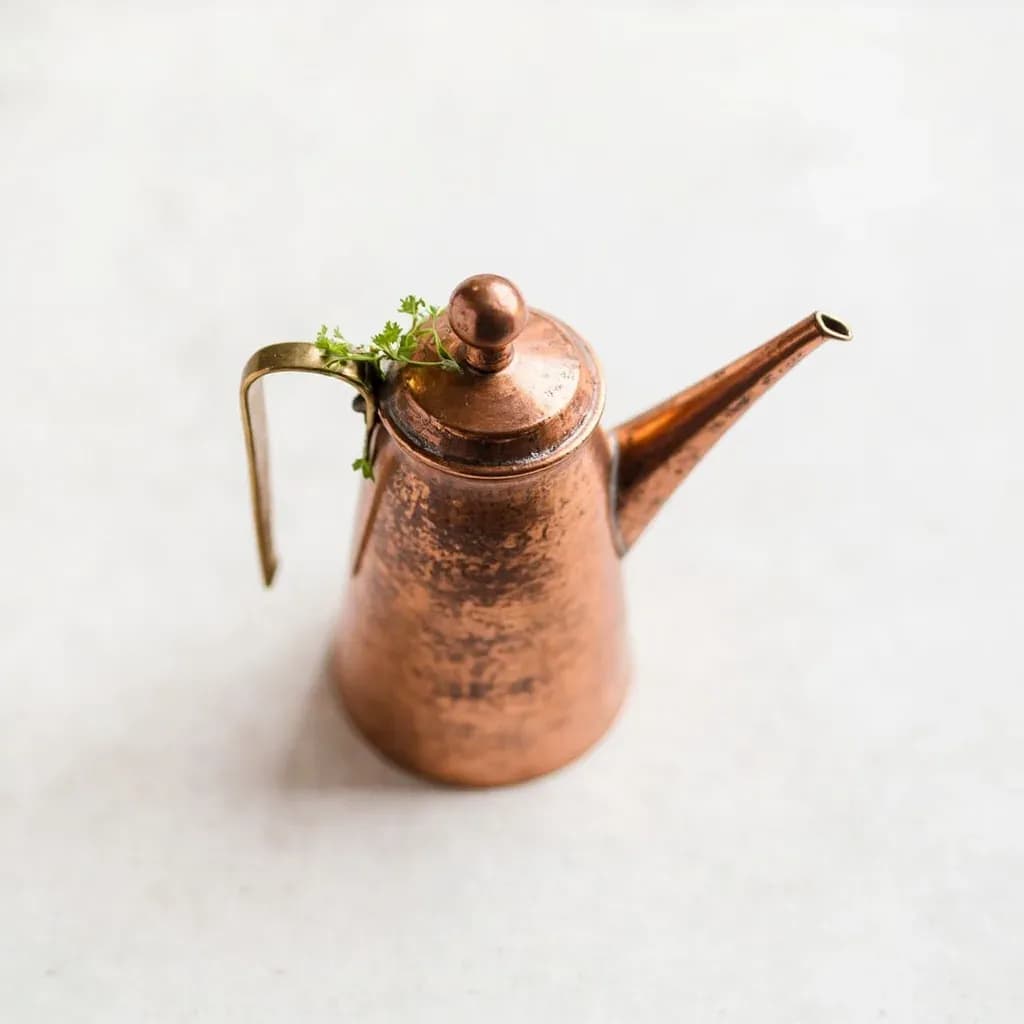
A briki (also cezve, dzezva, or jebena) is a small, narrow-necked pot with a long handle used to brew unfiltered Greek, Turkish, Balkan, and Arabic-style coffee. Finely ground coffee, water, and sometimes sugar are heated slowly over low heat to build a frothy foam before serving. Traditionally copper or brass, the tapered shape concentrates the foam and makes pouring easy.
A cezve — also called briki, ibrik, or džezva depending on where you are — is a small, long-handled pot shaped for one specific job: brewing unfiltered coffee on the stovetop. Its wide base tapers to a narrow neck, with a pronounced pouring lip and a handle set well away from the body. That silhouette is functional, not decorative: the broad bottom spreads heat across a thin film of water and grounds, the sloped walls funnel steam upward, and the constricted neck traps pressure so the foam — the prized kaymak — climbs the pot rather than boiling off into the air.
Copper remains the traditional material because it conducts heat faster and more evenly than stainless steel, giving the cook split-second control over the moment the foam rises. Tinned on the inside to keep the metal from tasting metallic, a good copper cezve is the difference between coffee that scorches and coffee that blooms. The craft itself is easy to learn and hard to master: the whole skill lies in heat control, timing the pour, and never letting the brew actually boil.
Don't confuse the cezve with a dallah, the large lidded Arabic coffee pot used for serving at the table. A cezve is a brewing vessel designed for the flame; a dallah is for pouring from and keeping warm.
Alternatives
Types & varieties
The archetypal form: copper with a tinned interior, wide belly tapering to a narrow neck, pronounced pouring lip. Available in 1- to 6-cup sizes.
Nearly identical to the cezve; commonly sold in smaller 1- to 2-cup sizes and frequently seen in stainless steel as well as copper.
Similar tapered body; some regional versions have a slightly more cylindrical neck and a longer, often blackened handle.
Smaller and more squat than its Turkish cousin, with a distinctive angled handle; the coffee inside is traditionally brought to a longer boil.
Induction-compatible when fitted with a clad base and dishwasher-safe; the standard choice in cafés and on modern stovetops.
Heats slowly and evenly, and is prized for table presentation, but is far less responsive to flame adjustments than copper.
Thick-walled copper with a flat bottom, designed to be half-buried in hot sand for the traditional Turkish sand-brewing ritual.
Anatomy of a Cezve
Every line of a cezve is a heat-management decision. The wide base spreads the flame across a large surface area, so the thin layer of water and grounds heats quickly and evenly — important because Turkish-style coffee is brewed in a shallow pool, not a deep one. The sloped walls then funnel that rising liquid and steam toward the center, while the narrow neck acts as a pressure regulator: it slows the escape of steam just enough to push dissolved air out of the slurry, building the foam from below. The pouring lip (dudak) is shaped to slow the pour and keep the heavy grounds in the pot. The handle is set at a right or slightly downward angle so the hand stays clear of the flame and the pot can be tilted without burning the wrist. None of this is ornament; remove any one element and the brew suffers.
Choosing and Caring for a Cezve
When shopping, weight and wall thickness matter more than decoration.
- Copper cezves are the gold standard. Look for heavy-gauge copper with a visibly bright tinned interior; a thin, decorative pot will scorch and warp within a season.
- Stainless steel cezves are practical and dishwasher-safe, but less responsive to heat changes — choose one with a thick, clad base if you cook on induction.
- Avoid aluminum for coffee. It reacts with the natural acids and lends a metallic taint to the cup.
- Re-tin the interior every few years if the silver-white coating wears through, especially on the base where the flame hits hardest.
- Hand-wash only and dry immediately. Detergents and prolonged soaking strip tinning and dull the copper's polish.
- Store bone-dry. Moisture left inside a copper cezve will spot the tinning and stain the metal.
Common uses
Tips & pitfalls
- Start with cold water and sugar in the pot; add the coffee only after the sugar has dissolved, then bring the heat up gently. Sugar added late caramelizes on the surface of the grounds and muddies the flavor.
- Once the grounds have settled and the foam begins to rise, never stir — stirring breaks the kaymak and clouds the cup with sediment.
- Pull the cezve off the heat the instant foam reaches the rim; return it to a low flame to let the foam rise a second time for a thicker cap and fuller aroma.
- Fill no more than one-third to one-half full. The foam expands dramatically and needs headroom to climb the neck — overflow is the single most common beginner mistake.
- Use the lowest possible flame on gas. A fierce flame scorches the grounds, dulls the foam, and can spit hot coffee across the stove.
- On induction, choose a cezve with a ferromagnetic base (stainless or clad). A pure copper pot will not heat without a diffuser disk in between.
- Pour slowly from the lip so the heavy grounds stay at the bottom of the pot, and serve the cup without decanting the dregs into it.
- Never reheat finished Turkish coffee in the cezve. It dulls the aroma and over-extracts the sediment into a flat, bitter finish.
Good to know
- Also called
- Cezve (Turkish), Briki (Greek), Ibrik (Arabic), Džezva (Bosnian/Serbian), Jezve
- Origin
- Ottoman Empire; used across Turkey, the Balkans, Greece, the Levant, and the Arabian Peninsula
- Cultural status
- Turkish coffee culture, with the cezve at its center, was inscribed on UNESCO's Representative List of the Intangible Cultural Heritage of Humanity in 2013
- Traditional material
- Copper, almost always tinned on the inside; sometimes brass
- Typical capacities
- About 60 ml (1 demitasse) to 300 ml (about 4 servings); most household pots are 150–250 ml
- Standard dose
- Roughly 7–8 g coffee to 60–70 ml cold water per demitasse; sugar added at the start, never after
- Grind required
- Extra-fine, almost powdery — finer than espresso — ideally ground just before brewing
- Key physical effect
- The narrow neck traps rising steam, forcing the foam (kaymak) upward and concentrating aroma rather than letting it escape
Also called
briki · cezve · dzezva · jazzve · jebena · ibrik · stovetop-coffee-pot
Related

Steamer
Gentle moist heat that keeps vegetables, fish, and dumplings tender

Frying Pan
Shallow sloped pan for frying, sautéing, and quick sears

Saucepan
Tall, straight-sided pot for sauces, grains, and small batches

Sauté Pan
Wide straight-sided pan with room to brown and braise

Dutch Oven
Heavy lidded pot that turns tough cuts tender over hours

Stock Pot
Tall, roomy pot for stocks, pasta, and big-batch cooking

Wok
High-sided bowl pan built for blistering-hot stir-fries

Griddle
Flat, broad surface for pancakes, smash burgers, and breakfast