Knives & Cutting
Brisket Slicing Knife (Granton Edge)
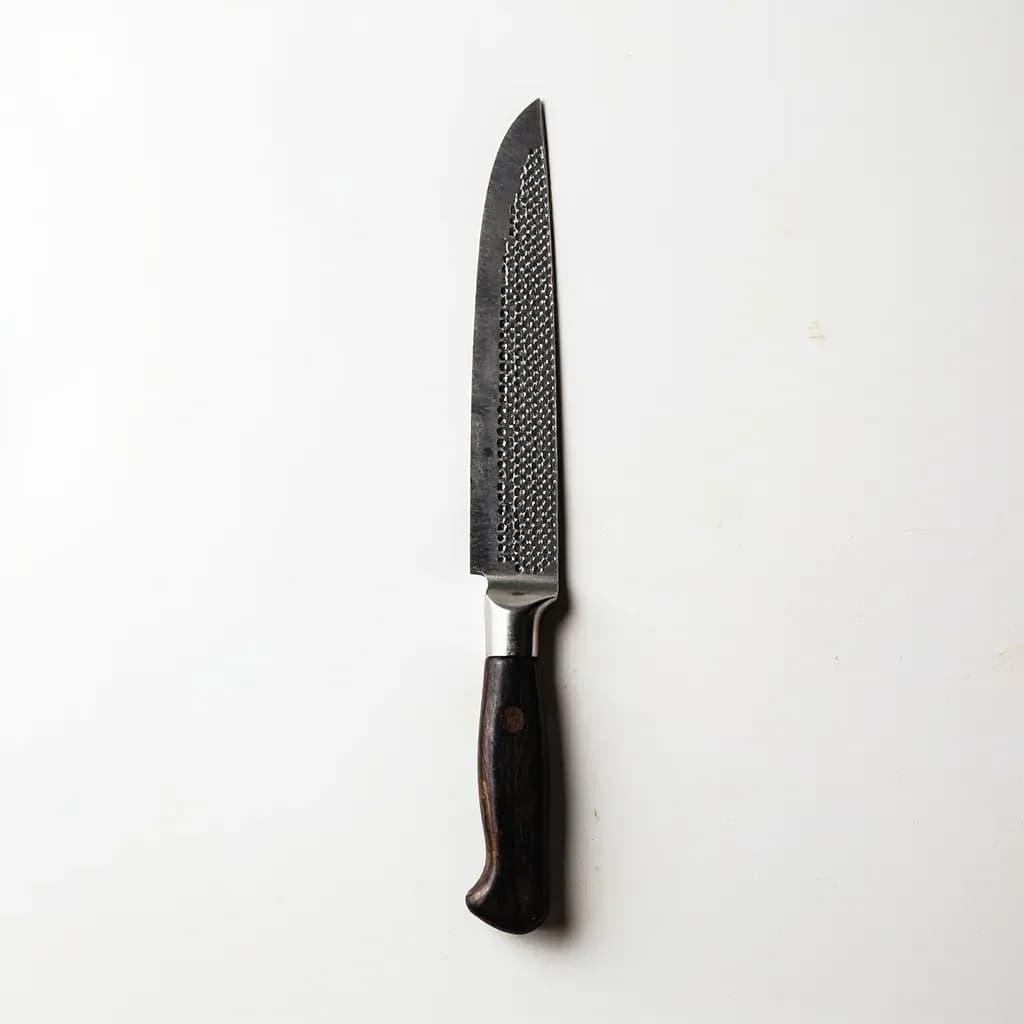
A long Granton-edged slicer whose scalloped dimples release thin brisket slices cleanly.
This brisket slicing knife carries a Granton edge: a row of oval hollows ground along the blade that create air pockets so slices fall away instead of sticking. The long, narrow blade slices smoked brisket, roasts, and large hams in smooth single strokes. The Granton dimples are especially useful for moist, fatty cuts where ordinary blades drag and tear.
The brisket slicing knife is a specialized long slicer built around two engineering choices that matter enormously when you're cutting smoked beef. The first is sheer length — 10 to 12 inches of blade, with 12 inches being the most common size for a whole packer — so a single draw stroke covers the full width of a brisket flat without stopping or sawing. The second is the Granton edge, a row of scalloped hollow-ground dimples running along the blade that break the suction between meat and steel. Together they let you put down thin, even slices of brisket that hold together on the way to the plate instead of shredding, dragging bark, or sticking to the blade and tearing apart.
What separates it from a general carving knife or a chef's knife is stiffness. The blade resists lateral flex, which matters when you're pushing through a thick flat with bark on one side and fat cap on the other — a flexible blade deflects and crushes the slice instead of parting it. The tip is usually rounded or French-shaped rather than pointed, a deliberate choice that lets the blade ride along the bone side of the point without punching through and tearing the crust. Most commercial and prosumer models are high-carbon stainless steel at roughly Rockwell 56–60, hard enough to hold a fine edge through a long slicing session but not so brittle that the scallops chip.
The Granton name traces to Joseph Rodgers & Sons, whose Granton facility near Edinburgh produced the original hollow-ground slicer; the trademark has long since gone generic, and any hollow-dim slicer is now sold as a Granton. For Texas-style barbecue and competition cooks, a 12-inch Granton slicer — most often the workhorse Victorinox Fibrox — is the default. Home cooks willing to spend more step up to forged German or Japanese versions for better edge retention, but the geometry stays the same: long, stiff, dimpled, and built for the single draw stroke that defines good brisket service.
Alternatives
Types & varieties
Workhorse of BBQ joints and competition circuits; Granton edge, textured slip-resistant handle, stamped high-carbon stainless.
American-made, soft-grip handle, common in BBQ restaurants and meat markets.
Forged high-carbon German steel, Granton edge, full tang; favored for higher-end home and prosumer use.
Japanese VG-10 core with stainless Damascus outer; thin profile and very acute edge for clean brisket slices.
Forged German slicer with Granton scallops; rounded tip and full bolster.
American forged slicer with Granton scallops and full tang; walnut or POM handle.
Entry-level stamped slicers with dimple patterns, sold in BBQ supply stores.
Anatomy of a Brisket Slicer
Three parts of the knife do the real work, and they're easy to take for granted until you've used a slicer that gets any of them wrong. The blade is long (10–12 in) and stiff rather than flexible, with a tall profile so the spine acts as a guide while the edge does the cutting. Most have a slight distal taper and a rounded or French tip — pointed tips look elegant but punch into the point muscle and tear bark. The scallops are a row of 6–12 hollow-ground oval dimples running along the side of the blade. They don't sharpen the cut; they create tiny air pockets that interrupt the vacuum between warm meat and polished steel. Without them, paper-thin slices cling and fold. The edge itself is fine and straight, and must stay that way — honed before each session, sharpened on a 1000/6000 stone or ceramic rod as needed. The scallops sit above the edge and don't need separate maintenance.
Technique: The Single Draw Stroke
Even the best slicer produces ragged brisket if the meat and the motion aren't right. Rest the brisket 30–60 minutes after the cook — held in a faux cambro or wrapped in a towel inside a dry cooler — so the juices redistribute and the muscle fibers relax. On the flat, find the grain: the muscle fibers run in one direction, and rotating the meat 90° to your knife so you slice perpendicular to the grain is what makes brisket feel tender on the palate. Start the cut at the heel with light pressure and pull the knife toward the point in a single, even stroke; sawing back and forth drags bark off the slice and tears the meat. Aim for slices about 1/4 inch (6 mm) thick — roughly the width of a #2 pencil. Thinner slices cool fast, lose juice, and read as dry. Use a long, stable board with a juice channel, or a dedicated brisket slicing board with grooves and a backstop so the knife doesn't skate.
Choosing Your Slicer
Stamped workhorses in the $40–80 range — the Victorinox Fibrox 12" and Dexter-Russell S138 — dominate competition pits and BBQ joints because they take abuse, sharpen easily, and the textured polymer handle stays grippy with wet or greasy hands. The tradeoff is edge retention: expect to hone and sharpen more often. Forged German slicers from Wüsthof, Mercer Genesis, and Lamson ($80–250) offer better balance, fuller tangs, and harder steel that holds an edge through longer sessions; they're heavier in the hand, which many cooks prefer for control. Japanese slicers like the Tojiro DP and other VG-10 or Damascus models ($150–400+) carry thinner blade geometry and harder steel (often HRC 60+) for an exceptionally clean cut, but they demand more careful handling — they chip if you twist against bone or slam the board. For most home cooks who slice a brisket a handful of times a year, a stamped Victorinox or Dexter is the rational pick. If brisket is a recurring centerpiece — holidays, dinner parties, or a smoking hobby — a forged slicer pays back its cost in less frequent sharpening and a more confident stroke.
Common uses
Tips & pitfalls
- Let the brisket rest 30–60 minutes after the cook; slicing hot meat squeezes out juice and shreds the slice.
- Identify the grain on the flat before slicing and rotate the meat 90° to your knife — slicing perpendicular to the muscle fibers is what makes brisket feel tender.
- Use one long, even pull stroke for the full length of the flat; sawing back and forth drags bark off the slice and tears the meat.
- Aim for slices about the thickness of a #2 pencil (roughly 1/4 in / 6 mm) — thinner slices cool fast and feel dry.
- Wipe the blade between slices with a damp towel; the dimples reduce sticking but rendered fat still clings to the steel.
- Don't use the tip as a wedge to pry slices apart — that bends thin slices and can chip the rounded tip against bone or cartilage.
- Hone with a honing rod before each session and skip the dishwasher: alkaline detergent pits the scallops and dulls the edge fast.
- If slicing cold reheated brisket, temper it on the counter for 10–15 minutes for better juice release and slice cohesion.
Good to know
- Typical blade length
- 10–12 in (25–30 cm); 12 in is the most common size for a full-packer brisket
- Blade style
- Granton edge — hollow-ground scallops (dimples) along one or both sides of the blade
- Edge geometry
- Stiff blade with a fine, straight edge and a rounded or French tip rather than a sharp point
- Steel
- Usually high-carbon stainless; premium models in VG-10, SG2, or Damascus
- Tang
- Full tang for balance and strength on long slicing strokes
- Rockwell hardness
- HRC 56–60 for typical stainless versions
- Origin of the Granton name
- Trademark of Joseph Rodgers & Sons (Sheffield/Edinburgh); now generic for any dimpled slicer
- Price range
- $40–$80 for commercial stainless; $150–$400+ for forged and Japanese versions
Also called
Granton slicer · scalloped slicing knife · barbecue carving knife
Related

Knife
The fundamental cutting tool every kitchen is built around

Chef's Knife
The do-everything blade for chopping, slicing, and mincing

Paring Knife
Small, nimble blade for peeling and detailed in-hand work

Serrated Knife
Saw-toothed blade that slices crusty bread without crushing

Cleaver
Heavy broad blade for chopping through bone and bulk prep

Cutting Board
The stable surface every cut starts on

Mandoline
Adjustable blade for paper-thin, perfectly even slices

Kitchen Shears
Heavy-duty scissors for poultry, herbs, and packaging