Knives & Cutting
Bush Knife (Machete)
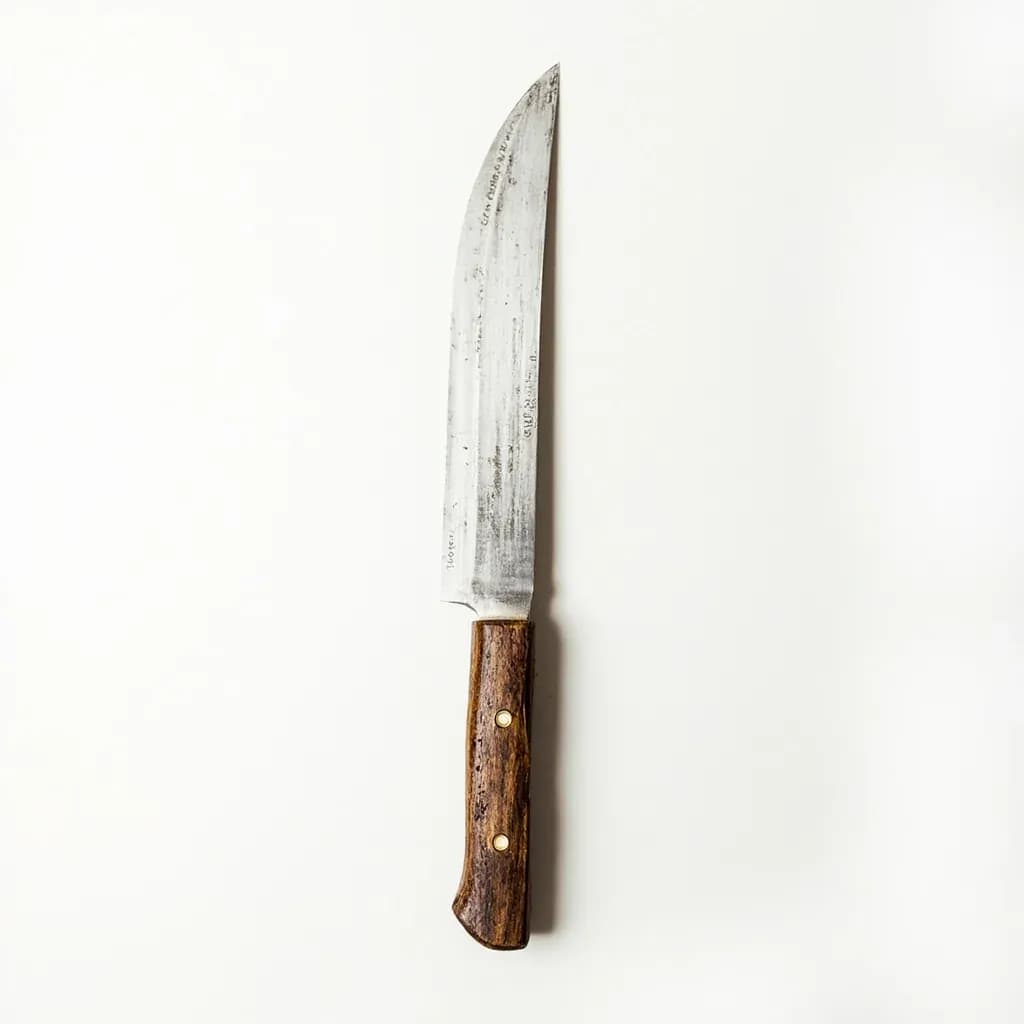
Long, broad blade for splitting coconuts, hacking tough produce, and rough field prep.
A bush knife, or machete, is a long, broad-bladed knife used in many tropical kitchens for heavy cutting tasks. Cooks split open coconuts, husk and chop large root vegetables and squashes, cut down stalks of plantains, and break apart tough produce. Its length and weight let one swing do work that would take many strokes with a small knife.
A bush knife — the machete, cutlass, parang, golok, or panga of regional vocabularies — is a long, heavy, fixed-blade chopper built for the work a chef's knife cannot do. In outdoor kitchens, beachside cookshops, jungle camps, fish markets, and smallholder farms across the tropics and subtropics, it is the first tool off the wall: the thing that splits whole coconuts, opens breadfruit and jackfruit, tops pineapples, chops sugarcane, and breaks down a large whole fish before any of it ever reaches a proper prep surface. It is not a kitchen knife and shouldn't be asked to behave like one.
What makes a bush knife work is geometry, not sharpness. The blade is long enough (commonly 35–45 cm) to build momentum on a swing, and heavy enough at the striking section that gravity does most of the cutting. The edge is honed to a working bevel — keen enough to bite husk and shell, robust enough that a glancing blow against coconut shell or bone doesn't chip it. A full tang, a hardwood or polymer handle, and a solid chopping surface under it complete the package.
Used correctly, a bush knife is faster, safer, and less wasteful than a cleaver or chef's knife on tough, bulky produce. Used carelessly — on a flimsy board, with a razor edge, against bone or frozen food — it is the quickest way to ruin a blade and a hand in the kitchen.
Alternatives
Types & varieties
Long, slim, slightly upswept blade (~45–60 cm); the classic cane, brush, and backyard kitchen chopper of the Caribbean and Central America.
Filipino broad-tipped blade with a swelling near the point; excellent for splitting coconuts and chopping root crops.
Malaysian/Indonesian short, heavy, tip-weighted blade; built for hardwood clearing and splitting.
Thick, straight or slightly curved Indonesian/Malay chopper with a deep belly for woody stems and sugarcane.
East African deep-bellied blade with a dropped point; common at Swahili-coast fish markets and farm kitchens.
Caribbean/Naval-style shorter machete with a hooked or clipped point; used for coconuts, breadfruit, and fish butchery.
Short, deeply hooked blade for pulling brush and limbing; useful for trimming stalks rather than splitting.
Nepalese forward-weighted blade; works as a heavy bush chopper though its geometry is really a utility/fighting hybrid.
Choosing by task
The names above aren't interchangeable — the blade geometries do different jobs. Match the tool to the produce and the cutting motion you'll make most.
- Long, slim Latin machete or cutlass: cane, brush, long sweeping cuts where reach matters more than weight.
- Bolo or golok: coconuts, breadfruit, cassava, jackfruit — anything that needs a heavy, broad strike.
- Panga or parang: short, chopping strokes on bulky round produce — melons, squash, breadfruit, green papaya.
- Billhook: pulling and trimming banana stumps, palm fronds, and stalks; less useful for splitting.
Field care
A bush knife lives in humidity, salt air, and hard use. A few habits keep it serviceable for decades.
- Wipe the blade dry immediately after use; tropical humidity rusts carbon steel overnight.
- Oil lightly before storage — a thin film of food-safe oil (food-grade mineral oil is the standard choice) is enough.
- Keep a bastard file or coarse whetstone at the prep station; touch up the working edge as you go.
- Store in a dry sheath (leather treated with oil, kydex, or even a heavy cotton wrap); never loose in a damp drawer.
Common uses
Tips & pitfalls
- Chop on a thick end-grain block or a section of felled log — never on a thin plastic board, which the blade will punch straight through.
- Curl the fingers of your guiding hand into a claw and hold produce well away from the blade's path; bush-knife work is about controlling where the swing ends.
- A blunt bush knife is more dangerous than a sharp one: it bounces off hard produce and skids sideways. Keep a file within reach.
- Hone to a working edge, not a razor edge — a thin polished bevel chips on coconut shell and bone; a toothy 20°–25° bevel holds up.
- Strike with the weight of the blade, not the force of the arm; let the geometry do the work and you'll be accurate and uninjured at the end of a long shift.
- Never use a bush knife on bone, frozen food, or glass — these chip and crack the edge in a single stroke.
- For coconuts, score a full circle around the husk with the tip first, then lever it apart; trying to cleave an un-scored coconut wastes force and slips.
- When splitting round produce — melon, squash, breadfruit — make a starter notch so the blade has somewhere to bite before you commit to the swing.
Good to know
- Type
- Large fixed-blade chopping tool (outdoor / field kitchen)
- Typical blade length
- 25–60 cm (10–24 in); most kitchen-field use 35–45 cm
- Blade material
- High-carbon steel; some stainless or spring-steel variants
- Handle
- Hardwood (hickory, rosewood) or injection-molded polymer
- Weight
- 300–700 g (0.7–1.5 lb)
- Tang
- Full tang preferred for heavy chopping; rat-tail tang common on lighter Latin machetes
- Edge
- Single-bevel on Latin and Asian forms; flat grind on many general-purpose bush knives
- Not suitable for
- Bone, frozen food, fine slicing, or general kitchen-knife duty
Also called
panga · Machete · Cutlass
Related

Knife
The fundamental cutting tool every kitchen is built around

Chef's Knife
The do-everything blade for chopping, slicing, and mincing

Paring Knife
Small, nimble blade for peeling and detailed in-hand work

Serrated Knife
Saw-toothed blade that slices crusty bread without crushing

Cleaver
Heavy broad blade for chopping through bone and bulk prep

Cutting Board
The stable surface every cut starts on

Mandoline
Adjustable blade for paper-thin, perfectly even slices

Kitchen Shears
Heavy-duty scissors for poultry, herbs, and packaging