Knives & Cutting
Butcher Cleaver
A heavy rectangular blade built to chop through meat, bone, and joints with one strong stroke.
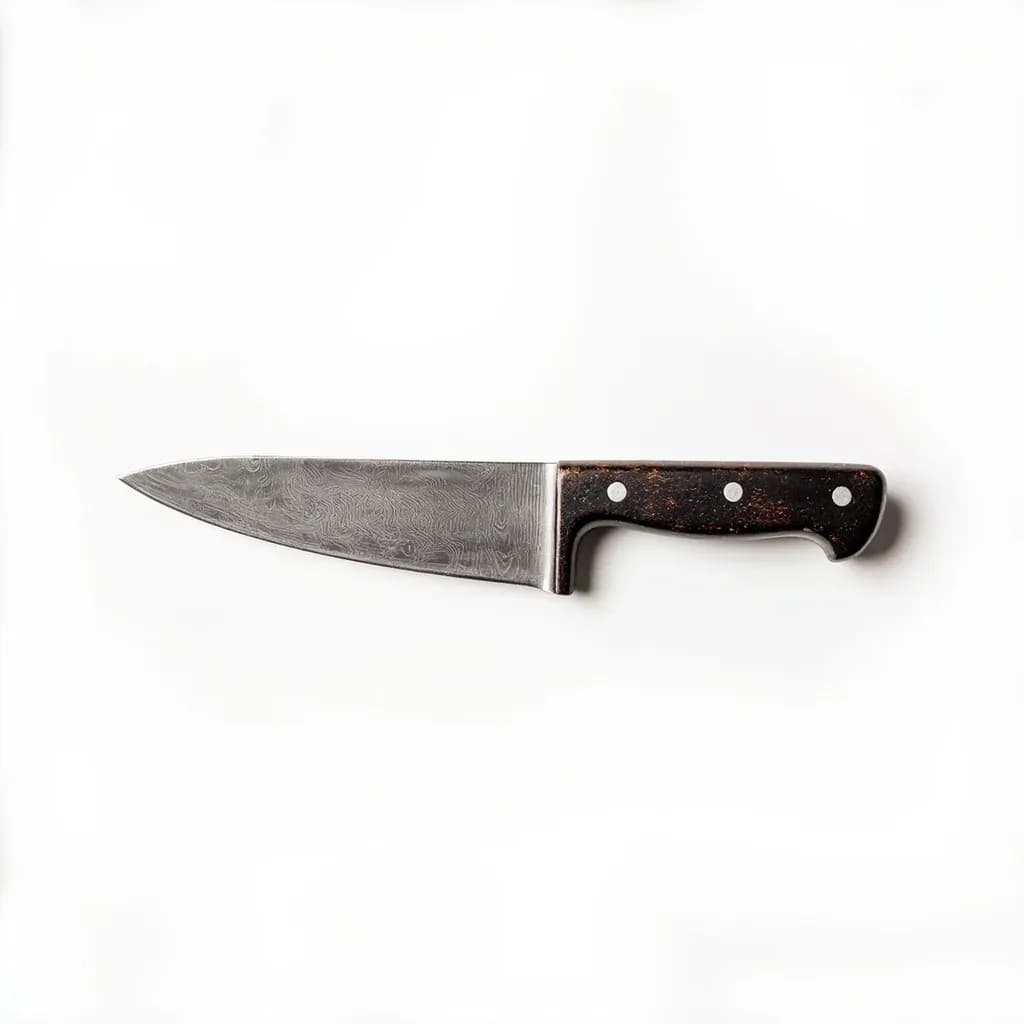
A butcher cleaver is a thick, weighty knife with a broad rectangular blade designed to break down carcasses and cut through bone and cartilage. Its mass does the work, letting the cook split joints and portion large cuts cleanly. The lighter Chinese cleaver, by contrast, is a thin all-purpose blade for slicing vegetables and boneless meat, and is often confused with the heavy bone cleaver.
A butcher cleaver is a tool defined by mass. Where a chef's knife parts flesh with a long, slicing draw, the cleaver relies on a short, vertical chop in which the blade's weight does the cutting. A heavy rectangular spine — typically 3–6 mm thick at the heel and a kilogram or more in total mass — stores kinetic energy in a way no thinner knife can. Drop a 1 kg blade from 30 cm and the focused impact cracks pork spine, halves a chicken through the breastbone, or shaves a knob of frozen meat down to a workable size. That same mass makes a cleaver slow and clumsy for parsley and a poor choice for most vegetable prep; it is, by design, a specialist's tool.
The cleaver's geometry is dictated by its job. The tall, flat blade gives a long, straight edge to lay against bone and acts as a barrier that protects the knuckles when a cut goes all the way through. The edge is ground more obtusely than a slicer's — roughly 20–25° rather than 15° — because a thin edge would chip on contact with bone and dense cartilage. The handle is built to absorb repeated shock: full-tang construction, riveted hardwood or dense composite, often with a steel bolster that doubles as a balance point. The result is a tool that can take daily abuse in a working butcher shop and stay in service for decades if kept dry and occasionally honed.
Regional traditions have produced strikingly different cleavers for the same essential task. The Western butcher's cleaver is compact, square-headed, and handle-heavy, optimized for control and a precise strike. The Chinese bone cleaver (猪骨刀, zhū gǔ dāo) is taller, heavier, blade-forward, and built to split pork spine with one swing; the everyday Chinese cài dāo (菜刀) that shares its silhouette is a thinner, all-purpose slicer, distinguished more by spine thickness than shape. The Japanese deba bōchō fills the same role — breaking down fish and poultry — but with a single-bevel, triangular blade rather than a rectangular chopper. All share a single principle: when bone, joint, or dense cartilage must be parted, mass wins.
Alternatives
Types & varieties
Square or rectangular blade, very thick spine, short cutting edge. The classic butcher-shop tool for splitting bone and rough breakdown, usually with a steel bolster and riveted wood handle (Dexter-Russell, F. Dick, Wüsthof, Victorinox).
Tall, rectangular, heavy blade (often 1.5–2 kg) with a spine noticeably thicker than a regular cài dāo. Built specifically for chopping through pork spine, ribs, and frozen meat; heel strikes bone, front edge slices.
Thinner, lighter, taller blade than the bone cleaver. Used for vegetables, poultry, and light bone work, and the dominant knife in many Chinese home kitchens (Zhang Xiaoquan, Shibazi, Aishan).
Thicker chef's-knife-style profile rather than a true rectangle; cuts vegetables and small bones but is less specialized than a true meat cleaver.
Not a cleaver in shape but fills the same role: thick, heavy, single-bevel blade for breaking down fish and poultry. Included because cooks often compare it to a cleaver.
Thin, rectangular, designed for slicing cooked meats (roast duck, char siu) and shaved vegetables; not for bone and easily confused with a cleaver by silhouette alone.
Smaller square blade (~5 in) for poultry bones, small racks, and kitchen work where a full-size cleaver is unwieldy.
Choosing a Cleaver
Selection comes down to weight, balance, and the work you actually do. A Western cleaver in the 0.8–1.2 kg range is the most versatile for a home cook; lighter than that and it stops feeling like a cleaver, heavier and it becomes exhausting. Balance matters as much as mass: handle-forward balance favors controlled chops on small bones and poultry, blade-forward balance favors momentum-driven strikes through pork spine and frozen meat. Test the balance by resting the bolster on your index finger before you buy.
- Steel: high-carbon tool steels (5Cr15MoV, AUS-10, SK-5) take a keener edge and are easier to sharpen, but they will rust if left wet. Stainless or laminated versions are more forgiving in a busy kitchen.
- Tang: full-tang construction is essential. Partial-tang cleavers work loose at the handle after a few months of bone strikes.
- Handle shape: Western riveted hardwood and Chinese round/oval pommels feel very different in the hand. The Chinese style rewards a pinched grip and lets the wrist snap; the Western style suits a firm, hammer-style hold.
- Edge: buy a cleaver that arrives reasonably sharp and reasonably thick at the edge. A factory edge ground too thin is a chipping waiting to happen the first time you meet a chicken carcass.
Common uses
Tips & pitfalls
- Let gravity do the work: lift straight up and let the blade fall. Forcing a cleaver sideways can crack the spine or work the handle loose.
- Strike the joint, not the bone shaft — aim for the gap between bones (between ribs, at the knee joint, at the oxtail vertebrae) so the edge works where the bone is weakest.
- Use the heel of the blade for bone and the middle or front of the edge for meat; the front edge is usually the thinnest and sharpest section.
- Curled fingertips and a flat, slightly damp cutting board keep the food in place — bone is unforgiving if it slips mid-strike.
- Never pry or lever a cleaver. If a cut won't go through, reposition and strike again; twisting chips the edge and can split the handle tang.
- Avoid striking the board directly with the blade's edge when chopping soft items; this rapidly dulls and rounds the tip.
- Keep the edge, but don't over-sharpen. A cleaver runs at a wider bevel than a slicer — a 20–22° edge will chip on bone; a 25° micro-bevel holds up better.
- Hand-wash and dry right away. High-carbon cleavers (common in Chinese models) will flash-rust in seconds if left wet or stored in a damp sheath.
- Store in a knife block, on a magnetic strip, or in a saya sheath. Don't toss a cleaver loose in a drawer — the corner will nick and the edge will dull.
- Common mistake: using a cleaver for everything. It is slower and coarser than a chef's knife for vegetables and boneless butchery; reach for it for bone and dense cartilage, then switch back.
Good to know
- Type
- Heavy, rectangular-bladed chopping knife
- Typical blade length
- 6–10 in (15–25 cm)
- Spine thickness
- Roughly 3–6 mm at the heel; thicker than virtually any other kitchen knife
- Weight
- 0.7–1.5 kg (1.5–3 lb) for most Western cleavers; 1–2 kg for heavy Chinese bone cleavers
- Edge geometry
- Broadly ground, often near-flat with a small secondary bevel; sharpened to a relatively obtuse 20–25° for durability on bone
- Primary motion
- Vertical chopping using blade mass and gravity, not a slicing draw
- Cutting surface
- End-grain wood or thick HDPE/poly board; never glass, ceramic, or bamboo
- Maintenance
- Hand-wash and dry immediately; hone lightly on a rod or 1000-grit stone; thick geometry makes frequent freehand sharpening harder, so many cooks send heavy cleavers to a pro
Also called
meat cleaver · Chinese cleaver · dim sum cleaver · bone cleaver
Related

Knife
The fundamental cutting tool every kitchen is built around

Chef's Knife
The do-everything blade for chopping, slicing, and mincing

Paring Knife
Small, nimble blade for peeling and detailed in-hand work

Serrated Knife
Saw-toothed blade that slices crusty bread without crushing

Cleaver
Heavy broad blade for chopping through bone and bulk prep

Cutting Board
The stable surface every cut starts on

Mandoline
Adjustable blade for paper-thin, perfectly even slices

Kitchen Shears
Heavy-duty scissors for poultry, herbs, and packaging