Baking & Pastry
Cake Decorating Comb
A notched scraper that drags clean ridges or patterns into iced cake sides.
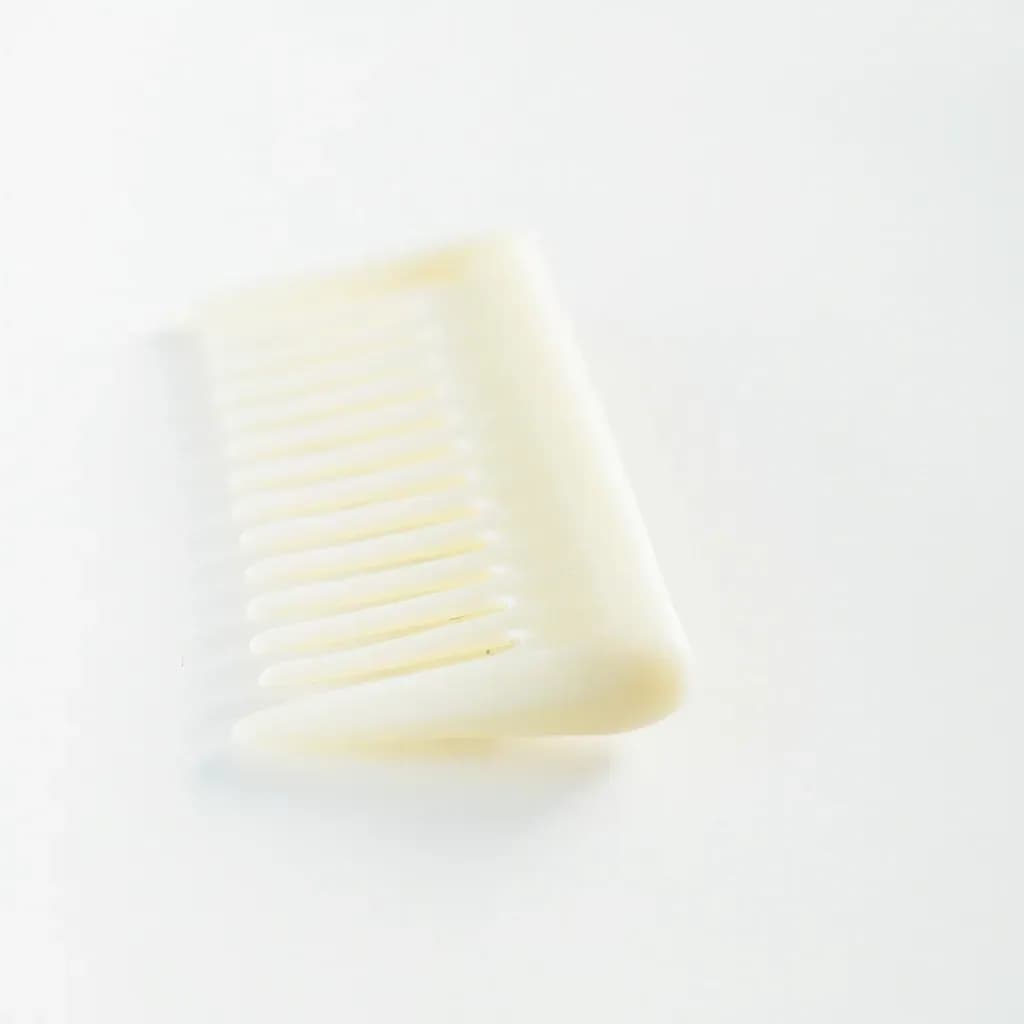
A cake decorating comb is a flat plastic or metal scraper with serrated or patterned edges, held against a turning cake to carve even lines, waves, or grooves into the frosting. Bakers use it to give buttercream and ganache a crisp, professional texture in a single rotation. The different edges let one tool produce several finishes.
The cake decorating comb is a small, flat bar — typically 3 to 4 inches wide and 4 to 10 inches tall — with one smooth edge and one notched edge, held against a rotating cake to drag repeating patterns into soft icing. Unlike a bench scraper, which lives on the countertop for dough and pastry work, the comb is sized and shaped for the vertical side of a finished cake, where its teeth bite into a generous layer of buttercream or whipped ganache and leave behind ridges, waves, basketweave, or stucco-style arcs. The tool exists because a turntable and a stationary hand can produce in a single pass what piping or hand-texturing would take many minutes to imitate.
Most combs are made of plastic, acrylic, or stainless steel, and the material changes the result: plastic flexes slightly and softens the line, acrylic lets the decorator watch the pattern form against the icing, and stainless steel holds a truer, crisper ridge. The comb only works on pliable icing — soft buttercream, cream-cheese frosting, whipped ganache, and similar. On hard royal icing or set fondant the teeth will chip, drag, or tear rather than texture; this is why a comb and a fondant smoother are complementary tools for different mediums rather than substitutes for one another.
Used well, the comb is fast: one smooth pass lays the crumb coat, a second pass with the notched side lays the pattern, and the cake is ready to top in moments. Used carelessly, it cuts through to the sponge, smears the icing, or produces ragged lines — which is why turntable speed, icing thickness, and a clean, warm tool matter as much as the pattern chosen.
Alternatives
Types & varieties
Inexpensive and slightly flexible; the everyday choice for home bakers. The flex rounds the pattern's depth, giving a softer line.
Rigid and durable, holds its edge precisely; favored by pastry shops for the cleanest, sharpest ridges.
Transparent body that lets the decorator watch the pattern form against the icing as the cake turns.
Movable teeth on a track that change pattern depth and spacing on a single tool.
Two or three different patterns cut into the faces of one bar (for example, straight ridges, waves, and fine lines).
A three-faced bar with a different tooth profile on each side, effectively three combs in one.
Closely spaced, shallow teeth for delicate vertical pinstripes.
Wide, deep grooves for bold, architectural texture.
Continuous S-curve teeth producing an ocean-wave or ribbon pattern.
Squares or rectangles cut into the edge that imitate woven icing strips.
Irregular, organic ridges designed to imitate wood grain.
Scalloped arcs that give a Mediterranean-stucco or shell finish.
Choosing the right comb for the cake
The comb's material and length should be matched to the cake's size and the icing's body. Plastic is forgiving on small celebration cakes where the icing is soft and the decorator is still learning to keep the tool perpendicular. Stainless steel rewards a steady hand on tiered and wedding cakes, where a true, sharp line reads from across the room. For tall tiers, a 9- or 10-inch comb finishes the whole side in one pass; for 4- to 6-inch celebration cakes, a 4- to 5-inch comb is easier to control. A triangular or multi-sided comb is the most economical buy for a cook who wants several patterns without filling a drawer.
- Plastic and acrylic: forgiving, lightweight, good for beginners and soft buttercream.
- Stainless steel: crispest ridge, worth the cost for tiered or display cakes.
- Long combs (9–10 in) suit tall tiers; short combs (4–5 in) suit small or mini cakes.
- A triangular or multi-sided comb is the best value if you want several patterns in one tool.
Working with different icings
The comb behaves differently depending on the icing underneath it, and the right timing matters as much as the right tool. Soft American buttercream is the easiest to teach on: it accepts a deep pattern, forgives a slightly wobbly hand, and wipes clean in a single pass. Whipped ganache needs a brief set in the refrigerator until the surface is firm enough that the teeth carve cleanly without dragging chocolate. Cream-cheese frosting is similar to buttercream but softens faster at room temperature, so a chill between the smoothing and texturing pass is essential. Royal icing and fondant are not comb-friendly; the teeth will chip the surface or tear the icing rather than texture it.
- American buttercream: most forgiving; the everyday comb icing.
- Whipped ganache: chill briefly after applying, then comb while still pliable but not liquid.
- Cream-cheese frosting: chill between the smoothing pass and the texturing pass to prevent smearing.
- Royal icing: too hard once set; skip the comb and use a stencil or piping instead.
- Fondant: too firm; use a textured rolling pin or impression mat before draping, not a comb after.
Common uses
Tips & pitfalls
- Always work on a turntable — hold the comb still and rotate the cake so the depth and angle stay even all the way around.
- Apply buttercream generously, roughly 6–10 mm thick, so the teeth have material to bite into; thin icing tears and exposes the crumb.
- Hold the comb perpendicular (90°) to the cake; tilting rounds the teeth and softens the pattern's read.
- Wipe the comb with a warm, damp paper towel every one or two passes to prevent icing buildup that smears the pattern.
- For the cleanest lines, dip the comb in hot water and wipe it dry between passes so the icing doesn't drag.
- Do a first smoothing pass with the flat edge of the tool, then switch to the notched side so the pattern is laid on an even base.
- Chill a soft-frosted cake for 10–15 minutes after the smoothing pass; cold frosting carves cleanly instead of smearing.
- Don't press hard — let the teeth do the work, or you will cut through to the crumb.
- For a sharp top edge, run a hot, dry bench scraper around the rim before texturing the sides.
- Avoid using a comb on hard royal icing or set fondant; the teeth will chip or tear the surface rather than texture it.
Good to know
- Material
- Plastic, acrylic, or stainless steel
- Typical dimensions
- 3–4 inches wide × 4–10 inches tall (7.5–10 cm × 10–25 cm)
- Edge profiles
- One flat or level edge, one notched edge
- Best used with
- Rotating cake turntable
- Best medium
- Soft buttercream, whipped ganache, cream-cheese frosting, or similar pliable icing
- Also called
- Icing comb, cake scraper comb, decorating comb, cake texture comb
- Cleaning
- Hand-wash in warm soapy water; many plastic models are top-rack dishwasher safe
- Distinct from
- Bench scraper (larger, for countertops and dough) and icing smoother (flat on both sides, for fondant)
Also called
icing comb · frosting comb · decorating scraper
Related

Muffin Pan
Multi-cup pan for muffins, cupcakes, and egg bites

Bundt Pan
Fluted ring mold for showstopping cakes with a center hole

Springform Pan
Latch-release pan that frees delicate cakes without flipping

Pie Dish
Sloped round dish for crisp-bottomed pies and quiches

Tart Pan
Fluted pan with a pop-out base for clean-edged tarts

Rolling Pin
Rolls dough into even sheets for pastry and bread

Pastry Brush
Brushes on egg wash, glaze, butter, and marinades

Bench Scraper
Flat blade that divides dough and clears your work surface