Baking & Pastry
Cake Decorating Turntable
A rotating pedestal that spins a cake smoothly for even frosting and decorating.
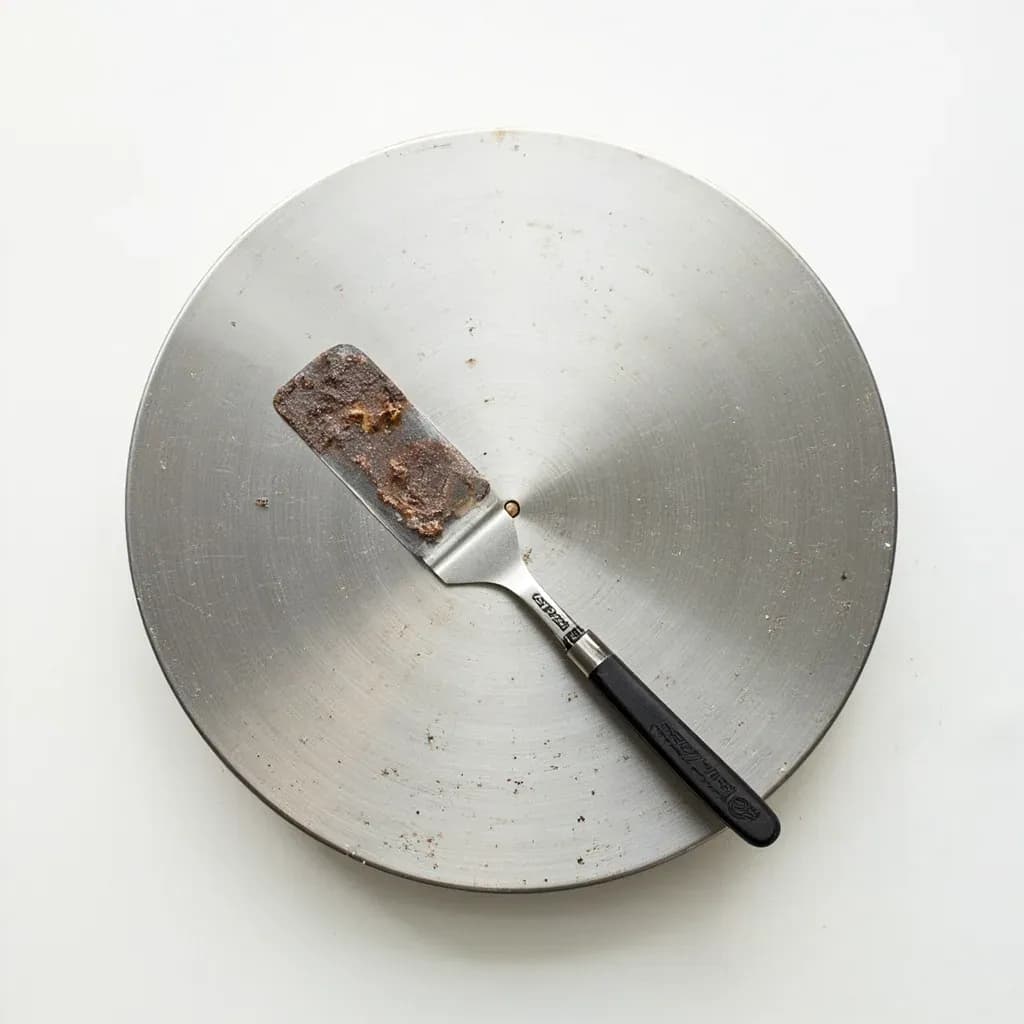
A cake decorating turntable is a flat, rotating platform on a weighted base that lets a decorator spin a cake freely while smoothing buttercream, piping borders, and applying crumb coats. The steady rotation gives the even, professional finish that is hard to achieve while reaching around a stationary cake. Many have a non-slip surface and tilt or lock to hold position when needed.
A cake decorating turntable is a low, weighted pedestal with a smooth-turning top that holds a cake while the decorator works around it. The defining trick of the tool is that the cake comes to the decorator rather than the decorator walking around the cake — the piping hand, the smoothing tool, and the wrist angle can all stay locked in one position while every side of the cake is reached in a single fluid pass. The mark of a good decorating turntable is controlled rotation: the top should slow and stop within roughly one to one-and-a-half revolutions, not spin freely like a kitchen-cabinet Lazy Susan.
The bearing system is what separates a real decorating turntable from a serving stand. A central ball-bearing or pin-bearing race sits in a heavy base, so the top carries inertia but also resistance. That resistance is what lets a decorator pipe a precise border or smooth a tall side of buttercream — the cake can be nudged a quarter-inch at a time, or sent around in one steady sweep. Base weight, whether cast iron, weighted plastic, or stamped steel, keeps the unit planted when a hand presses down on the rim or when the cake itself is heavy.
The turntable is a near-universal tool in professional pastry kitchens and a worthy upgrade for home bakers tackling buttercream, fondant, mirror glaze, or any work that requires seeing the cake from all sides. It pairs naturally with a bench scraper for sides, an offset spatula for tops, and a non-slip mat or a dab of buttercream to anchor the cake board. Once you have one, you will find yourself reaching for it not just for cakes but for any project that benefits from a steady, rotating work surface.
Alternatives
Types & varieties
Entry-level; 8–9 in plastic top on a thin base. Fine for a single 6–8 in layer cake; tends to wobble under heavy fondant-covered tiers.
Professional standard; thick metal top, weighted base, smooth bearing. The first choice for tiered, fondant, and wedding cakes.
Middle ground in weight and price; lighter than cast iron but sturdier than plastic. A favorite of many pastry chefs for everyday work.
Top pivots to a fixed angle so the decorator can lean into tall cakes without crouching. Especially useful for tall buttercream and ganache work.
Decorative as well as functional; the see-through top helps align patterns. Heavier than plastic, lighter than cast iron.
Has a brake or locking pin that holds the top still for piping precise details, lettering, or dragée placement.
Sold with a textured comb and bench scraper for ridged buttercream finishes.
Smaller diameter (around 5 in) for piping individual cupcakes, petit fours, or sugar flowers.
Choosing the right turntable
Weight matters more than diameter. A heavy 8 in cast-iron or aluminum turntable will outperform a lightweight 12 in plastic model for almost every job, because a weighted base keeps the unit planted when you press down with a scraper and gives the spin a controlled, slowing stop rather than an over-long coast. For home baking of single 6, 8, or 10 in layer cakes, an 8 or 9 in aluminum or cast-iron model is the sweet spot; reserve 11 and 12 in tops for very large or stacked cakes. The single biggest upgrade you can make to any turntable, budget or professional, is anchoring the cake board so it never shifts during heavy work.
- Cast iron or aluminum for tiered, fondant, and wedding work where weight and stability are non-negotiable.
- Plastic hobby models are fine for occasional buttercream on a single small cake and are kinder to the budget.
- Tilt-top styles earn their keep when you regularly decorate tall cakes (over 5 in) and want to protect your back.
- Locking tops are worth the small premium if you pipe detailed flowers, lettering, or do a lot of hand-painted work.
- A non-slip mat or a dab of buttercream under the cake board is the cheapest upgrade you can make to any turntable.
Common uses
Tips & pitfalls
- Always work on a separate cake board anchored to the turntable with a dab of buttercream or a non-slip mat — never spin a loose, unsupported cake.
- Keep the tool (spatula, scraper, or piping bag) steady and let the turntable do the moving; the tool stays still while the cake comes to you.
- Hold the bench scraper at a consistent 90° to the surface and brace it against your body for tall cakes; the steady tool plus the spinning cake is what gives a glass-smooth side.
- Spin with the fingertips of your non-tool hand using a small push, not the whole palm — palm pressure causes jerkiness and skips in the finish.
- For buttercream, chill the frosted cake 10–15 minutes before the final spin-smooth pass; cold frosting shaves cleanly rather than dragging.
- Center the cake by eye, then give it a quarter-turn and recheck before committing to frosting — an off-center cake is impossible to fix later.
- Don't oil the bearing with food oils if it squeaks; they migrate into the cake. A drop of food-grade silicone spray on the race, with the top removed, is the safe fix.
- If a plastic turntable wobbles, suspect the floor or table first — most wobble comes from beneath. A damp tea towel folded under the base often cures it instantly.
- Wipe the top with a barely damp cloth between cakes to stop color cross-contamination, especially when switching from dark cocoa buttercream to white vanilla.
- For a clean top edge, hold a small offset spatula flat against the rim and let the cake rotate under it; resist the urge to chase the frosting with the spatula.
Good to know
- Also called
- Cake stand, decorating turntable, lazy Susan (colloquial)
- Typical diameters
- 7–12 in (18–30 cm); 8 and 9 in are the most common home sizes
- Standard top height
- Roughly 3.5–4.5 in (9–11 cm) from the counter, so the decorator's hand can rest on the edge with forearms level
- Common materials
- Cast iron, aluminum, stamped steel, or weighted plastic top on a heavy base; some glass-topped models
- Mechanism
- Central ball-bearing or pin-bearing race that lets the top rotate smoothly under fingertip pressure
- Weight range
- Lightweight plastic models 1–2 lb (0.5–1 kg); professional cast-iron models 4–10 lb (2–4.5 kg)
- Load capacity
- Plastic tops hold roughly 5–8 lb (2.3–3.6 kg); cast-iron professional models handle tiered cakes of 15 lb (7 kg) and up
- Pairs with
- Bench scraper and offset spatula for the classic spin-and-smooth technique
Also called
Cake Turntable · Decorating Stand · Revolving Cake Stand
Related

Muffin Pan
Multi-cup pan for muffins, cupcakes, and egg bites

Bundt Pan
Fluted ring mold for showstopping cakes with a center hole

Springform Pan
Latch-release pan that frees delicate cakes without flipping

Pie Dish
Sloped round dish for crisp-bottomed pies and quiches

Tart Pan
Fluted pan with a pop-out base for clean-edged tarts

Rolling Pin
Rolls dough into even sheets for pastry and bread

Pastry Brush
Brushes on egg wash, glaze, butter, and marinades

Bench Scraper
Flat blade that divides dough and clears your work surface