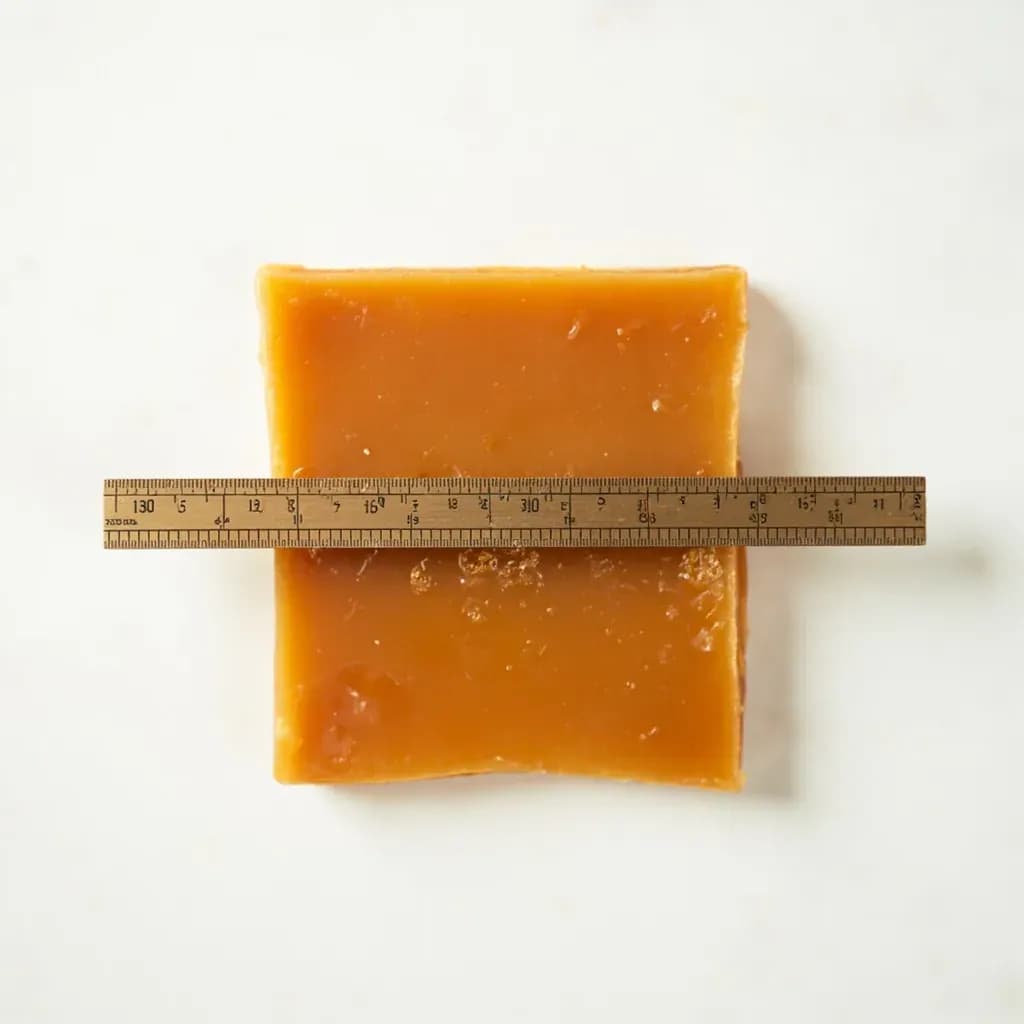
Baking & Pastry
Caramel Ruler (Confectionery Bars)
Heavy steel bars that frame poured caramel, ganache, or pâte de fruit to set an even thickness.
Caramel rulers are square-section stainless steel bars arranged into a frame on a slab, used by confectioners to corral poured caramel, ganache, marshmallow, or pâte de fruit at a precise, uniform depth. Once the candy sets, the bars lift away and the slab is cut into clean squares. Their weight and straight edges give consistent thickness that hand-spreading cannot match.
Caramel rulers — the heavy L-shaped steel bars pastry cooks call confectionery bars, règles à confiserie, or simply pastry bars — are the simplest tool in the candy kitchen and one of the hardest to substitute well. Each bar has a flat bottom flange that rests on the work surface and a vertical wall, usually 10 to 30 mm tall, that defines the exact thickness of whatever is poured inside the frame. Laid out as a rectangle on a marble slab, a granite counter, or an inverted full-size sheet pan, four bars form a leak-resistant mold of any footprint you need, at a precise depth you cannot reliably get from a rimmed pan, a loaf tin, or a custom-cut silicone frame.
In practical terms, the bars do one job: they make a slab uniform. Uniformity matters more in confectionery than almost anywhere else in the kitchen. A caramel slab that is 22 mm thick at one end and 14 mm at the other cuts into inconsistent pieces and looks amateur when wrapped. Pâte de fruit poured to the wrong depth sets unevenly, with one side still soft and the other over-firm. A marshmallow slab poured 5 mm too thick takes forever to set and can collapse under its own weight. The bars eliminate that variable — the wall is the wall, the pour self-levels to the top edge, and the resulting slab is the same thickness in every corner.
French confectioners developed the format for pâte de fruit, guimauve, nougat, and caramel, and it migrated to modern pastry kitchens worldwide because it is faster and more flexible than dedicated molds. The frame is built to size on the spot, used once, lifted away, and cleaned. There is no demolding, no lining of corners, and no warping of soft walls. The bars are heavy enough not to bow under the weight of a hot sugar pour, and the L-profile means they stand on their own without clamps in most applications. They are distinct from cake rings, which are circular and vertical, and from frame molds, which are closed rectangular forms used for layered entremets — confectionery bars are open-top straight edges designed to be reconfigured into a fresh rectangle every time.
Alternatives
Types & varieties
The classic format — two pre-cut lengths that butt against each other to form a rectangle. Most rigid and most consistent, but limited to one footprint per pair.
Bars fitted with thumbscrew or cam-lock corners (Boers is the well-known example); allow any rectangular frame up to the bar length. More versatile but slower to set up.
Traditional French style with pre-formed 90° corners that link to straight extensions; eliminates the need to square up two bars against each other.
Bars sold in matched pairs at 10/15/20/25/30 mm — common in pro kitchens where the same frame footprint is reused for different confections.
Lighter and cheaper, but softer — prone to denting and warping if dropped or stored on edge. Acceptable for soft work only.
Choosing a height and footprint
Bar heights are standardized in 5 mm increments. Match the height to the confection you are pouring, and match the footprint to the volume of the batch. The two numbers together determine how much mixture you will need.
- 10 mm: thin pâte de fruit, fruit leathers, small-cut Turkish delight.
- 15 mm: marshmallow, soft caramel squares, most tablet.
- 20 mm: the workhorse height — caramels, nougat, energy bars, tempered chocolate slabs.
- 25–30 mm: rustic Montélimar-style nougat, very thick caramels, slab cake batters set to a uniform thickness.
- Standard pro footprints are 30 × 40 cm and 40 × 60 cm; a 30 × 40 frame at 20 mm deep holds roughly 1.8–2.4 kg of cooked sugar mixture, depending on density.
- French sets are metric (5 mm increments); American sets (notably Ateco) are inch-based at 3/8, 1/2, 3/4, and 1 in — buy the system that matches your recipes and the rest of your tools.
Frame setup and pour technique
A good frame is square, level, oiled, and on a good mat. The bars themselves do very little work once the frame is built; success comes from the surface underneath and the pour that goes in.
- Place a silicone mat or acetate sheet on the work surface; arrange the bars on top so the bottom flange is fully in contact with the mat — gaps will leak hot sugar.
- Lightly oil or spray the inside faces of the bars. Even stainless steel grips hot caramel and pâte de fruit hard enough to tear the mat when the frame is lifted.
- If using corner clamps, square the frame with a set square or a right-angle before tightening the screws. A frame locked out of square gives a parallelogram, not a rectangle, and every cut will be a fight.
- Pour into the center and let the mixture find the walls on its own. Pouring directly against a wall traps air pockets at the edge.
- When the slab is set, lift the frame straight up before sliding the mat off. Sliding first smears the edges and ruins the clean line that makes the bar system worth using in the first place.
Common uses
Tips & pitfalls
- Verify the work surface is truly level — even 2 mm of slope will produce a wedge-shaped slab that cuts unevenly and sets at different rates across the frame.
- Always lay the bars on a silicone mat, acetate sheet, or well-oiled marble; never pour directly onto bare steel or unprotected wood, and never let hot sugar reach the seam where bar meets surface.
- Lightly film the inside faces of the bars with neutral oil or nonstick spray — even stainless steel grips hot caramel and pâte de fruit hard enough to tear the mat when the frame is lifted.
- Bars should be at room temperature before the hot pour hits them. A cold bar will shock caramel against its edge and cause cracking, sticking, or a crystalline skin on the face of the slab.
- Use a long, thin, hot knife (wiped clean between cuts) and cut while the slab is still warm and pliable for caramels, or fully chilled for pâte de fruit — cutting at the wrong temperature tears the surface.
- Lift the frame straight up before trying to slide the mat off. Sliding first smears the edges and undoes the clean line the bars are there to give you.
- Never grab a bar by one end to pry a set slab loose. Flexing a thin bar permanently warps it; slide an offset spatula between the mat and the work surface instead.
- Store bars flat, not on edge, and never stacked heavy-on-light, to preserve straightness over years of service.
- To strip very sticky confections (high-sugar caramel, marshmallow), freeze the slab briefly in the frame for 10–15 minutes before lifting the bars; the thermal contraction pops the edges cleanly.
Good to know
- Also called
- Confectionery bars, pastry bars, caramel bars, règles à confiserie (French); the framing technique itself is called cadrage.
- Material
- Heavy-gauge stainless steel, typically 304 / 18-10 food grade; economy versions are aluminum.
- Standard heights
- 10, 15, 20, 25, and 30 mm, sold as fixed-height pairs or as matched sets spanning all five.
- Standard lengths
- Commonly 40, 50, or 60 cm (16–24 in); sold in pairs (one short, one long) or as four-bar rectangle kits.
- Profile
- L-shaped or right-angle cross-section: a flat bottom flange that sits on the surface, and an upright edge that sets the pour depth.
- Work surface
- Used on marble or granite slab, or an inverted full-size sheet pan; always paired with a silicone mat, acetate sheet, or a very lightly oiled surface.
- Notable makers
- Matfer (the French reference), Gobel, DeBuyer, Ateco, Lacor, and Boers (adjustable corner-clamp version).
- Cleaning
- Hand-wash and dry immediately; dishwashers will dull the finish over time. Store flat to avoid warping.
Also called
confectionery bars · caramel bars · candy frame bars
Related

Muffin Pan
Multi-cup pan for muffins, cupcakes, and egg bites

Bundt Pan
Fluted ring mold for showstopping cakes with a center hole

Springform Pan
Latch-release pan that frees delicate cakes without flipping

Pie Dish
Sloped round dish for crisp-bottomed pies and quiches

Tart Pan
Fluted pan with a pop-out base for clean-edged tarts

Rolling Pin
Rolls dough into even sheets for pastry and bread

Pastry Brush
Brushes on egg wash, glaze, butter, and marinades

Bench Scraper
Flat blade that divides dough and clears your work surface