Cookware
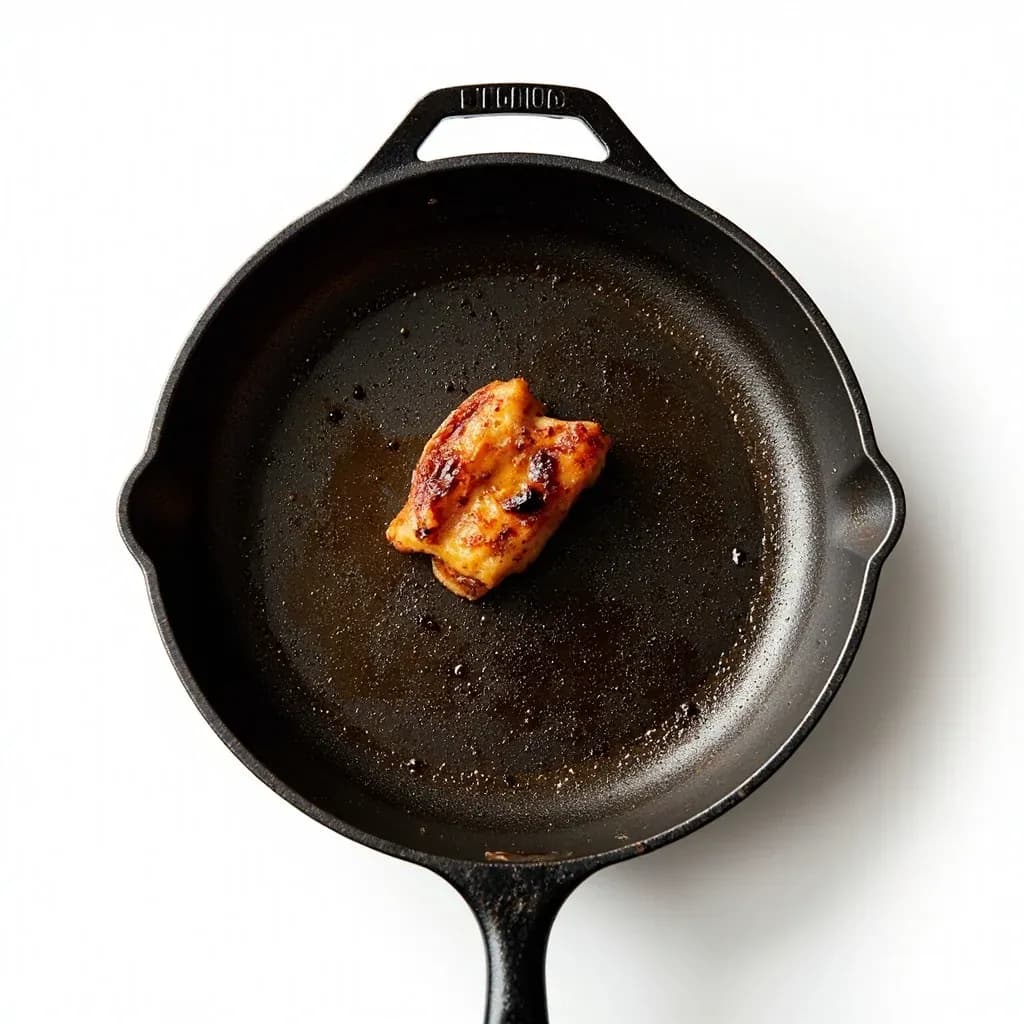
Carbon-Steel Frying Pan
Lightweight, high-heat pan that seasons to a natural non-stick finish like cast iron.
A carbon-steel frying pan is a thin but tough metal pan that heats fast, takes very high temperatures, and develops a slick seasoned patina with use. Cooks favor it for searing, omelets, and stir-frying because it is lighter and more responsive than cast iron while sharing its non-stick character. It needs drying and light oiling after washing to keep the seasoning intact.
Carbon steel is the workhorse of professional kitchens from Lyon to Guangzhou — an iron alloy with about 1% carbon, hot-rolled into thin sheets and pressed or spun into pans. Because it is rolled rather than cast, the grain is finer and the walls can be drawn thin enough to weigh roughly a third less than an equivalent cast-iron skillet, while keeping cast iron's tolerance for screaming heat and its ability to develop a natural non-stick patina. The trade-off is that, like cast iron, a carbon-steel pan is reactive and must be seasoned, and that seasoning has to be maintained — but in return you get a surface that sears without a synthetic coating, slides eggs once the patina is built, and travels from stovetop to oven to grill without complaint.
How a carbon-steel pan behaves is largely a story of thermal response. It heats faster and recovers faster than cast iron when you add cold food, which makes it more forgiving for quick work like searing fish, stir-frying, and sliding crêpes. It is also more reactive than stainless: a thin or stripped patina will turn a tomato sauce gray and lend a metallic edge to a wine deglaze, so acidic foods belong in a pan with a well-established seasoning or in a different vessel altogether. After a few months of regular cooking and oiling, the surface becomes deep, glossy, and nearly as slick as a modern non-stick — only built out of polymerized oil rather than fluoropolymers, and capable of taking a metal spatula without flinching.
Alternatives
Types & varieties
Sloped, flared sides with a single long handle; the classic restaurant pan, shaped for tossing and flipping.
Vertical walls, closer to a shallow saucier; holds more liquid and is favored for shallow frying and blini.
Traditional heat-treated factory finish, deep blue-black, sold mainly by de Buyer in the Vintage line; the finish is thinner than modern pre-seasoning and is built up further with use.
The standard modern finish — an oiled, pre-seasoned matte black surface, ready to cook on after a quick re-oil.
Wider and shallower than a Lyonnaise, with a long handle and a helper handle on the 14 in / 36 cm size and up.
Very shallow and flat with a short handle, usually 10–12 in (26–30 cm); designed to spread thin batter.
Tiny pan, often 4–6 in (10–15 cm), for individual omelets, eggs, and blinis.
Spun carbon steel, lighter and more responsive than cast iron; the dominant style in restaurant Chinese kitchens.
Shallow, wide, two-handled disc; a lighter, more responsive alternative to traditional steel paelleras.
Choosing a pan
Shape, gauge, and bottom geometry matter more than brand. The two reference shapes are Lyonnaise (flared sides, single handle) and Marseille (straight sides); most cooks end up preferring one and using it for almost everything. Diameter follows French convention in even centimeters — 20, 24, 26, 28, 30, 32, and 40 — and 26 or 28 cm is the most versatile home size. Heavier is better: thicker steel resists warping on a hot burner, holds heat when cold food hits, and seasons into a more durable patina. The handle should be riveted, never screwed, and the disc should be machined fully flat for flush contact on induction. The major makers — de Buyer (Mineral B, Carbone Plus, Blue Steel Vintage), Matfer Bourgeat, and a handful of heavier-gauge 'Lyonnaise Tradition' brands — differ more in gauge and finish than in actual cooking performance.
Common uses
Tips & pitfalls
- Before first use, scrub off the factory oil with hot water and a drop of mild soap, dry the pan on the burner, rub in a paper-thin layer of high-smoke-point oil (flaxseed, grapeseed, or vegetable), and heat it past the smoke point for 10–15 minutes; repeat two or three times to build a strong base.
- Preheat the pan empty over medium heat for 1–2 minutes before adding oil. The Leidenfrost test — water droplets that dance and skitter across the surface — confirms the pan is hot enough to sear instead of stick.
- Add oil only after the pan is hot. Cold oil on a cold carbon-steel pan encourages sticking and patchy, uneven seasoning.
- Save acidic foods — tomato sauce, wine deglazes, lemon-butter pan sauces — for a pan with a dark, glossy, well-built patina, or cook them in a different pan; acid on a thin seasoning strips it and leaves a metallic taste.
- After cooking, rinse with hot water, scrape with a wooden spatula or chain-mail scrubber, dry immediately on a warm burner, and rub in a few drops of oil while still warm. Never let it air-dry wet, or it will flash-rust.
- If rust appears, scrub it out with a paste of coarse salt and a little oil on a paper towel, rinse, dry thoroughly on the burner, and reseason the spot.
- Never put a hot carbon-steel pan under cold water — thermal shock can warp the disc. Let it cool on the burner for a few minutes first.
- Store the pan in a dry place with the lid off or a paper towel inside to absorb humidity; if stacking, slip a paper towel between pans to protect the seasoning.
Good to know
- Material
- Iron alloy with roughly 1% carbon (sometimes up to 1.5%); no stainless cladding, no non-stick coating.
- Weight
- About 30–50% lighter than an equivalent cast-iron skillet; a 12 in (30 cm) pan typically weighs 4–6 lb (1.8–2.7 kg) with handle.
- Heat tolerance
- Safe well above 500 °F / 260 °C; works on the stovetop, in the oven, on a grill, and in a pizza oven.
- Cooktop compatibility
- Gas, electric coil, glass/ceramic, induction, and open flame; flat-bottomed versions sit flush on induction, while older flared pans may need a flat adapter.
- Reactivity
- Reacts with acidic ingredients (tomato, citrus, wine, vinegar) when the seasoning is thin or worn, producing a metallic taste and gray food; a dark patina neutralizes most of this.
- Seasoning
- Polymerized oil film built up by heating thin coats of high-smoke-point oil past their smoke point; same chemistry as cast-iron seasoning.
- Handle
- Steel, riveted (never screwed) on quality pans; conducts heat, so use a towel, a hanging loop, or move the pan to the oven for finishing rather than gripping it over a flame.
- Dishwasher
- Never — detergents strip the seasoning and trapped moisture causes flash rust.
Also called
Carbon Steel Skillet · Black Steel Pan
Related

Steamer
Gentle moist heat that keeps vegetables, fish, and dumplings tender

Frying Pan
Shallow sloped pan for frying, sautéing, and quick sears

Saucepan
Tall, straight-sided pot for sauces, grains, and small batches

Sauté Pan
Wide straight-sided pan with room to brown and braise

Dutch Oven
Heavy lidded pot that turns tough cuts tender over hours

Stock Pot
Tall, roomy pot for stocks, pasta, and big-batch cooking

Wok
High-sided bowl pan built for blistering-hot stir-fries

Griddle
Flat, broad surface for pancakes, smash burgers, and breakfast