Cookware
Cast-Iron Cauldron (Gamasot / Bogrács)
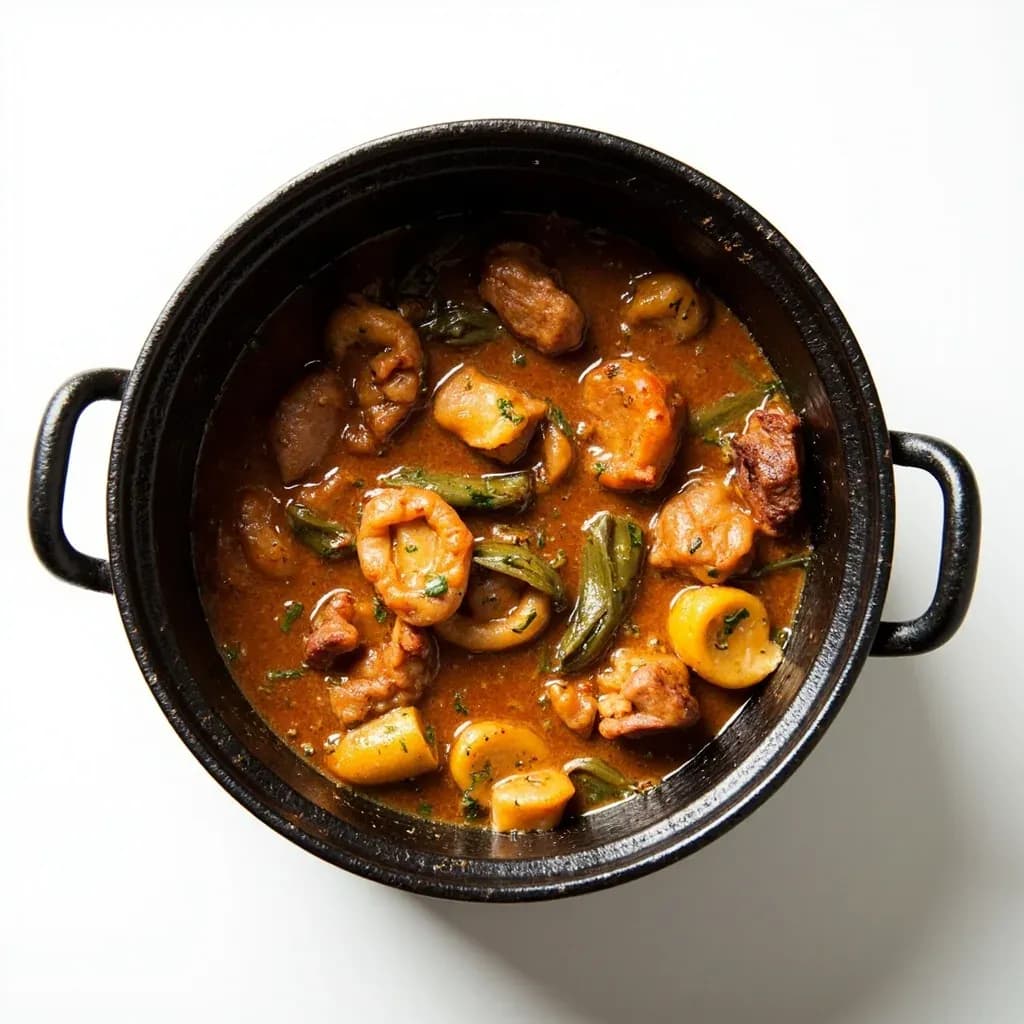
Large heavy cast-iron pot for cooking big batches of soup, stew, and rice over fire.
A cast-iron cauldron is a large, thick-walled round pot used to cook substantial quantities of food, often over an open flame or built-in hearth. The Korean gamasot steams rice and simmers broths, while the Hungarian bogracs hangs over a fire for goulash. The heavy iron holds and spreads heat evenly for long, gentle cooking.
The cast-iron cauldron is the heirloom pot of open-fire cooking across Eurasia — a thick-walled, heavy vessel that turns a wood fire into a slow, even simmer for stews, rice dishes, and soups meant to feed a crowd. The Korean gamasot, Hungarian bogrács, Central Asian kazan, and Balkan kotlić are all members of the same family, distinguished less by function than by regional form: bellied and leggy in Hungary, squat and lidded in Korea, deep and round-bottomed in Uzbekistan, hung from a tripod in the Balkans. What unites them is the logic of thick cast iron set directly over flame or coals — a vessel built for volume, patience, and the kind of one-pot cooking that a thin enameled stockpot cannot match.
What sets the cauldron apart from a Dutch oven is not the iron itself but the geometry and the heat source. Walls run 4–6 mm thick, the base is broad and heavy, and the empty weight is enormous — roughly 1.5–2 kg per liter of capacity, so a 10 L pot can tip the scales at 15–20 kg before a single onion goes in. That thermal mass means the pot takes its time to heat up, then holds a steady, even temperature with very little stirring, even when the fire under it flares and dies back. Large cuts of meat, dried beans, and rice cook through gently without hot spots, and a long simmer is closer to a held temperature than a rolling boil.
Bare cast iron asks for a small ritual of care: an initial oil seasoning, a thorough dry-down after every wash, and a thin film of oil rubbed in while the pot is still warm. Treated this way, a cauldron darkens and patinas over years of use, and the surface becomes more, not less, useful. Enameled versions trade that maintenance and the high-heat sear for the convenience of soap-and-water washing and the freedom to cook long, acidic stews without stripping the surface.
Alternatives
Types & varieties
Bellied, three- or four-legged pot, often hung from a tripod (bográcsállvány); the standard vessel for bográcsgulyás and halászlé. Sizes 6–20 L are most common for home use.
Squat cast-iron pot with a domed iron lid, used over a wood-fired hearth (아궁이) for rice, gamjatang, kimchi-jjigae, and doenjang-jjigae. Heirloom pieces pass through generations.
Deep, rounded-bottom cauldron without legs; sits on a trivet or is lowered into a fire pit. The defining vessel for Uzbek plov (osh) and similar rice dishes.
Tripod-hung cauldron used across Serbia, Bosnia, and surrounding regions for goulash, bean stews, and whole lamb. Often paired with a domed sač lid, with bread dough pressed onto the lid's underside to bake from the rising steam.
Smaller, often thinner-walled tripod cauldron used for mămăligă, stews, and for boiling ţuică (plum brandy) over winter fires.
Cast-iron body with porcelain-enamel coating; requires no seasoning, tolerates acidic and dairy-heavy cooks, but loses the high-heat sear and the patina that bare-iron devotees prize.
Sizing the cauldron
A cauldron is sized to the meal, not the burner. The working rule: 1 L of capacity per diner for soup or stew, 0.5 L per diner for rice-based dishes like plov, where the grain swells dramatically. A 6 L bogrács feeds four to six on goulash; the same pot stretches to ten or twelve over rice. Buy the next size up from what you think you need — the empty-weight difference between an 8 L and a 12 L pot is a matter of kilograms, but the difference between cooking for six with room to spare and cooking for six with the spoon hitting the bottom is the difference between a relaxed afternoon and a stressful one.
Heating geometry: legs, tripods, and pits
The shape of the cauldron dictates how it sits over the fire, and getting this right is the single biggest factor in even cooking.
- Legged bogrács and tuci sit directly on a stone hearth or ground-level fire ring — coals under the bottom, flames licking the lower third of the walls.
- Tripod-hung kotlić and bogrács hook from a chain or iron bar; aim for 15–25 cm of air between the fire bed and the pot bottom so flames don't scorch the iron.
- Kazans for plov are traditionally lowered into a fire pit wider than the pot itself, so the curved bottom heats evenly from rim to rim — this is the entire reason the kazan is round-bottomed.
- On a stovetop, a flat-bottomed bogrács works on a gas ring but loses the thermal headroom of an open fire; an induction or electric coil is a sluggish match for a thick-walled cauldron because the iron's mass resists rapid response.
Caring for bare cast iron
A seasoned cauldron is largely self-maintaining; an unseasoned one is a chore. The routine is short, but skipping any step is what causes the rust and stripped patches that give cast iron a bad name.
- First-use seasoning: scrub the new pot with hot water and a stiff brush (skip soap before the first seasoning — the bare iron hasn't earned a patina yet), dry it on or near the fire, then rub a thin film of neutral oil inside and out. Smoke it over low coals or in a 200 °C oven for 30–60 minutes. Repeat two to three times before cooking food in it.
- After every cook: empty the pot, rinse with hot water, scrape with a wooden spoon or chain-mail scrubber if needed, then set it on or near the fire long enough to flash off all moisture.
- While still warm, rub the inside with a paper towel soaked in a few drops of neutral oil. This thin film is the entire maintenance routine — do it, and the patina builds itself over months and years.
- Storage: keep the lid ajar or off so air can circulate; trapped moisture in a closed, oily pot is the fastest route to rust. In humid climates, store the pot in a paper bag with a few silica packets.
Common uses
Tips & pitfalls
- Heat the pot gradually — a cold cauldron set into a hot fire is the most common cause of cracking, especially at the leg joints and around the rim.
- Set the pot on a ring, trivet, or hung tripod so flames and coals contact the bottom, not the side walls; this prevents warping and burning food at the level of the rim.
- Let coals burn down to a steady bed before placing the cauldron over them; roaring flames scorch the bottom before the heat has had time to spread through the iron.
- Dry the pot on or near the fire immediately after washing — trapped moisture is what kills bare cast iron with rust, not the soap (which is fine on seasoned iron in any case).
- Rub a thin film of neutral oil inside while the pot is still warm after every use; this single habit is the difference between a patina that improves with age and a surface that scales and pits.
- Use wooden, plastic, or metal utensils freely — the seasoning on a thick-walled cauldron tolerates abrasion far better than on a thin skillet.
- Reserve long acidic cooks (tomato-heavy goulash, sauerkraut stews, wine-bra
Good to know
- Other names
- Gamasot (가마솥, Korean), bogrács (Hungarian), kazan (Central Asian/Russian/Turkish), kotlić (Balkan), tuci (Romanian)
- Material
- Cast iron, traditionally sand-cast; modern versions may have porcelain-enamel coating
- Wall thickness
- Typically 4–6 mm
- Weight
- Roughly 1.5–2 kg per liter; an 8 L cauldron is often 12–16 kg empty
- Typical sizes
- 3–5 L personal, 8–12 L family, 15–25 L group/event, 30 L+ for festival cooking
- Heat source
- Open wood fire, charcoal, or gas; designed for direct flame or coals beneath, not a stovetop ring
- Seasoning
- Required for bare iron — oil-baked or smoked 2–3 times before first use; enameled versions need none
- Storage
- Must be fully dried, lightly oiled, and kept in a dry place to prevent rust
Also called
cast-iron-cauldron · cauldron · large-cauldron · Gamasot · Bogracs
Related

Steamer
Gentle moist heat that keeps vegetables, fish, and dumplings tender

Frying Pan
Shallow sloped pan for frying, sautéing, and quick sears

Saucepan
Tall, straight-sided pot for sauces, grains, and small batches

Sauté Pan
Wide straight-sided pan with room to brown and braise

Dutch Oven
Heavy lidded pot that turns tough cuts tender over hours

Stock Pot
Tall, roomy pot for stocks, pasta, and big-batch cooking

Wok
High-sided bowl pan built for blistering-hot stir-fries

Griddle
Flat, broad surface for pancakes, smash burgers, and breakfast