Cookware
Cast-Iron Combo Cooker
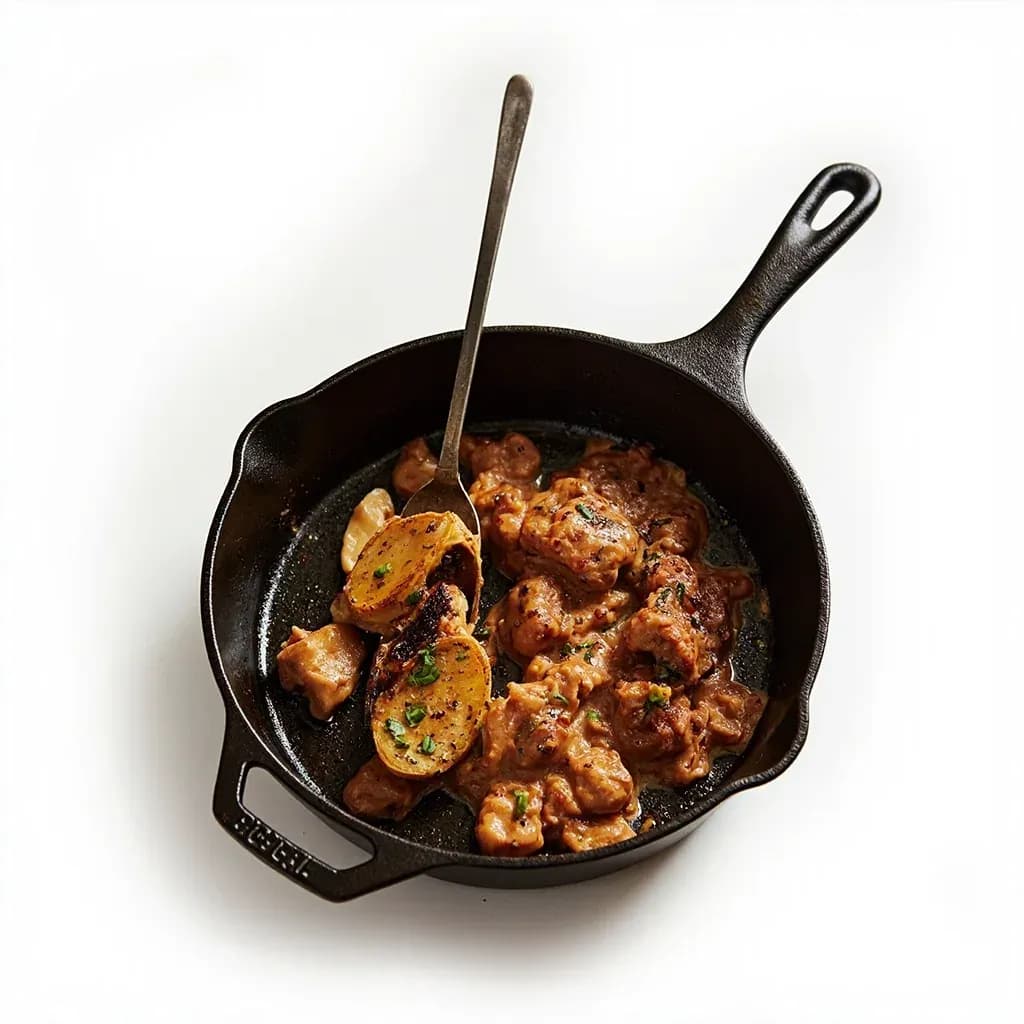
A two-piece cast-iron set whose skillet doubles as the lid for a shallow Dutch oven.
A cast-iron combo cooker pairs a deep skillet and a shallow pan that lock together, so each piece works alone or the deep half plus the lid forms a covered baker. Home bakers love it for no-knead bread: the dough bakes in the shallow base under the skillet-as-lid, trapping steam for a crackling crust. It is a versatile, space-saving alternative to a full Dutch oven plus separate pans.
A cast-iron combo cooker is two pans sold as a matched set: a shallow, long-handled skillet and a deeper pan with loop handles that nests over it to form a tight-fitting lid. When the two are closed together, the assembly behaves like a shallow Dutch oven — heavy enough to hold steady heat, sealed well enough to trap steam, and deep enough to handle wet braises, breads, and small roasts. Used on its own, the deep pan is a second vessel for shallow-frying, simmering sauces, or small braises; the two pieces are usable independently or stacked, which is why a single purchase covers a surprising share of stovetop, oven, and campfire work.
What gives the combo cooker its character is cast iron's thermal mass. The walls and base heat slowly but, once hot, hold their temperature with very little sag, so a hard sear on a chicken thigh and a long, gentle simmer for beans are both within reach of the same vessel. The bare cast-iron version demands a thin layer of seasoning — a polymerized oil patina — but rewards that small effort with a naturally nonstick surface and a depth of flavor that improves with use. Enameled variants trade the seasoning obligation for a glass-smooth interior that shrugs off tomatoes, wine, and citrus, though they are more vulnerable to thermal shock and to chipping if dropped.
The shape itself is older than most of the cookware on a modern stove. American foundries such as Griswold and Wagner were making two-piece "chicken fryers" by the late 1800s, and Lodge's LCC3 — still made in South Pittsburg, Tennessee — is the direct modern descendant. Once you understand that the deep pan is also a pot, and that both pieces can take the same brutal heat of stovetop, oven, grill, or coals, the combo cooker stops feeling like a specialty gadget and starts looking like the most versatile piece of cast iron you can own.
Alternatives
Types & varieties
The American benchmark: small enough for a 3–4 lb chicken or a no-knead boule, light enough to lift one-handed with the helper handle.
Larger version for whole chickens, deep-frying, and family-sized stews; the deeper lid pan is genuinely useful as a stand-alone Dutch oven.
Round camp-oven geometry with a flat lid that doubles as a griddle or second skillet, designed around charcoal and campfire cooking.
Same two-piece shape with a porcelain-enamel interior; no seasoning required, less reactive with wine and tomatoes, but not suited to dry high-heat seasoning or open flame.
Often lighter and smoother out of the box; Victoria (Colombian-made) is the most common budget alternative to Lodge.
Collectible late-1800s to mid-1900s American cast iron with notably smooth cooking surfaces; functional equivalents of the modern LCC3, but increasingly a collector's market.
Choosing the right size
The LCC3 is the right call for most households. It fits a 3- to 4-pound chicken with room to spare, bakes a single boule of no-knead bread comfortably, and weighs just enough that a fit cook can move it one-handed with the helper. The LCC5 earns its keep when you regularly feed six or more, want to deep-fry a small turkey, or want the deep lid pan to function as a full Dutch oven on its own. Anything smaller than 3 quarts is a specialist's tool; anything larger starts to lose the single-lift convenience that makes the combo cooker so useful in the first place.
- LCC3 (3 qt): 1–4 people, single loaves, whole chickens up to 4 lb, weeknight braises.
- LCC5 (5 qt): 4–8 people, small turkeys, deep-frying, larger batches of chili or gumbo.
- Enameled models: worth the premium if you cook a lot of wine- or tomato-based dishes and don't want to manage seasoning.
Seasoning and day-to-day care
Bare cast iron is not high-maintenance, but it does have a small, consistent routine. The enemies are trapped moisture, prolonged acid, and the dishwasher. The allies are heat, a thin film of oil, and prompt drying. Enameled versions trade this routine for the discipline of avoiding thermal shock — no ice water on a hot pan, no high-heat dry heating without food or oil — and the constant worry of chipping if dropped.
- After washing, dry the piece on a warm burner for a minute, then wipe a whisper-thin coat of oil on the still-warm surface.
- Never soak; never put it in the dishwasher. A chain-mail scrubber or coarse salt with a little oil handles stuck-on food.
- Refresh a gummy or rusty pan with a full oven re-seasoning: thin oil, 1 hour at 475 °F / 245 °C, repeat 2–3 times.
The combo cooker over live fire
The two-piece form was designed, and is still most at home, around a campfire ring. The shallow skillet sits on a trivet or coals as the base, the deep pan nests on top as the lid, and a few briquettes mounded on the lid deliver top-down heat the way a convection oven never can. This is the geometry that makes it a Dutch oven at all, and it is the reason bakers prize it for bread even at home: the heavy lid and base together mimic a hearth oven.
- Use 1 briquette per inch of lid diameter on top and the same underneath as a starting ratio, then adjust to your fuel and weather.
- For bread at home, preheat the closed cooker in a 450 °F / 230 °C oven for at least 30 minutes before loading the dough.
- Reverse the geometry at camp: shallow base as a comal or griddle, deep pan as a standalone pot, both over the same fire ring.
Common uses
Tips & pitfalls
- Dry the pan on a warm burner for a minute after washing; trapped moisture, not rinsing, is the single biggest cause of rust.
- Re-oil the still-warm, cleaned surface after any cook with acidic ingredients, sugar, or old fryer oil — a thin coat heated just until it smokes keeps seasoning intact.
- Preheat longer than you would with stainless or aluminum: cast iron is slow to come up to heat, and food sticking to a cold pan is almost always an underheated pan.
- Use a chain-mail scrubber or ridged pan scraper for stuck-on fond; never soak for hours, and never run it through the dishwasher.
- The long bottom handle gets hot — grip it with a thick towel or a silicone handle cover; the loop handles stay cooler but are still unsafe to grab bare after a long bake.
- Season the inside of the lid with the same care as the base; rust on the lid interior transfers onto food when steam condenses back into the pot.
- Avoid long, wet braises with wine, tomatoes, or citrus in a bare cast-iron piece — they strip seasoning and can leave a metallic taste. Use enameled cast iron for those, or keep such cooks under 30 minutes.
- For bread, preheat the closed combo cooker in a 450 °F / 230 °C oven for at least 30 minutes before scoring and loading the dough; the thermal shock is what gives the crust its oven spring.
- When deep-frying, fill no more than one-third full — oil rises sharply when food goes in, and the closed pot is harder to monitor than an open Dutch oven.
Good to know
- Form factor
- Two-piece cast-iron set: a shallow long-handled skillet forms the base; a deeper pan with loop handles nests on top as a lid, creating a shallow Dutch oven when closed.
- Iconic model
- Lodge LCC3 — 3-quart capacity, roughly 10.5 in (27 cm) top diameter, base pan about 1.25 in deep, lid pan about 2.5 in deep, total weight about 12 lb (5.4 kg).
- Larger sibling
- Lodge LCC5 — 5-quart capacity, about 11 in diameter, sized for whole chickens, deep-frying, and family stews.
- Other names
- Cast-iron chicken fryer, combo cooker, Dutch oven combo, camp oven (in Australia).
- Material & finish
- Sand-cast iron; modern production is sold pre-seasoned with a baked-on vegetable-oil patina. Enameled versions (Le Creuset, Staub) have a porcelain-enamel interior.
- Heat tolerance
- Safe on stovetop, oven, grill, open fire, and under charcoal/ember Dutch-oven cooking; rated for any oven temperature.
- Thermal behavior
- Slow to heat but exceptionally heat-retentive; ideal for searing, frying, and steady simmering.
- Historical lineage
- Two-piece "chicken fryers" were made by Griswold, Wagner, and other American foundries from the late 19th century; Lodge's LCC3 is the modern continuation of that form.
Also called
combo cooker · double Dutch oven · cast-iron bread baker
Related

Steamer
Gentle moist heat that keeps vegetables, fish, and dumplings tender

Frying Pan
Shallow sloped pan for frying, sautéing, and quick sears

Saucepan
Tall, straight-sided pot for sauces, grains, and small batches

Sauté Pan
Wide straight-sided pan with room to brown and braise

Dutch Oven
Heavy lidded pot that turns tough cuts tender over hours

Stock Pot
Tall, roomy pot for stocks, pasta, and big-batch cooking

Wok
High-sided bowl pan built for blistering-hot stir-fries

Griddle
Flat, broad surface for pancakes, smash burgers, and breakfast