Cookware
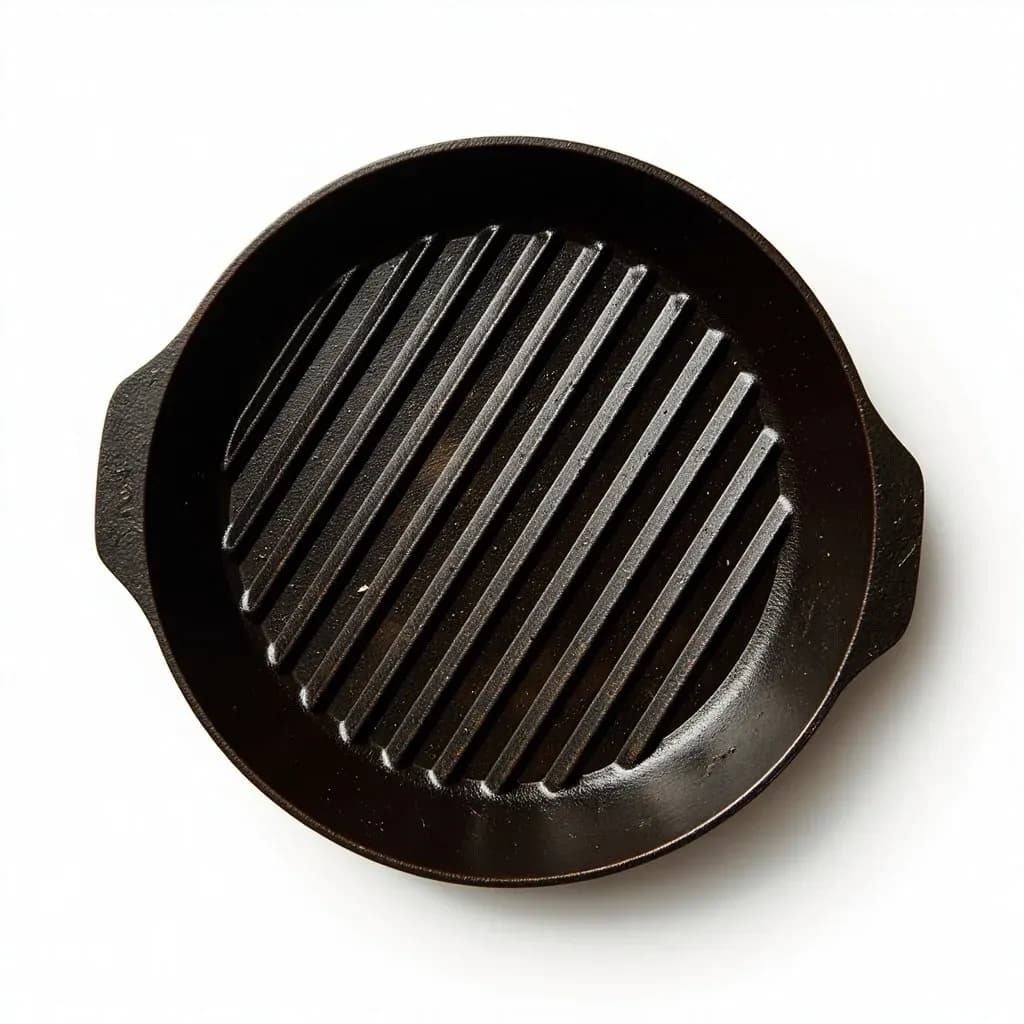
Cast-Iron Grill Pan
Ridged cast-iron pan that gives stovetop sear marks like an outdoor grill.
A cast-iron grill pan has raised ridges that lift food off the surface, creating charred grill marks and letting fat drain away while cooking indoors on the stovetop. It is used for steaks, chops, vegetables, and paninis when an outdoor grill isn't available. Cast iron holds high heat well for a strong sear, and the ridges deliver that grilled look and smoky char.
A cast-iron grill pan is a heavy, ridged skillet that brings the searing power of an outdoor grate to a stovetop or oven. The raised ridges hold the food above rendered fat while the deep channels between them collect drippings, and the dense iron mass keeps the surface hot enough to drive Maillard browning aggressively even when a cold steak hits the metal. The result is the dark, well-defined sear marks that signal a properly grilled piece of meat, plus better drainage than a flat pan can offer for fatty cuts.
The appeal is also the limitation. A grill pan will not give you the smoke and char of wood or charcoal — only browning and the visual signature of the marks — and it produces far more smoke than a flat skillet, so it punishes kitchens without good ventilation. It is at its best in the first 60 to 90 seconds of contact on each side, when the heat transfer and fat drainage matter most. Past that, it loses ground to a flat pan or griddle for anything needing continuous surface contact, like eggs, pancakes, or a sauce.
In practical terms, a grill pan is a specialty tool rather than a daily driver. Bare cast-iron versions demand seasoning and care but reward the cook with decades of service and a superior crust; enameled versions are more forgiving but shallower in their ridges and muted in browning. Either way, mastering the long preheat, oiling the food rather than the pan, and venting smoke aggressively is the difference between a streak-marked steak and a kitchen full of haze.
Alternatives
Types & varieties
The classic stovetop form; least expensive, most versatile, requires seasoning and builds character with use.
Larger flat area across the ridges; better for sandwiches and getting two or three portions on the heat at once.
Coated with porcelain enamel (Le Creuset, Staub); no seasoning required, but the ridges are shallower and browning is muted.
Flat griddle on one side, ridged grill on the other (for example, the Lodge 20 in reversible); doubles as a plancha.
A ridged base paired with a domed or weighted press; the press is heated separately and set on top of the food.
Makers like Finex use shaped bodies with coiled spring handles; often polished to a smoother cooking surface than sand-cast pieces.
A flat cast-iron pan with a low-rib insert that lifts out, easing cleaning and storage.
Heat management
The grill pan's behavior is governed almost entirely by its mass. Cast iron heats slowly, holds heat for a long time, and recovers between batches only after a pause. Most of the disappointment that cooks report comes from skipping the preheat, which leaves the surface unevenly hot and prone to sticking.
- Preheat 5 to 8 minutes on medium-low to medium before adding food; high flame from cold creates hot patches and burnt oil.
- Use the water-dance test: flick a few droplets onto the surface — they should skitter and evaporate in 1 to 2 seconds when ready.
- After the first batch, give the pan 60 to 90 seconds to recover its surface temperature before adding the next.
- Cook in small batches. A pan loaded with cold food drops below searing temperature and the marks go pale and gray.
Seasoning and care
Bare cast iron is not high-maintenance so much as it is finicky about a few specific things. The goal is a thin, polymerized film of oil on the surface that resists rust and keeps food from welding itself to the metal.
- Wash with hot water and a stiff brush or chain-mail scrubber; a small amount of mild dish soap is fine when needed.
- Dry on the burner over low heat, then wipe a barely visible film of high-smoke-point oil (canola, grapeseed, or vegetable) onto the warm surface.
- Never soak, never put in the dishwasher, never leave wet in the sink overnight — all three invite flash rust.
- Re-season by baking a thin oil coat at 450 °F (230 °C) for an hour, upside down on a rack, whenever the surface turns dull, sticky, or develops rust patches.
- Stack with a paper towel, linen pan protector, or cork trivet between pieces so the rim of one pan does not scrape the seasoning off another.
What a grill pan can and cannot replace
A grill pan is a heat-retaining griddle that mimics the contact pattern of an outdoor grate, not the cooking experience of one. It earns its place in the cabinet for the things a flat pan does poorly and steps aside when a flat pan is the better tool.
- Concentrated Maillard browning at the ridge contact points, supported by thermal mass that keeps the surface hot when cold food lands.
- Better fat drainage for bacon, sausages, and fatty cuts, with the rendered fat pooling in the valleys.
- No true smoke flavor, only browning and visual marks — the volatile phenols that taste like a grill come from wood combustion, not from contact with hot metal.
- Worse than a flat pan for eggs, pancakes, tortillas, and any liquid-based cooking where continuous surface contact is needed.
Common uses
Tips & pitfalls
- Preheat thoroughly on medium-low for 5 to 8 minutes before raising the heat; cast iron needs time to even out and rushing is the most common mistake.
- Oil the food, not the pan. Oil pooled in the valleys smokes, polymerizes into a bitter varnish, and makes the surface sticky.
- Use the water-dance test to confirm temperature: flicked droplets should skitter and evaporate in 1 to 2 seconds when the pan is ready.
- Use a metal spatula or a fish spatula. Plastic tools melt against the ridges and the rough surface will strip seasoning regardless.
- Ventilate aggressively. A grill pan produces far more smoke than a flat skillet, so run the hood on high or open a window before the first piece of food goes on.
- Avoid long cooking of acidic ingredients (tomato sauce, wine reductions, lemon braises) in bare cast iron; the acid strips seasoning and can lend a metallic taste.
- Deglaze the valleys with a splash of water or stock while the pan is still hot to lift fond for a quick pan sauce — the ridges hold a surprising amount of flavor.
- If food sticks, the pan is either not hot enough or under-seasoned. Adding more oil to the surface is not the fix; better preheat and a healthier seasoning layer are.
Good to know
- Material
- Cast iron, sand-cast or machined; some versions coated with porcelain enamel.
- Common sizes (round)
- 10 in (25 cm), 12 in (30 cm), and 13 in (33 cm) diameters are standard.
- Common sizes (square)
- 10.5 in and 13.25 in squares; popular for two-zone searing across the ridges.
- Weight
- Roughly 4–8 lb (1.8–3.6 kg) depending on size; a 12 in Lodge square grill pan is about 8 lb.
- Ridge height
- Typically 4–6 mm above the pan floor; channeled valleys catch fat drippings.
- Heat tolerance
- Safe to 500–600 °F (260–315 °C) bare; enameled versions typically rated to about 500 °F.
- Compatible heat sources
- Gas, electric coil, induction, oven, broiler, outdoor grill, and open flame or campfire.
- Preheating time
- 5–8 minutes over medium-low to medium heat for the mass to even out; longer if going to full searing temperature.
- Notable makers
- Lodge (South Pittsburg, TN, est. 1896), Le Creuset and Staub (enameled, France), Smithey Ironware, Field Company, Finex, and Butter Pat.
Also called
cast-iron-grill-pan · grill-pan · griddle-pan · cast-iron-grill
Related

Steamer
Gentle moist heat that keeps vegetables, fish, and dumplings tender

Frying Pan
Shallow sloped pan for frying, sautéing, and quick sears

Saucepan
Tall, straight-sided pot for sauces, grains, and small batches

Sauté Pan
Wide straight-sided pan with room to brown and braise

Dutch Oven
Heavy lidded pot that turns tough cuts tender over hours

Stock Pot
Tall, roomy pot for stocks, pasta, and big-batch cooking

Wok
High-sided bowl pan built for blistering-hot stir-fries

Griddle
Flat, broad surface for pancakes, smash burgers, and breakfast