Cookware
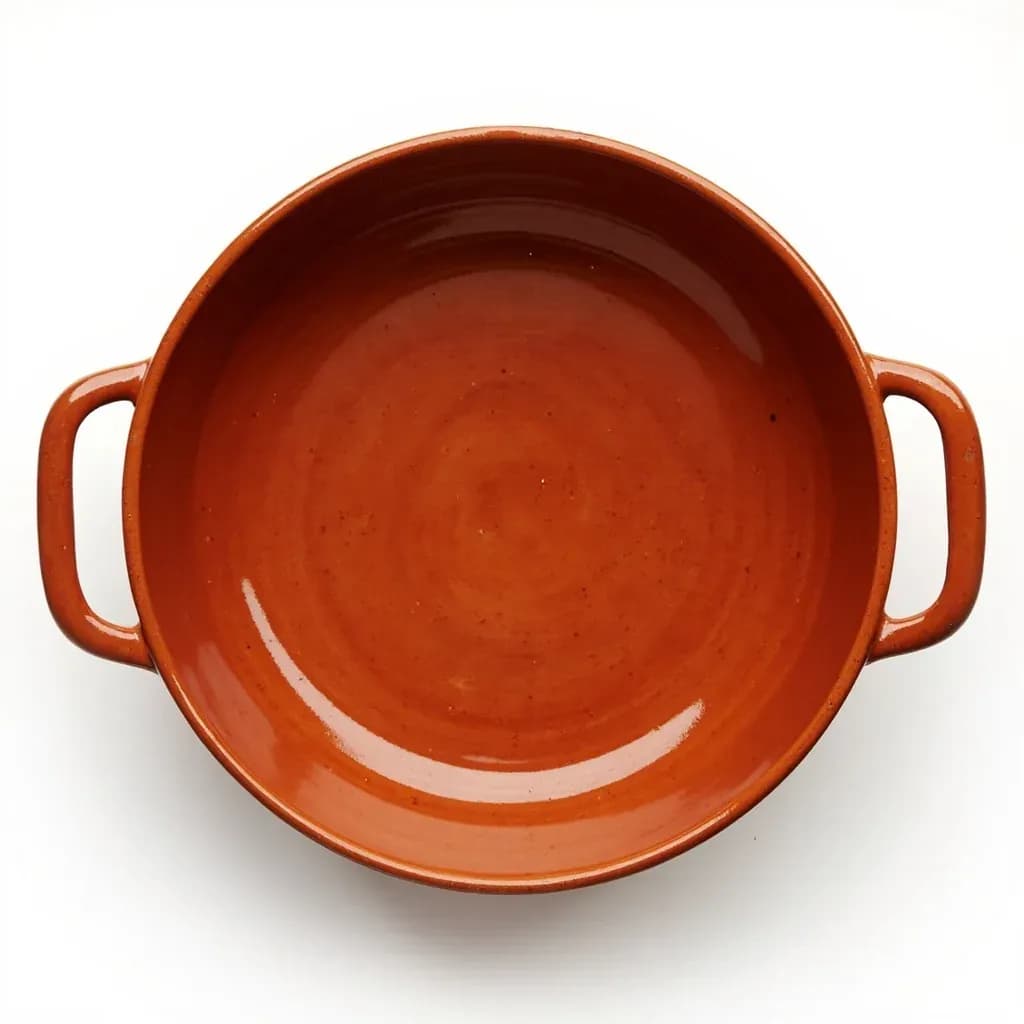
Earthenware Casserole (Cazuela)
Glazed clay dish that holds gentle, even heat for stews, rice, and baked dishes.
A cazuela is a shallow, round glazed-earthenware dish used across Spain and Latin America for slow-cooked stews, baked rice, and table-served dishes. Clay heats slowly and retains warmth well, giving even, gentle cooking and keeping food hot at the table. Similar clay vessels exist worldwide, such as the Japanese donabe and various terracotta pots; most need seasoning and gradual heating to avoid cracking.
The cazuela is a broad, handled clay vessel that has anchored home kitchens from rural Chile to Andalusia for centuries, and it earns its place by doing what no metal pot quite manages: holding heat in a steady, low, even register. Fired from earthenware — a porous, low-fire clay — the dish absorbs thermal energy slowly and releases it gradually through the walls, so a stew simmers with the gentlest possible pulse and a rice finishes without the harsh sizzle that metal conducts. Unglazed pieces (the Chilean greda tradition, for example) breathe slightly, wicking and returning moisture in a way that keeps beans intact and gives slow braises a faint, mineral softness; glazed versions (typical in Mexico and parts of Spain) trade that breathability for an easier, more food-safe surface.
The catch is that earthenware is unforgiving of thermal shock. A cold cazuela dropped onto a flame or slid into a hot oven will crack; an acidic sauce left to bubble dry in unglazed clay will erode the surface and leach off-flavors. A cook who cures the pot on arrival, heats it gradually, and matches it to long, wet, low-heat cooking is rewarded with results that are difficult to replicate in stainless or cast iron. Treat the cazuela less like a workhorse and more like a coopered barrel — a vessel that improves a dish by being itself.
Alternatives
Types & varieties
Unglazed reddish-brown clay from Quinchamalí or Pomaire; the classic pot for cazuela soup, porotos granados, and charquicán
Lead-free glazed earthenware in clear or colored glazes; the workhorse for mole, arroz a la cazuela, frijoles, and salsas; the Oaxacan barro negro is a burnished black-clay subset
Often glazed, low-walled earthenware from Andújar, Bailén, and other Iberian centers; used for gazpacho, salmorejo, migas, and baked shepherd's dishes
Smaller clay bowls fired at lower temperatures; suited to ají sauces, seco, and estofado
Modern reinforced earthenware formulated for direct gas flame, common in Brazil; still benefits from gradual heating and is not the same as old-style unglazed greda
Decorative blue-and-white or multicolored glaze from Puebla and Michoacán; functional but verify lead-free certification before regular food use
Curing a new cazuela
An unglazed cazuela arrives thirsty. The curado — curing — swells the clay particles, closes the surface pores with a thin film of oil, and pre-seasons the walls so they stop sucking flavor (and color) out of the first few dishes. Skip it and the pot may crack on first heat or stain permanently.
- Soak the pot, lid included, in cold water for 12–24 hours so the clay saturates evenly.
- Drain and rub the interior generously with a cut garlic clove dipped in a neutral vegetable oil; the garlic is traditional, but a thin coat of oil alone works.
- Place the oiled pot in a cold oven, set to 180 °C (350 °F), and hold for 30 minutes.
- Turn off the oven and let the cazuela cool fully inside — never pull a hot clay pot into a cool kitchen.
- Repeat the oil-and-oven step once more for a more durable seasoning; glazed pots need only a gentle rinse and a slow warm-up before use.
Heat management
Clay is patient but fragile in the wrong hands. Almost every ruined cazuela in a home kitchen dies from a single moment of thermal shock — a cold pot onto a flame, a hot pot onto a wet counter, an empty pot left over a burner. Build the habit of moving clay as slowly as the food inside.
- Always start a cazuela on a cold or room-temperature burner; bring flame and food up together.
- On the stovetop, sit the pot on a cast-iron diffuser and keep the flame inside the base footprint.
- Add ingredients to a cold or barely warm pot, not to one that has been preheated empty.
- Move the pot from oven to a wooden trivet or dry towel, never a cold stone or marble counter.
- Reserve a 'flame-proof' labeled cazuela if you want direct burner use; ordinary earthenware is an oven-and-diffuser tool.
Common uses
Tips & pitfalls
- Cure an unglazed cazuela before first use: soak 12–24 hours, rub the inside with oil (traditionally via a garlic clove), then bring it up to 180 °C (350 °F) in a cold oven for 30 minutes and let it cool inside.
- Never subject a clay pot to thermal shock — a cold cazuela must not go on a lit flame or into a preheated oven, and a hot one must not go on a cold or wet surface.
- Use a cast-iron heat diffuser on the stovetop unless the pot is explicitly rated 'flame-proof' or 'fogo direto'; keep the flame tucked under the base.
- Add a splash of water or stock when cooking acidic foods (tomato, wine, vinegar, citrus) in unglazed clay; prolonged acidity erodes the surface and can lend a gritty mouthfeel.
- Salt only after liquid is in the pot and the clay is warming; dry salt on raw earthenware draws out moisture unevenly and can pit the surface.
- Use wood or silicone utensils on glazed cazuelas to preserve the seasoning; metal scrapes will eventually expose bare clay beneath the glaze.
- Never heat an empty cazuela — always have liquid, fat, or food in it before any flame or oven warmth is applied.
- If a finished dish tastes earthy, gritty, or dusty, retire the pot: either it was never properly cured, or the glaze has hairline-cracked and is shedding into food.
Good to know
- Material
- Fired earthenware clay; unglazed in Chile, glazed in most of Mexico and much of Spain
- Form
- Round or oval shallow-to-medium bowl with two side handles, often a lid, flat or slightly rounded base
- Typical sizes
- Individual (250–500 ml), medium (1–2 L), family (3–5 L), market pailas up to 8–10 L
- Heat tolerance
- Oven-safe; stovetop only with a heat diffuser unless labeled 'flame-proof' or 'fogo direto'
- Thermal behavior
- Slow heat absorption, steady release; unglazed walls allow slight moisture circulation that keeps food moist
- First use
- Must be cured/seasoned (curado) before cooking to seal pores and prevent cracking or leaching
- Cleaning
- Hand wash with hot water and a brush; no dishwasher; avoid prolonged soaking of unglazed pieces
- Storage
- Store completely dry with the lid ajar in a ventilated cupboard to prevent mold and mustiness
Also called
cazuela · clay-cazuela · cassola · earthenware-casserole · clay-pot · clay-cooking-pot · earthenware-pot · terracotta-pot · donabe
Related

Steamer
Gentle moist heat that keeps vegetables, fish, and dumplings tender

Frying Pan
Shallow sloped pan for frying, sautéing, and quick sears

Saucepan
Tall, straight-sided pot for sauces, grains, and small batches

Sauté Pan
Wide straight-sided pan with room to brown and braise

Dutch Oven
Heavy lidded pot that turns tough cuts tender over hours

Stock Pot
Tall, roomy pot for stocks, pasta, and big-batch cooking

Wok
High-sided bowl pan built for blistering-hot stir-fries

Griddle
Flat, broad surface for pancakes, smash burgers, and breakfast