Cookware
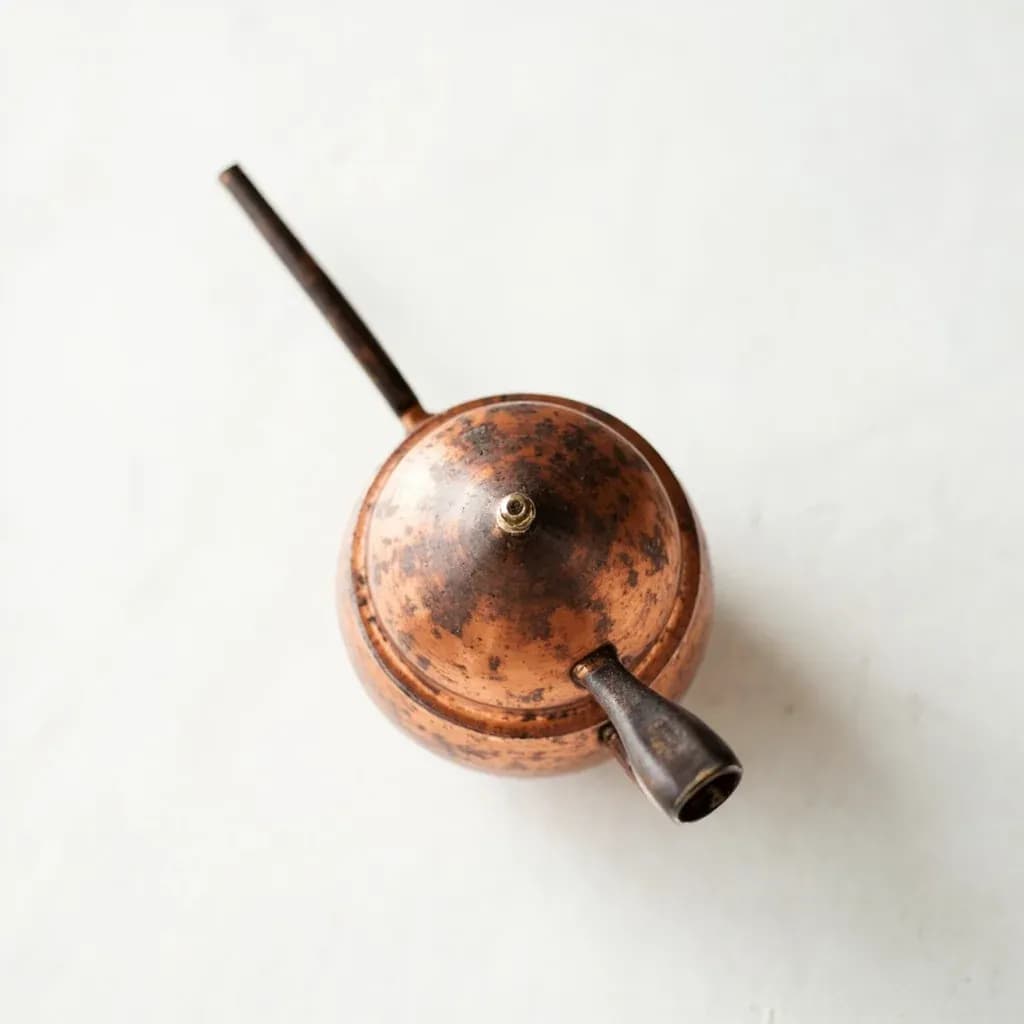
Cezve Coffee Pot
A small long-handled pot for brewing Turkish-style coffee directly on heat.
A cezve is a small, narrow-necked pot with a long handle, traditionally copper or brass, used to brew Turkish and Middle Eastern coffee over a flame or hot sand. Finely ground coffee, water, and sugar are heated slowly so the brew foams up just to the boil, then poured grounds and all into small cups. Regional cousins include the dallah, jebena, and greca, each tied to its own coffee ritual.
The cezve is a small, long-handled pot built for one job: brewing unfiltered, foam-topped coffee directly over low heat. Its silhouette is instantly recognizable — a narrow base flaring outward toward a wide mouth, paired with a handle (usually wood, horn, or plastic) angled slightly upward so the hand stays clear of the flame. That shape is not decorative. The constricted base concentrates heat into a small column of water and grounds, the wide rim gives the rising foam (köpük) somewhere to climb, and the long handle lets the cook pull the pot on and off the heat in seconds. The same vessel is called briki in Greece, rakweh in the Arab world, and džezva across the Balkans — all descendants of the Ottoman coffee pot that has been pouring thick, sweet cups since at least the 16th century.
What distinguishes a cezve from a small saucepan is how it behaves with the grind. Turkish-style coffee is ground to a powder finer than flour, and in a cezve the grounds are never filtered out; they settle into a thick sludge at the bottom of the cup while the liquid above stays aromatic and intensely flavored. That only works if the pot heats slowly and evenly, which is why traditional cezves are copper — the most thermally responsive common metal — with a tin or stainless lining to keep acidic coffee from reacting. Modern stainless, aluminum, and ceramic versions exist, but each trade-off is real: stainless is less responsive, aluminum reacts with coffee, and ceramic is slow to heat. A cezve is also small by design, typically 60–250 ml (one to three fincan cups), because the brew is meant to be made fresh and poured immediately.
Brewing is a performed gesture: cold water, sugar to taste, a heaping teaspoon of grounds per cup, then a slow climb up to a foam rise that the cook interrupts by lifting the pot, spooning foam into waiting cups, and returning the cezve to finish the liquid. Turkish coffee culture and its social practice were inscribed on UNESCO's Intangible Cultural Heritage list in 2013, and the cezve is the physical object at the center of that tradition.
Alternatives
Types & varieties
The traditional choice. Heats quickly and responsively, which is what makes the foam climb cleanly. Buy tinned or stainless-lined — unlined copper is unsafe for acidic coffee over time.
Heavier than copper and holds heat longer; often ornately engraved and tinned inside. A solid, slow-brewing option.
Durable, dishwasher-safe, and the only widely available option for induction. Heats less responsively than copper, so the foam takes longer to form.
Light and inexpensive, common in cafés. Reacts with coffee and is generally avoided by purists; not induction-compatible.
Taller and narrower with a longer handle, designed to be partially buried in a bed of hot sand for exceptionally even, gentle heat.
A close cousin with a slightly rounder belly and a shorter, more upright handle. Used interchangeably for Greek/Turkish-style coffee; functional differences are minor.
Often a dallah-family vessel with a spout and crescent handle, used for cardamom-spiced Arabic coffee. The shape supports pouring, not just brewing.
Decorative modern versions. Slow to heat but good at holding warmth, so they're often used for serving rather than stovetop brewing.
Brewing in the cezve
The cezve's geometry dictates the entire brewing rhythm. Cold water goes in first with sugar to taste, then the powder-fine grounds are added and stirred once. The pot goes on the lowest possible heat — never a rolling boil, which destroys the foam and turns the brew bitter. As the surface darkens and a pale foam gathers, the cook lifts the cezve off the heat just before the foam crests the rim, spoons the foam into the waiting cups, and returns the pot to low heat to finish. This two-stage lift is the single most important move in Turkish coffee, and it's only possible because the cezve has a long handle and a wide mouth.
Choosing and caring for a cezve
Material matters more than looks: copper with a tin or stainless lining is the gold standard; unlined copper is unsafe. Wooden handles should never go in the dishwasher, and the inside of a copper cezve is traditionally rinsed with water only — soap strips the patina that many regulars value. For induction stoves, check for a magnetic base or use a cast-iron diffuser plate; standard copper and aluminum will not work otherwise.
- Size the pot to your usual brew: a cezve should end up about one-third full at the start so the foam has room to rise.
- Look for a handle angled up and away from the rim — it should clear the flame and stay cool enough to grip bare-handed.
- A wider mouth is easier to skim foam from; a narrow spout is easier to pour cleanly into small cups.
- For induction, choose stainless with a magnetic disc base, or use a cast-iron diffuser plate under a copper cezve.
- Re-tin a worn copper cezve at a tinsmith rather than retiring it — the pot is usually the best part.
Common uses
Tips & pitfalls
- Use fresh, cold water for every brew — never start with warm or previously boiled water, which dulls the flavor and weakens the foam.
- Rinse the inside of the cezve with a little cold water and discard it before brewing; this prevents a metallic taste and helps the grounds settle cleanly.
- Add sugar at the start, not the end. The four Turkish styles are sade (none), az şekerli (little), orta (medium), and şekerli (sweet).
- Keep the heat low. A rolling boil collapses the köpük (foam) and makes the coffee bitter and flat.
- Lift the pot off the heat the moment foam begins to rise, spoon the foam into cups, then return the cezve to low heat to finish the liquid — this preserves the prized foam layer.
- Never stir once the foam has formed; agitation disturbs the grounds and breaks the foam's structure.
- Avoid soap on the inside of a traditional copper cezve if you want to preserve the coffee patina — rinse with hot water, dry on the burner, and store open.
- For induction, pick a stainless cezve with a magnetic base, or use a diffuser plate; standard copper and aluminum will not work without one.
Good to know
- Also called
- Cezve (Turkish), briki (Greek, μπρίκι), rakweh (Arabic, راكوة), džezva/dzezva (Bosnian/Serbian), jezve
- Etymology
- From Arabic jadhwa (جذوة), meaning 'ember' or 'live coal' — a reference to the hot coals it was originally heated over
- Origin
- Ottoman-era, 16th–17th century; Turkish coffee culture inscribed on UNESCO's Intangible Cultural Heritage list in 2013
- Traditional material
- Hammered copper, tinned or stainless-lined inside; brass and plain stainless steel are also common
- Typical capacity
- 1 fincan ≈ 60–70 ml; 2 fincan ≈ 130–140 ml; 3 fincan ≈ 200–250 ml; family sizes run to ~700 ml
- Shape
- Narrow base flaring to a wider mouth, with a long handle (wood, horn, or plastic) angled slightly upward
- Grind required
- Powder-fine Turkish grind, finer than espresso — flour-like in texture
- Heat compatibility
- Gas, electric, and traditional sand baths; induction only with a ferromagnetic (magnetic) base or a diffuser plate
Also called
Dzhezve · Xhezve · Dallah · Jebena · Greca · Ibrik · Arabic Coffee Pot
Related

Steamer
Gentle moist heat that keeps vegetables, fish, and dumplings tender

Frying Pan
Shallow sloped pan for frying, sautéing, and quick sears

Saucepan
Tall, straight-sided pot for sauces, grains, and small batches

Sauté Pan
Wide straight-sided pan with room to brown and braise

Dutch Oven
Heavy lidded pot that turns tough cuts tender over hours

Stock Pot
Tall, roomy pot for stocks, pasta, and big-batch cooking

Wok
High-sided bowl pan built for blistering-hot stir-fries

Griddle
Flat, broad surface for pancakes, smash burgers, and breakfast