Cookware
Perforated Chestnut Roasting Pan
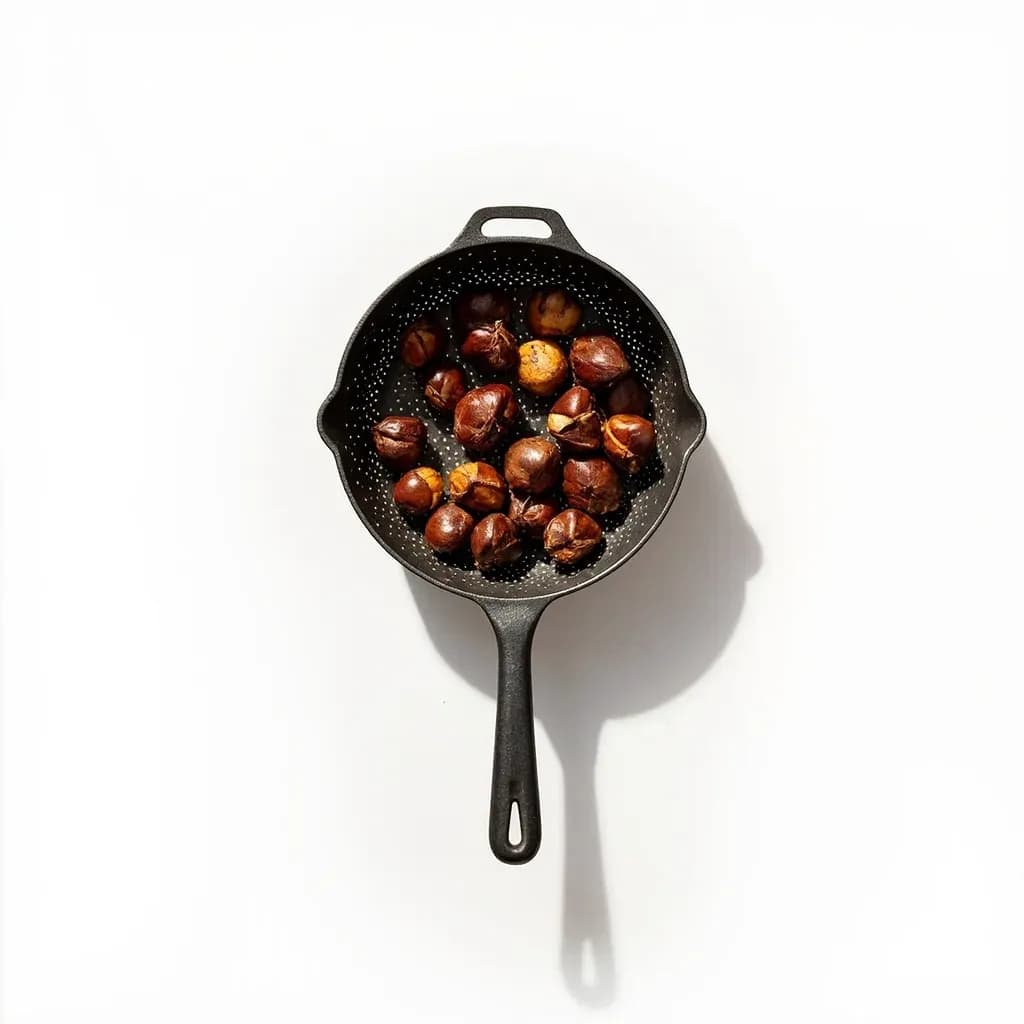
A long-handled pan riddled with holes for roasting chestnuts directly over an open flame.
A chestnut roasting pan is a shallow metal pan, often with a very long handle, whose base is pierced with large holes to let flames and smoke reach the nuts. Scored chestnuts are tossed inside and held over a fire or burner, shaken often so they char and roast evenly. It is a seasonal winter tool common across Europe for street-style roasted chestnuts.
The perforated chestnut roasting pan is purpose-built cookware for one specific job: exposing chestnuts to flame and hot gases rather than trapping them in their own steam. The bottom — drilled with round holes or made from expanded metal mesh — sits the nuts directly over the fire, so the skins char and split while the starchy interior cooks through. A long handle (typically 25–40 cm, often with a wooden grip on a metal shaft) keeps hands a safe distance from the heat source, which on traditional equipment is an open wood fire, a fireplace, or a campfire.
Unlike a cast-iron skillet or a sheet pan in a hot oven, this pan doesn't try to brown the nuts by surrounding them in stored heat. Instead it relies on convection and radiant energy passing upward through the perforations, which is why the body is deliberately thin and the holes are large and numerous. The trade-off is constant attention: the cook must shake or stir the chestnuts every 30–60 seconds, work in a single layer, and use a moderate flame to keep the skins from igniting before the centers are tender. Treated well, a good chestnut pan turns out nuts with crisp, smoky shells and fluffy interiors — the texture that street vendors in Rome, Lyon, and the Cévennes spend all autumn selling.
Most modern pans are made from carbon steel, stainless steel, or aluminized steel and weigh roughly 0.7–1.2 kg; traditional Italian and French examples are simple round disks with a single riveted iron handle. Carbon-steel versions require the same care as a carbon-steel skillet — hand-washing, immediate drying, and a light oiling — but they reward that care with decades of service. Strictly seasonal in much of Europe, where the pan appears in markets from late October through December, it works indoors on a domestic gas burner year-round.
Alternatives
Types & varieties
Round, shallow pan with drilled holes and a long iron handle; the classic Roman and Lazio street-vendor style.
Similar drilled-hole pan, sometimes with a tighter hole pattern; sold fresh each autumn during the marrons season.
Bottom made of woven or expanded metal mesh rather than drilled steel; lighter, transmits flame more aggressively, and browns faster.
Enclosed two-piece design for indoor gas stoves; the perforated domed lid catches stray shell fragments and helps hold heat.
Oversized version with an extra-long or telescoping handle for reaching over a campfire grate or fireplace andirons.
Why the holes matter
The perforation pattern is the entire point of the pan. A solid skillet would trap the moisture that chestnuts release as they heat, creating a humid microclimate that essentially steams the nuts from the inside and leaves them flabby. Holes let water vapor escape the moment it forms, while admitting flame, hot gases, and radiant heat straight up to the shells. The bigger and more numerous the holes, the closer the cooking environment comes to direct exposure — which is why wire-mesh and expanded-metal pans brown faster than drilled-steel ones, but also scorch more readily if the cook isn't paying attention. Round drilled holes are the usual compromise: large enough to vent steam and admit flame, small enough that a chestnut cannot fall through.
Working over fire versus gas
Over a wood fire or campfire the pan sits on a grate and is held out at arm's length; the cook must keep it in constant circular motion to mimic the hand-tossed action of traditional street vendors. Heat is uneven and can spike whenever moisture drips into the coals. Over a domestic gas burner, heat is more controllable but the flame is also more directional, so the pan should be rotated as well as shaken. A medium flame — the burner at roughly half its maximum — is almost always the right starting point. A tall, licking flame scorches the outer shell and the bitter inner pellicle before the starch underneath has had time to soften, so resist the urge to crank the heat up to hurry things along.
- Wood fire or campfire: rely on circular motion, expect hot spots, and use a grate to keep the handle at a comfortable angle.
- Gas burner: use a medium flame and rotate the pan frequently; the lid-equipped indoor version is safest here.
- Avoid high heat in either case — scorched shells mean underdone centers.
- If the shells begin to flare up, pull the pan off the heat for a few seconds and let the flames die down before resuming.
Common uses
Tips & pitfalls
- Score each chestnut with a sharp paring knife before roasting; un-scored nuts build internal steam and will burst with surprising force.
- Toss or shake the pan every 30–60 seconds so the nuts char evenly and don't catch fire on one side.
- Use a medium flame rather than high; a tall licking flame scorches the skins well before the interior cooks through.
- Work in a single layer — piling chestnuts traps steam between them and produces soggy, under-roasted centers.
- Wear an oven mitt on the pan-handle hand; even a wooden grip becomes dangerously hot over an open flame.
- After roasting, wrap the hot chestnuts in a clean tea towel for about 5 minutes; the residual steam loosens the inner pellicle and makes peeling dramatically easier.
- Dry the pan thoroughly on a warm burner right after washing; standing water on carbon steel will flash-rust within hours.
- Season a new carbon-steel chestnut pan with a thin coat of oil before first use, exactly as you would a carbon-steel skillet.
Good to know
- Type
- Specialty cookware for roasting chestnuts over direct flame
- Also called
- Chestnut pan, marrons pan, padella per caldarroste (Italian), poêle à marrons (French)
- Material
- Traditionally wrought iron or black steel; modern versions in carbon steel, stainless steel, or aluminized steel
- Perforations
- Bottom is drilled with round holes or made from expanded metal mesh so flame and hot gases reach the nuts directly
- Typical pan diameter
- 24–30 cm, holding roughly 500 g of chestnuts
- Handle
- Long metal shaft (25–40 cm), often fitted with a wooden grip, to keep the hand away from the flame
- Heat source
- Open fire, fireplace, campfire, or domestic gas burner
- Care
- Hand-wash and dry immediately on the stovetop; not dishwasher safe — carbon-steel versions will rust
Also called
chestnut-roasting-pan · chestnut roaster · chestnut pan · padella forata
Related

Steamer
Gentle moist heat that keeps vegetables, fish, and dumplings tender

Frying Pan
Shallow sloped pan for frying, sautéing, and quick sears

Saucepan
Tall, straight-sided pot for sauces, grains, and small batches

Sauté Pan
Wide straight-sided pan with room to brown and braise

Dutch Oven
Heavy lidded pot that turns tough cuts tender over hours

Stock Pot
Tall, roomy pot for stocks, pasta, and big-batch cooking

Wok
High-sided bowl pan built for blistering-hot stir-fries

Griddle
Flat, broad surface for pancakes, smash burgers, and breakfast