Cookware
Coconut-Shell Puttu Mould (Chiratta)
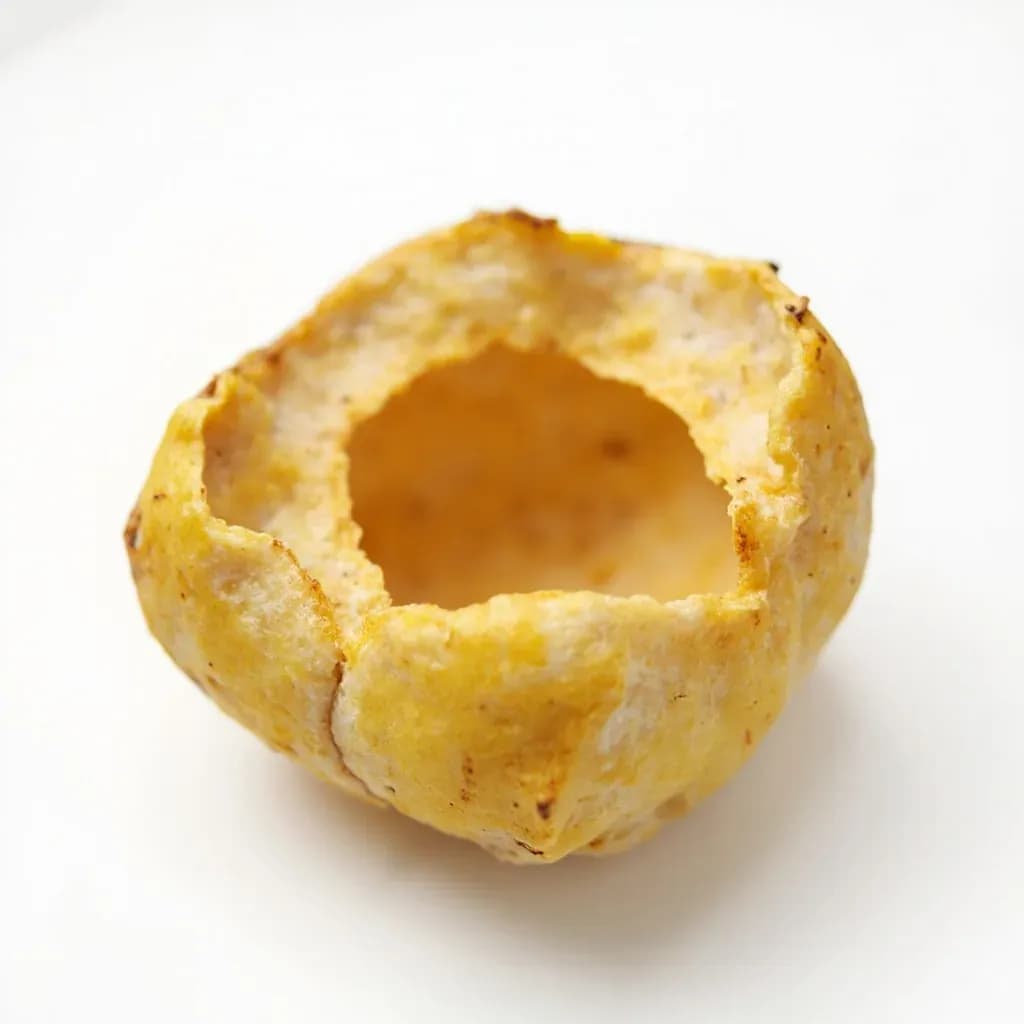
A coconut-shell steamer mould for cooking the Kerala rice cake puttu in a rounded shape.
A chiratta is a hollowed coconut shell with a small hole, used as a steaming mould for puttu, a layered rice-and-coconut cake from Kerala. The shell is packed with the rice flour mixture and set over a steaming pot so the cake takes its rounded form. The coconut shell adds a faint aroma and gives the traditional half-sphere shape distinct from the cylindrical metal puttu maker.
The chiratta is the most traditional form of puttu mould: a hollowed coconut shell, perforated at its rounded base, used in Kerala kitchens to steam small single-serving rice cakes. In a region where the coconut palm furnishes oil, milk, water, flesh and fibre all from one tree, the shell itself became cookware — trimmed of its husk, cleaned of meat and fibre, and punched with steam holes. The result is a one-handed cylindrical mould about 12–15 cm tall whose naturally domed bottom gives Kerala puttu its signature humped silhouette, quite different from the long straight log produced by a metal puttu kutti.
In use, the chiratta works on the same principle as any puttu steamer: moistened rice flour is layered with grated coconut, steam rises through the holes at the base, and the cake cooks from below while a tight lid traps the heat. The shell is not just a passive container — being a natural material it warms through and contributes a faint, toasted-coconut aroma to whatever is steamed inside, something steel and brass cannot replicate. It is, however, single-serving cookware: a family breakfast means running several shells in rotation in the steamer, or steaming them in batches of two or three at a time.
The appeal today is twofold. For Keralites who grew up with it, the chiratta carries the flavour and texture of ancestral home cooking; for new cooks, it represents an almost zero-waste piece of equipment that, once cracked, goes straight to the compost. There is no maker's mark and no standard size — every shell is a little different, and that variability is part of the point.
Alternatives
Types & varieties
Modern cylindrical metal version, typically holds 3–4 servings as one long log
Heavier traditional metal variant, used in temple and Brahmin households for ritual cooking
Coconut-shell mould fitted with a screw-press lid that compresses the flour and pushes the cooked cake out cleanly
Why a coconut shell works so well
A coconut shell is, by accident of botany, almost an ideal small steaming vessel. Its walls are thick and fibrous, so it tolerates repeated contact with steam without warping. Its base is naturally domed, which both sheds condensed water away from the food and gives puttu its characteristic rounded foot. The perforated base, once punched, behaves much like the slotted disc inside a commercial puttu maker. Because every shell is a different size, cooks quickly learn to read their own mould — how much flour fits, how long the steam takes — and that small adjustment is part of working with the tool.
- The shell's thickness buffers heat, so the cake cooks gently from below without scorching.
- The domed base sheds condensate away from the flour, keeping layers distinct rather than soggy.
- Every shell is a different size, so cooks learn to read their own mould rather than follow a fixed recipe.
Care, drying and end of life
The chiratta is fragile only in one way: it cannot tolerate being stored damp. Coconut shell is lignified plant tissue, and trapped moisture invites mould and rot long before it causes cracking. A few minutes in strong sun after every wash is enough. When a shell eventually splits — usually across the narrow waist — there is nothing to repair; it goes into the compost or the cookfire. That brevity is part of its character: a mould that does its job for a season and then returns to the soil.
- Always sun-dry immediately after washing, inside and out.
- Store in an airy place, never in a closed cupboard while still warm.
- Cracked shells make excellent small planters, herb pots or seedling starters.
- A shell that has gone soft or fuzzy inside should be retired — the mould will taint food.
Common uses
Tips & pitfalls
- Punch the steam holes from the inside out so the burr faces the flour side — smooth side down prevents rice granules from clogging the holes.
- Keep hole diameter small (about 1.5–2 mm); larger holes let wet rice flour fall straight through into the boiling water below.
- Always begin with grated coconut over the holes: it acts as a plug that stops flour from sifting down while still letting steam through.
- Do not press or tamp the flour down hard — gentle layering keeps the cake light and crumbly, the way Kerala puttu is meant to be.
- Keep the steamer water level well below the base and bring it to a full boil before setting the chiratta in, or splashing water will soggy the bottom layer.
- When unmoulding, tap the open end sharply on a plate; if the puttu sticks, the holes are probably blocked with over-wet flour or missing coconut plug.
- Dry the shell thoroughly in the sun after every use and store in a dry, airy place; trapped moisture turns the inner fibres mouldy and ruins the next cake.
- Lightly oiling the inside helps the puttu release cleanly, but skip the oil if you want the dry, traditional crumbly texture — for sweet puttu served with banana, the ungreased version is preferred.
Good to know
- Material
- Hollowed coconut shell (Cocos nucifera), traditionally with husk trimmed close
- Origin
- Kerala, South India — a coconut-growing region where the shell was a free by-product
- Base
- Perforated with small steam holes, traditionally punched with a heated nail
- Shape
- Cylindrical body with a domed base formed by the natural curve of the shell
- Capacity
- One single-serving puttu, noticeably smaller than a metal mould
- Heat source
- Steam from a separate pot of boiling water; works on wood-fired stoves, clay hearths (aduppu), or modern gas hobs
- Finish
- Untreated — washed and sun-dried, no lacquer, lining or coating
- Lifespan
- Months to over a year if dried thoroughly between uses; eventually dries out and cracks
- Eco profile
- Biodegradable, zero-waste, repurposes a shell that would otherwise be discarded
Also called
chiratta-puttu-mould · Chiratta · coconut shell puttu mould
Related

Steamer
Gentle moist heat that keeps vegetables, fish, and dumplings tender

Frying Pan
Shallow sloped pan for frying, sautéing, and quick sears

Saucepan
Tall, straight-sided pot for sauces, grains, and small batches

Sauté Pan
Wide straight-sided pan with room to brown and braise

Dutch Oven
Heavy lidded pot that turns tough cuts tender over hours

Stock Pot
Tall, roomy pot for stocks, pasta, and big-batch cooking

Wok
High-sided bowl pan built for blistering-hot stir-fries

Griddle
Flat, broad surface for pancakes, smash burgers, and breakfast