Baking & Pastry
Pasta Guitar (Chitarra)
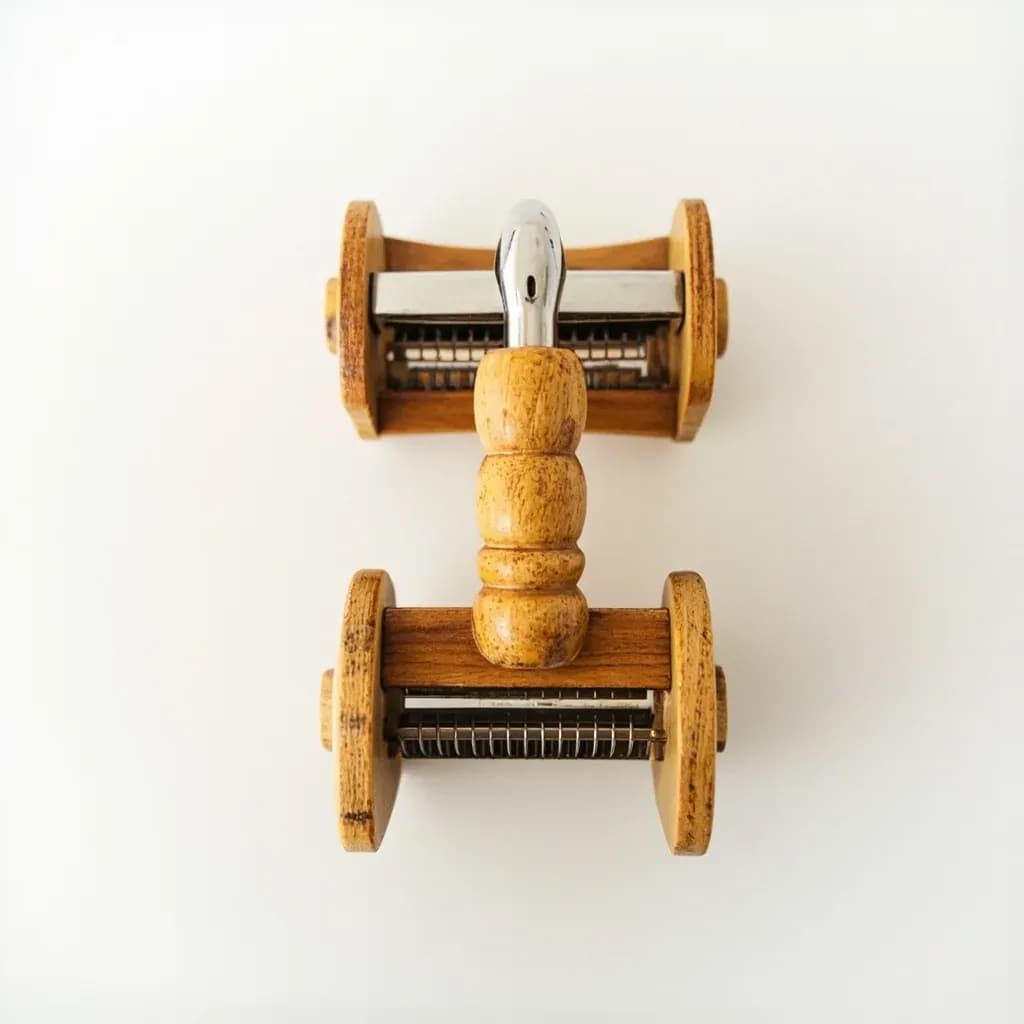
A wooden frame strung with steel wires that cuts rolled dough into square-cut fresh pasta.
A chitarra is a rectangular wooden frame strung with taut steel wires, named for its resemblance to a guitar. A sheet of pasta dough is laid across the strings and pressed through with a rolling pin, cutting it into uniform square-edged strands like spaghetti alla chitarra or tonnarelli. The same wire-frame principle is also used by confectioners to cut slabs of ganache and pâte de fruit.
The chitarra — Italian for "guitar" — is a rectangular hardwood frame strung head-to-head with parallel steel wires, used to cut a thin sheet of fresh pasta into uniform, square-cross-section strands. The name comes from the visual resemblance to a stringed instrument, with taut metal wires standing in for strings. You lay a rolled sheet of egg-and-semolina dough across the wires and press it through with a rolling pin; the wires slice the dough cleanly, and the cut strands fall away beneath the frame. It is the defining tool of the Abruzzo region, where the pasta it produces is known as maccheroni alla chitarra.
What makes chitarra-cut pasta distinctive is its texture. Because the strands are sliced, not extruded, they have slightly rough, irregular edges and a square profile rather than the smooth, round bore of bronze-die maccheroni. Those edges grip sauce in a way that smooth, flat, or round pasta cannot, and the open, slightly porous cross-section absorbs fat and liquid more readily. A well-made chitarra strand is firm but tender when cooked for just a minute or two, with a noticeable chew from the semolina.
For a home cook, the chitarra is the fastest way to produce large quantities of uniform fresh pasta once you have rolled the sheet. It is not, however, a universal pasta tool: it is essentially a regional specialty, and the dough it is designed for — no water, just eggs and a mix of '00' flour and durum semolina — differs from the softer northern egg-pasta doughs used for tagliatelle or ravioli.
Alternatives
Types & varieties
Wooden frame with stainless-steel wires spaced around 2 mm apart — the standard for maccheroni alla chitarra.
Tighter wire spacing (about 1 mm) producing thinner strands closer to tagliolini in weight.
Wider spacing (3–4 mm) for thick, robust strands suited to long-cooked meat ragùs.
Stainless-steel frames favored in restaurant kitchens for durability and sanitation; cuts identically to a wooden one.
Larger frames with longer wires, designed to be rested on a work surface for high-volume production.
The Abruzzese Context
The chitarra is inseparable from the food of Abruzzo, and that context dictates how the pasta it makes is used. Abruzzese cooking is rural, pastoral, and built around lamb, pork, and sheep's-milk cheese; sauces for chitarra are nearly always meat-based, most famously a slow-cooked pork or lamb ragù, or a soup of tiny meatballs — polpettine in brodo — served with the pasta. Butter is not traditional; the fat in this region is olive oil, often from the local groves that line the Adriatic hills. Even a simple tomato or grana sauce for chitarra in its home region will be built on good olive oil rather than northern butter.
Two textural rules follow. The first is that the sauce must be thick enough to cling to the rough, square strands — a watery broth is fine for the meatball soup, but a thin pan sauce will slide off. The second is that the pasta must be served the moment it is cooked, dressed immediately, and eaten at once; the thin square strands cool and clump faster than flat egg pasta, and they do not benefit from resting in the pan.
Choosing and Setting Up a Chitarra
If you are buying a chitarra, look first at the wires: they should be taut, evenly spaced, and the same diameter end to end. Loose or bent wires are the most common defect on secondhand or imported wooden frames, and they are what produces torn, ragged strands during pressing. The wood should be close-grained and dry, with no warping across the face; a twisted frame will not sit flat on the counter and the pressure will be uneven.
Before a session, dust the wires lightly with semolina — never with '00' flour, which clogs. A small dry brush is the easiest way to clean the wires between pressings. If a wire does lose tension over time, most wooden chitarras can be re-strung by removing one end peg, threading fresh stainless-steel wire (musical-instrument or hobby wire of the same gauge), and tensioning it with pliers before re-seating the peg.
Dough and Sheet
A classic chitarra dough is often built on a 50/50 blend of '00' flour and durum semolina, hydrated entirely with eggs — typically one whole egg plus one yolk per 100 g of combined flour. The semolina gives the strands their characteristic yellow color and firm bite; the '00' keeps the dough pliable enough to roll thin without tearing. The dough should be kneaded until smooth but not developed into an elastic mass; a short rest of 30 minutes wrapped in plastic relaxes the gluten so the sheet rolls evenly.
Roll the sheet to about 1–2 mm — thick enough to hold a square cross-section after cutting, thin enough to feed through the wires without jamming. Cut the sheet to the exact width of the frame (or slightly narrower) so the strands fall cleanly through rather than bunching on the wires. Press immediately; a sheet that sits on the counter for more than a few minutes begins to dry on the surface and the wires will tear rather than slice it.
Common uses
Tips & pitfalls
- Dust the wires with semolina before pressing, not flour — flour clogs between the wires and leaves a powdery, sauce-repellent coating on the strands.
- Roll the dough sheet to a true 1–2 mm. A thicker sheet jams between the wires and crushes; a thinner sheet tears and produces broken strands.
- Trim the sheet to the width of the frame. Overhanging dough bunches on the wires and the cut becomes uneven.
- Press the sheet through immediately after rolling. If the surface dries the wires will tear rather than slice the dough, and you will have to reroll.
- Use a smooth wooden rolling pin and press with firm, even pressure. The offcut — the leftover lace of dough left on top of the wires — should lift away cleanly; if it sticks, your dough is too wet or your wires are under-tensioned.
- Keep the wires taut. A loose wire produces ragged, broken strands; restring or replace a wire that has lost tension rather than working around it.
- Salt the cooking water generously (about 10 g per liter) and cook the pasta for only 1–3 minutes. Fresh egg-and-semolina chitarra is done the moment it floats and softens — overcooking turns it gummy.
- Cook immediately or dry fully. Partially dried chitarra turns gummy on the second cook; either use it within the hour or dry it on a rack until brittle for storage.
- Hand-wash and dry the frame; never soak the wood or the wire tension will be lost and the frame may warp.
Good to know
- Origin
- Abruzzo, central Italy, especially the province of Chieti; documented from at least the 18th century.
- Construction
- Hardwood frame (commonly beech, walnut, or oak) strung with parallel stainless-steel wires; brass wires appear on some older or artisan models.
- Wire Spacing
- Standard about 2 mm between wires, producing strands roughly 2 mm square; finer and wider spacings exist for different cuts.
- Pasta Produced
- Square-cross-section strands about 1–2 mm thick with slightly rough, sauce-grabbing edges.
- Dough
- Traditionally durum-wheat semolina and eggs with no added water; many recipes blend in '00' flour, often in roughly equal measure with the semolina.
- Local Names
- In Abruzzese dialect the tool is also called a tajarill or tajariell; the pasta it produces is known as maccheroni alla chitarra.
- Cooking Time
- 1–3 minutes in heavily salted boiling water; cook straight from pressing or fully dried.
- Portion
- One pressed sheet yields roughly 150–200 g of fresh pasta.
- Care
- Hand-wash and dry; never soak the wood, which will warp and loosen the wires.
Also called
chitarra-pasta-cutter · Chocolate Guitar Cutter · Guitar Cutter · Pasta Guitar
Related

Muffin Pan
Multi-cup pan for muffins, cupcakes, and egg bites

Bundt Pan
Fluted ring mold for showstopping cakes with a center hole

Springform Pan
Latch-release pan that frees delicate cakes without flipping

Pie Dish
Sloped round dish for crisp-bottomed pies and quiches

Tart Pan
Fluted pan with a pop-out base for clean-edged tarts

Rolling Pin
Rolls dough into even sheets for pastry and bread

Pastry Brush
Brushes on egg wash, glaze, butter, and marinades

Bench Scraper
Flat blade that divides dough and clears your work surface