Knives & Cutting
Coconut Splitter / Machete (Veetukathi)
A heavy blade or machete used to crack open and split whole coconuts cleanly.
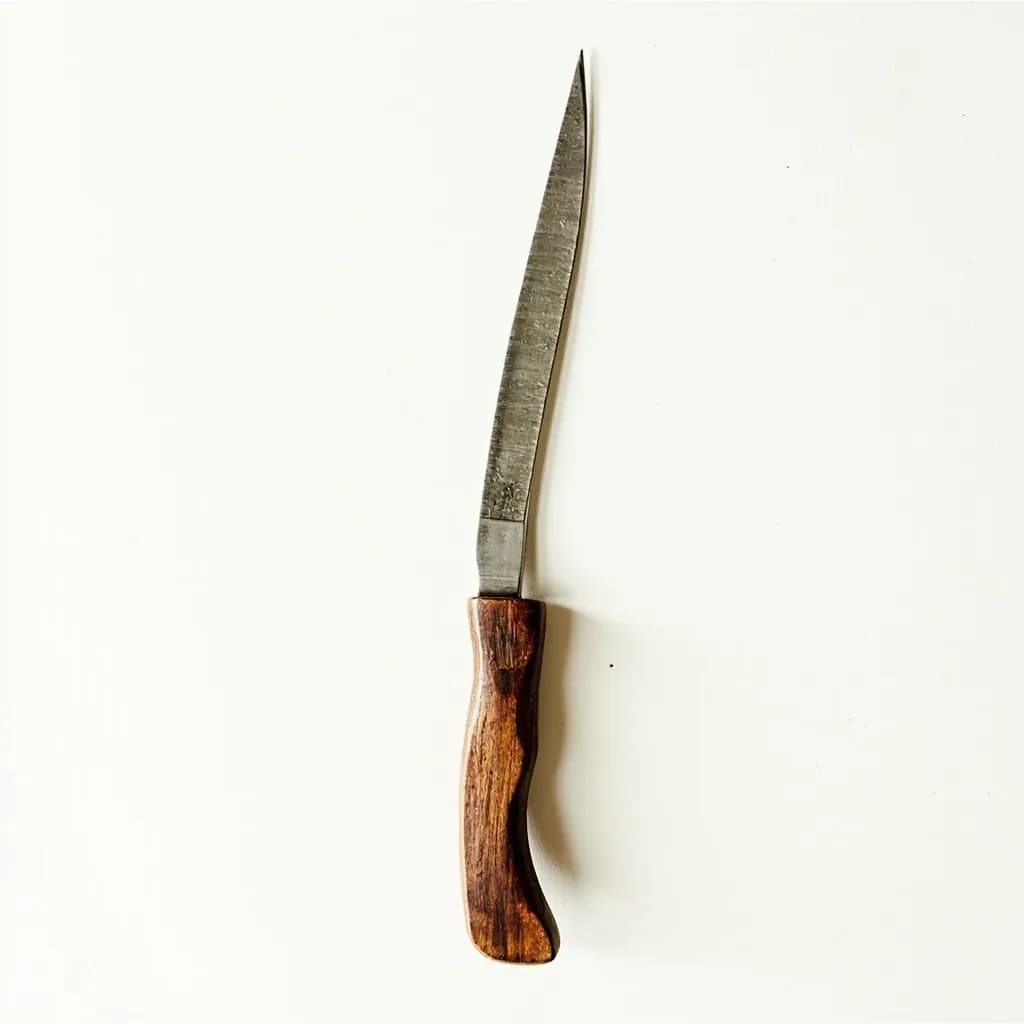
A coconut splitter is a stout, heavy-bladed knife or machete used to hack through a mature coconut's hard husk and shell. In South Indian kitchens the veetukathi, a curved blade fixed to a base, lets the cook chop and split with one hand. The weight of the blade does the work, breaking the coconut into halves for scraping or water extraction.
The vettukathi — literally 'cutting knife' in Tamil, from vettu (to cleave) and kathi (blade) — is the heavy, single-purpose machete that has opened coconuts in South Indian kitchens for generations. It is not a slicer; it is a controlled impact tool. Its thick spine, broad blade, and considerable mass are designed so that gravity, guided by a short overhead stroke, does the work of parting the husk and shell in one clean line. In Tamil Nadu, Kerala, and parts of Karnataka and Andhra Pradesh, where mature coconut is the foundational fat, milk, and cooking liquid of the regional cuisine, the vettukathi is the household tool dedicated to breaking it open reliably — the same blade is then pressed into service for jackfruit, ash gourd, pumpkin, and blocks of jaggery.
What separates the vettukathi from a cleaver or a Latin-American machete is its edge philosophy. The bevel is modest and the spine is left thick on purpose, because a razor edge chips the moment it meets a coconut shell. The tool relies on momentum, not keenness, and that momentum is what produces a clean split rather than a shattered shell that scatters fragments into the flesh. A modern home-cook 'coconut splitter' that mimics the shape but loses the weight is the most common reason beginners end up with a smashed, splintered coconut and a chipped blade.
Used correctly — held on a wooden block, struck along the equator where the shell is thinnest, with the blade allowed to fall rather than swung — a vettukathi opens a mature coconut in a single stroke with almost no effort. Used carelessly, it is the most dangerous tool in a traditional South Indian kitchen, more so than a chef's knife, because the combination of weight, length, and swing arc leaves little room for error.
Alternatives
Types & varieties
The classic broad, heavy-bladed form found in Tamil homes and teashops; balanced for a single overhead strike and the standard against which other versions are judged.
A lighter regional variant, often with a slightly curved edge; common in Kerala kitchens where it doubles as a jackfruit and gourd breaker.
Curved-tip machete form preferred in some coastal regions; the hooked nose levers the husk apart after the initial cut.
Sturdier mass-produced commercial version sold in South Indian utensil markets (Chennai's Pothys Junction, Kochi's Broadway); rectangular blade with a flat spine suited to repeated heavy use.
Why weight beats sharpness
A common mistake when buying a vettukathi is to choose the thinnest, shiniest blade on the shelf on the assumption that sharper means better. The opposite is true. A fine edge concentrates force on a hairline that crushes and chips the moment it meets coconut shell. The traditional vettukathi profile — a thick spine, a broad face, and the mass of the blade falling behind the edge — converts the strike into a sustained wedge of pressure along a line, and the shell parts along its grain rather than shattering. That is also why experienced users sharpen lightly on a coarse stone and stop well before a polished edge: the tool needs a working edge, not a razor, and over-sharpening invites chips.
- A heavier blade produces cleaner halves because momentum parts the shell along its grain instead of shattering it.
- Carbon steel holds up best under repeated impact; high-carbon stainless is easier to maintain in humid coastal kitchens.
- Avoid 'thin profile' home-use splitters — they look like a vettukathi but lack the mass to part shell in one stroke.
Reading the coconut
A coconut is not uniform. The three 'eyes' at one end are softer than the surrounding shell, and the equator — the widest line around the middle — is the thinnest part of the husk-and-shell sandwich. Striking along that equator, roughly halfway between the eyes and the opposite pole, gives the blade the path of least resistance and the highest chance of a clean two-piece split. Striking near the pole or directly over an eye drives the blade into the thickest, most irregular shell and tends to splinter it. Experienced cooks also drain the water first when they want clean, dry halves, because a full coconut on impact splashes unpredictably and the internal pressure can crack the kernel.
- Target the equator — the widest circumference — where shell is thinnest.
- Keep the cut line well clear of the three 'eyes'.
- Drain tender coconuts before splitting if you want clean, unbroken halves.
Care in a humid kitchen
Coastal South Indian kitchens are punishing on carbon steel: salt air, daily washing, and monsoon humidity will rust an unprotected vettukathi within a day. Wipe the blade dry the moment washing is done, then pass a thin film of food-safe oil (coconut oil is the traditional choice and the obvious one) along the face and spine before storage. Store on a magnetic strip with the edge clear, or in a wooden sheath — never loose in a drawer where the edge contacts other steel. A light rub on a coarse stone every few weeks keeps the working edge true; full sharpening is rarely needed in the tool's lifetime.
- Rinse, dry, and oil after every use — carbon steel will rust overnight in coastal humidity.
- Magnetic strip or sheath storage prevents edge contact with other utensils.
- Touch up lightly on a coarse stone; do not over-polish, which thins the impact edge.
Common uses
Tips & pitfalls
- Let the blade's weight do the work — lift and let it fall; do not swing with force, which shatters the shell.
- Aim for the equator of the coconut where the shell is thinnest and the three 'eyes' are farthest from the cut line.
- Work on a stable wooden chopping block; never strike a coconut resting on a glass or bare stone countertop.
- Keep the non-dominant hand clear of the swing arc; if steadying the coconut, tuck the thumb behind the fingers in a claw grip.
- Drain the coconut water first when you want two clean halves — a full coconut on impact splashes unpredictably and can crack the kernel.
- Sharpen lightly on a coarse stone; an overly keen edge chips under impact and is the most common beginner mistake.
- Wipe carbon-steel blades with a thin coat of food-safe oil after washing to prevent rust in humid coastal climates.
- Never use the spine to strike food the blade is resting on — a splintered spine ruins the tool and scatters shell fragments.
- Store out of reach of children; the combination of length and weight makes the vettukathi the most dangerous tool in a traditional South Indian kitchen.
Good to know
- Also known as
- Vettukathi, Vettu Kathi, Veetukatha, Coconut Machete, Coconut Cleaver
- Origin
- South India — Tamil Nadu, Kerala, parts of Karnataka and Andhra Pradesh
- Typical blade length
- 20–35 cm (8–14 in), broader and thicker than a chef's knife
- Blade material
- Carbon steel or high-carbon stainless steel
- Handle
- Seasoned hardwood (often rosewood), frequently full-tang and riveted
- Edge geometry
- Thick spine, modest bevel; built to absorb impact, not to slice
- Skill level
- Intermediate — requires controlled striking technique and safe handling
- Care
- Hand-wash, dry immediately, oil carbon-steel blades; store sheath-protected on a magnetic strip or in a dry drawer
Also called
Veetukathi · coconut machete · coconut cleaver
Related

Knife
The fundamental cutting tool every kitchen is built around

Chef's Knife
The do-everything blade for chopping, slicing, and mincing

Paring Knife
Small, nimble blade for peeling and detailed in-hand work

Serrated Knife
Saw-toothed blade that slices crusty bread without crushing

Cleaver
Heavy broad blade for chopping through bone and bulk prep

Cutting Board
The stable surface every cut starts on

Mandoline
Adjustable blade for paper-thin, perfectly even slices

Kitchen Shears
Heavy-duty scissors for poultry, herbs, and packaging