Knives & Cutting
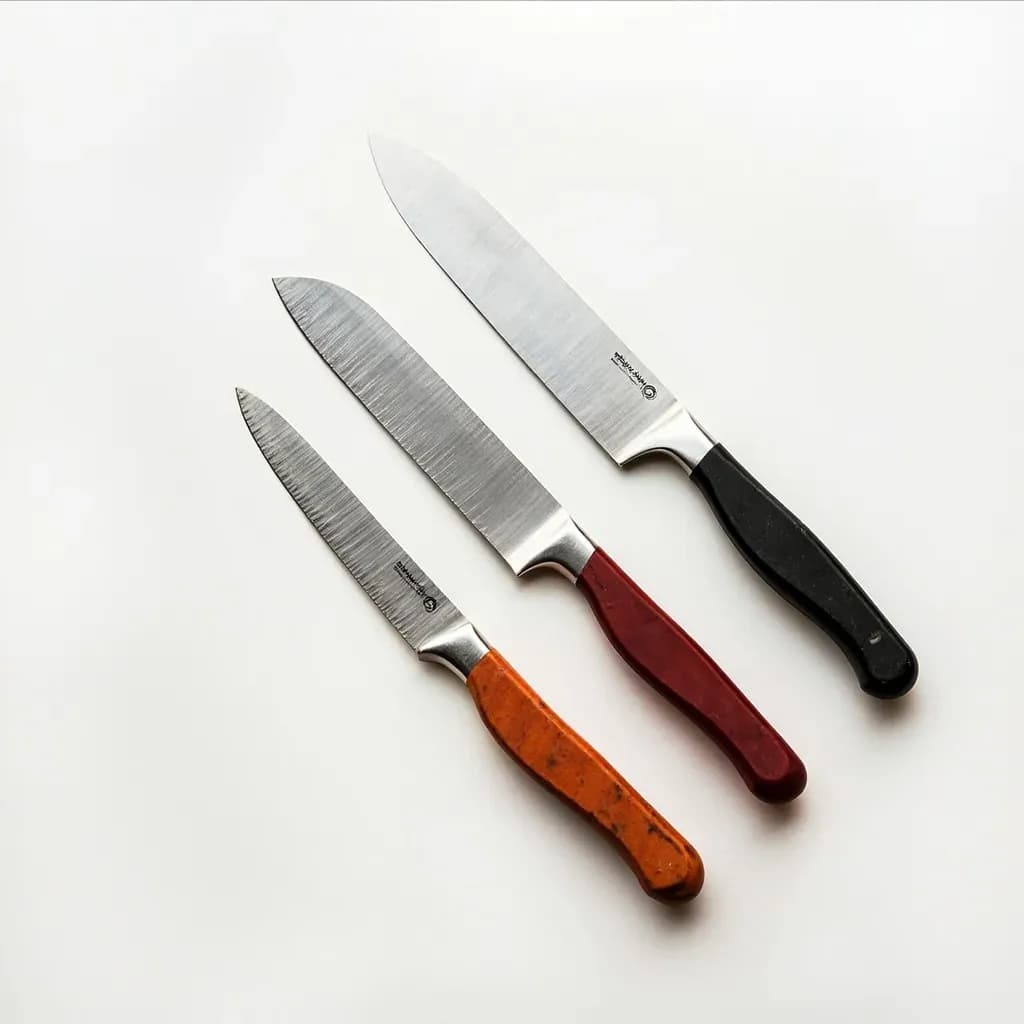
Color-Coded Knife Set
Knives with colored handles assigned to food types to prevent cross-contamination.
A color-coded knife set gives each knife a colored handle tied to a specific food category, mirroring the color-coded cutting board system to stop cross-contamination. Cooks reserve, for example, the red knife for raw meat and the green for vegetables. The scheme is widely used in commercial kitchens following food-safety protocols.
A color-coded knife set is less a product than a system: a matched group of otherwise ordinary kitchen knives whose polypropylene or santoprene handles are molded in distinct, saturated colors. Each color is assigned to a food category, and the cook reaches for the handle that matches the task. The blades are typically mid-grade workhorses—high-carbon stainless steel, with the same grinds and edge geometry found on any decent chef's or paring knife. The innovation is visual rather than metallurgical: a glance tells a cook, a manager, and a health inspector exactly which tool has touched what.
The scheme is rooted in HACCP (Hazard Analysis and Critical Control Points), the food-safety framework developed in the late 1950s and 1960s by Pillsbury, NASA, and the U.S. Army Natick Laboratories. In a busy commercial kitchen—where one line cook may break down a chicken, slice tomatoes, and portion cheese within the same hour—a single slip means pathogens travel. Color coding makes the correct choice the obvious one, the only reliable way to remove memory and training shortcuts from the equation. The system is now embedded in most national food-safety codes and is a near-universal expectation during health-department inspections of restaurants, schools, hospitals, and catering operations.
Outside professional settings, the same logic applies to home cooks managing food allergies, raw-meat separation, or households where more than one person cooks. Smaller retail sets (often three or four colors) work well for a family kitchen; full seven-color HACCP kits suit anyone wanting to bring restaurant discipline home. Because the color is a convention rather than a universal law, any kitchen adopting the system should post its specific chart somewhere visible—a printed card on the wall beats collective memory every time.
Alternatives
Types & varieties
The most widely adopted scheme in U.S. commercial kitchens, covering raw meat, poultry, seafood, produce, dairy, cooked food, and allergen-isolated prep.
Some jurisdictions and brands use different palettes—green may mean cooked meat rather than produce, and brown may be assigned to vegetables. UK NHS catering and Australian food-safety guides both diverge from the U.S. norm.
Smaller consumer kits, often red/yellow/green/blue, marketed for household cross-contamination control.
A dedicated color reserved for prep for guests with declared nut, gluten, or dairy allergies; increasingly common in school and event catering.
Matched knife-handle and cutting-board colors sold as a pair, enforcing station consistency by tying tools and surfaces to the same color.
Setting Up a Color Chart
Before the first knife leaves its box, the kitchen needs a written, posted chart that names every color in use and the food category it covers. Most U.S. operations adopt the seven-color HACCP palette without modification, but a small operation may need only three or four. The rule is that everyone in the kitchen—full-time, part-time, and dishwasher—can recite the chart from memory. A laminated card taped inside the prep-area door, plus color stickers on the knife rack, removes ambiguity for new hires and auditors alike.
- Post the chart where it is visible from the prep station, not buried in a manager's binder.
- Train every new cook on the chart before they are allowed to cut anything.
- If your facility uses a non-standard scheme, note the deviation prominently so visiting inspectors and borrowed staff do not grab the wrong knife.
Pairing Knives with Cutting Boards
Color is only half the system. A red knife on a green board defeats the entire purpose, because the board becomes a vector for whatever the knife carried. The strongest implementation pairs each knife color with a same-color cutting board, stored together on a labeled wall rack or in a dedicated slot. NSF-certified color-coded boards are widely available and inexpensive; buying them in matched sets is cheaper in the long run than replacing mismatched pieces one at a time.
When to Retire a Color-Coded Knife
Color-coded handles have a finite life. Polypropylene fades under commercial-dishwasher heat and bleach, santoprene softens and cracks with age, and rubberized grips can split where they meet the tang. A faded or cracked handle is a failure of the system, not a cosmetic problem—the visual signal is gone. Replace the knife immediately, and rotate stock so a single dulled or chipped edge is not allowed to linger on a station just because no one noticed.
Common uses
Tips & pitfalls
- Train every staff member on your specific color chart before they touch a knife—schemes vary between facilities, and a borrowed cook from another kitchen may default to a different convention.
- Color is a visual aid, not a substitute for washing: still sanitize blades between tasks within the same color group, especially when switching between raw proteins and ready-to-eat produce.
- Replace any knife whose handle has cracked, faded, or lost its texture—once the color dulls, the system stops working and you have a regular knife in a colored costume.
- Pair each color knife with a same-color cutting board and store them together; a red knife on a green board is a contamination event waiting to happen.
- Hand-wash rather than run through commercial dishwashers; the high heat and harsh detergents degrade polypropylene handles and dull edges faster than normal.
- Store knives on a magnetic strip, in color-coded sleeves, or in dedicated slots—never loose in a drawer where handles scuff against each other and colors blur together.
- Buy enough pieces in each color that you never feel tempted to grab the wrong knife because the right one is dirty, being sharpened, or in the dish pit.
- Check local health codes before assigning colors—some jurisdictions mandate specific mappings (for example, yellow for poultry in many U.S. states), while others leave the choice to the operator.
Good to know
- Primary purpose
- Cross-contamination prevention in commercial and institutional kitchens
- Handle materials
- Polypropylene, santoprene, or textured rubber molded over the blade tang
- Typical blade steel
- High-carbon stainless steel, often X50CrMoV15 (DIN 1.4116)
- Standard color set (U.S. HACCP)
- Red, yellow, blue, green, white, brown, purple
- Color convention
- Red = raw red meat; Yellow = raw poultry; Blue = raw fish/seafood; Green = produce; White = dairy/bread or general; Brown = cooked meat or root vegetables; Purple = allergens
- Originating system
- HACCP, developed in the late 1950s–1960s by Pillsbury, NASA, and the U.S. Army Natick Laboratories
- Relevant standards
- NSF/ANSI 2 for food equipment, plus most local health-department HACCP rules
- Care
- Hand-wash and sanitize; commercial dishwashers fade handle color and damage edges
- Typical price range
- Sets roughly $40–$300 USD depending on brand and piece count
Also called
HACCP Knife Set · Colour-Coded Knives
Related

Knife
The fundamental cutting tool every kitchen is built around

Chef's Knife
The do-everything blade for chopping, slicing, and mincing

Paring Knife
Small, nimble blade for peeling and detailed in-hand work

Serrated Knife
Saw-toothed blade that slices crusty bread without crushing

Cleaver
Heavy broad blade for chopping through bone and bulk prep

Cutting Board
The stable surface every cut starts on

Mandoline
Adjustable blade for paper-thin, perfectly even slices

Kitchen Shears
Heavy-duty scissors for poultry, herbs, and packaging