Cookware
Continuous Brew Vessel
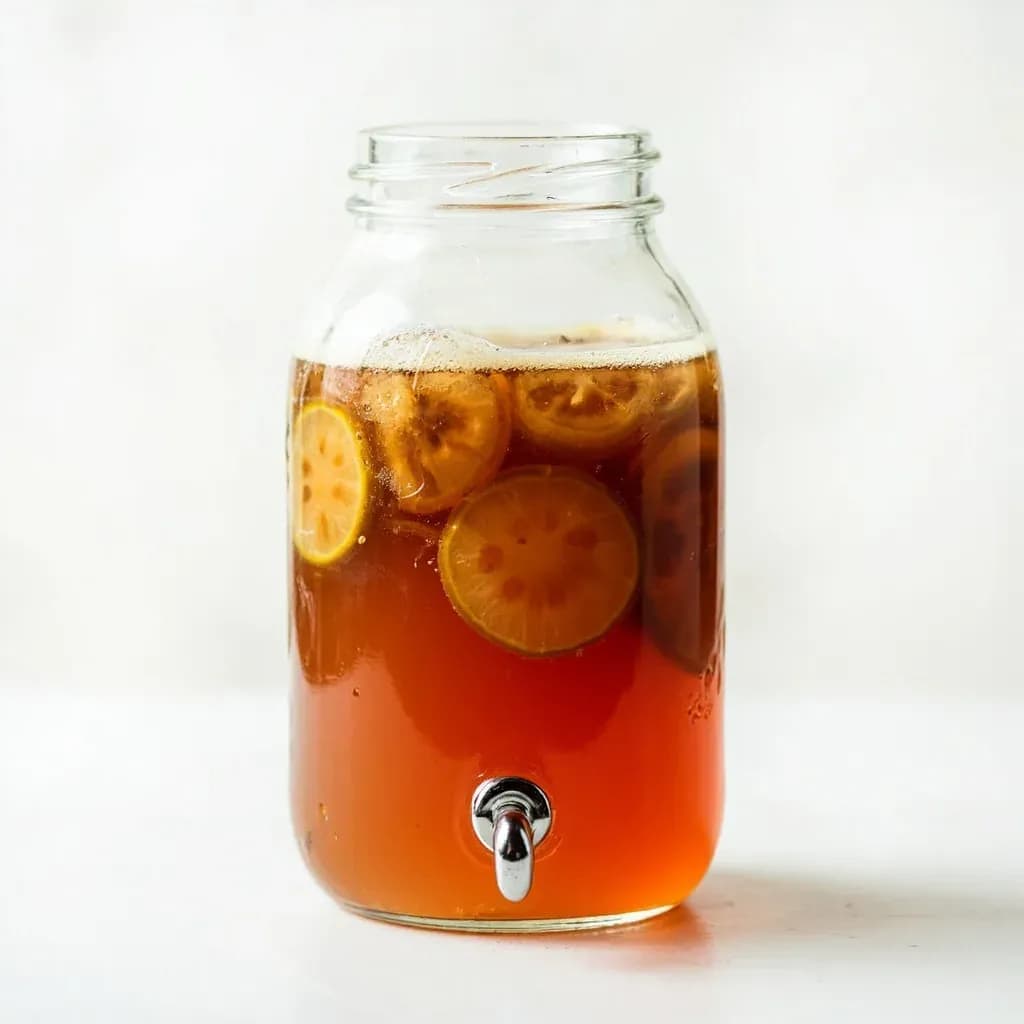
A spigoted jar for continuously brewing kombucha or other ferments without fully emptying it.
A continuous brew vessel is a large jar or crock fitted with a bottom spigot, used for ongoing fermentation of kombucha, water kefir, or vinegar. You draw finished liquid from the tap and top the vessel back up with fresh sweet tea, keeping the SCOBY and culture continuously active. The design reduces handling and contamination risk compared to repeated batch transfers.
A continuous brew vessel is a small, deliberately simple bioreactor built for long-running surface-pellicle ferments such as kombucha, jun, water kefir, and homemade vinegar. In its most common form it is a food-grade glass jar (clear or amber) fitted with a spigot a couple of inches above the bottom, a wide mouth to accept a growing SCOBY, and a breathable cloth cover secured with a band. The defining feature is the spigot, which lets you draw finished liquid off the working volume without disturbing the culture below.
What makes the system 'continuous' is the reserve: rather than brewing a discrete batch, fermenting it to completion, and starting over, you keep 10–20% of finished, acidic liquid in the vessel at all times and top the rest back up with fresh sweet tea. That leftover starter keeps the pH low and the culture stable, so each refill is essentially inoculated before fermentation even begins. Draws typically happen every 7–14 days, sized to temperature and how tart you like the result; pH (around 3.0–3.2) and taste — not the calendar — are the real signals that a brew is ready.
The continuous method trades a little ongoing tinkering for a far more consistent product than batch brewing, and most failures — mold blooms, off-flavors, stalled ferments — trace back to a short, repeatable list of mistakes: sealing the cover airtight, leaving the vessel in direct sun, using a non-food-grade spigot, or topping up with tea that is still hot. Because the draw comes off the settled liquid, the result is usually flat or only lightly effervescent and benefits from a short secondary conditioning in sealed bottles for natural carbonation.
Alternatives
Types & varieties
The most common and affordable form; usually 2–3 gallon bail- or screw-top jars with a 1/2" nylon spigot installed through a drilled hole.
Premium option with a metal ball valve; more durable but requires careful assembly to avoid cracking the glass.
Naturally opaque to block light; heavier and more traditional-looking, often modeled on water-dispenser crocks.
Larger commercial-style vessels (5–15 gallons) with welded sanitary fittings; favored by small kombucha producers.
Wide-mouth designs make SCOBY removal and hand-cleaning easier; narrow-mouth vessels lose less CO2 and admit fewer dust particles.
Some vessels include a fine mesh basket or filter at the spigot to keep yeast strands and SCOBY bits out of the draw.
How continuous brewing actually works
The reserve is the entire system. By keeping 10–20% of finished, acidic kombucha in the vessel, you guarantee that the new sweet tea you pour in lands in a low-pH environment that already has an active culture of bacteria and yeast. The brew is therefore protected from the contamination window that plagues first-generation batches, and fermentation kicks off within hours rather than days. As you draw liquid through the spigot, you deplete the working volume; as you add fresh sweet tea to refill it, you feed the culture. Over time the SCOBY and the pellicle adjust to the steady-state environment, and the flavor profile becomes remarkably consistent from draw to draw — a uniformity batch brewing rarely achieves.
- Draw no more than 50% of the working volume at a time; larger draws drop the pH and the population too aggressively.
- Refill with sweet tea that has cooled to room temperature or below; hot tea can kill the culture and crack glass vessels from thermal shock.
- Use the same ratio of sugar and tea each time you refill so the culture isn't recalibrating to a new recipe every week.
Choosing and installing the spigot
The spigot is the only mechanical part, and it is the part most likely to fail, leak, or leach. Choose one explicitly rated for food and for acidic liquids; generic hardware-store valves can off-gas or corrode. Plastic (nylon) spigots are forgiving to install — drill a clean hole, seat the spigot with a rubber gasket, and tighten the nut by hand. Stainless ball-valve spigots are more durable but unforgiving: the glass must be drilled cleanly and the fittings torqued evenly or the jar will crack.
- Position the spigot 1–2 inches above the true bottom so the yeast-and-sediment layer is not drawn into your glass.
- Wrap a piece of fine mesh or a small stainless screen inside the spigot inlet to catch stray SCOBY strands if your vessel doesn't have a built-in strainer.
- After every draw, squirt a small amount of kombucha through the spigot into a cup and pour it back in — this keeps the channel acidic and clear.
Troubleshooting the most common problems
Almost every issue with a continuous brewer has a known cause. Sweetness that won't fade usually means the room is too cold or the draw cycle is too short for the temperature. A sour, vinegary result means the opposite — the brew has been sitting too long, or the working volume is too small relative to the culture. Mold on the surface is rare in a healthy continuous system and almost always points to either a contaminated cover, fruit flies, or topping up with hot tea that killed part of the culture.
- If fermentation stalls, check temperature first, then confirm the starter reserve is still acidic (pH below 3.5).
- If the SCOBY grows thick enough to block the spigot opening, peel off the bottom layers and reserve them for new batches.
- If the kombucha smells yeasty or bready, the brew is under-acidic — shorten the draw cycle or add more starter reserve next refill.
Common uses
Tips & pitfalls
- Always order a food-grade spigot rated for acidic liquids; cheap hardware-store valves can leach flavors or corrode.
- Mark a fill line on the outside of the vessel with tape so each refill returns to the same working volume, keeping the culture's environment consistent.
- Replace the cloth cover and rubber band each time you refill — a damp cover is a mold and fruit-fly magnet.
- Reserve excess SCOBY layers peeled from a healthy vessel to start new batches or share with other brewers.
- Keep the vessel out of direct sunlight; UV degrades the culture and encourages off-flavors.
- Decant off the spigot into sealed bottles and let them sit at room temperature 2–4 days for natural carbonation, since the continuous draw itself is nearly flat.
Good to know
- Typical material
- Food-grade glass (clear or amber); ceramic and stainless steel are also available
- Spigot material
- Food-grade nylon/plastic or stainless steel ball valve, rated for acidic liquids
- Common capacities
- 1, 2, 3, and 5 gallons for home use; commercial sizes up to 15+ gallons
- Working volume
- Fill to roughly 80% to leave headspace for the SCOBY pellicle and CO2
- Starter reserve
- Leave 10–20% of finished kombucha in the vessel when topping up with fresh sweet tea
- Cover
- Breathable woven cloth (flour-sack towel, coffee filter, or tight-weave cotton) secured with a band — never airtight
- Optimal temperature
- 68–85°F (20–29°C); fermentation slows markedly below 65°F
- Spigot position
- Set 1–2 inches above the true bottom so settled yeast and sediment stay in the vessel
- Target pH of finished brew
- 2.5–3.5; most pull when pH is around 3.0–3.2 for balanced sweet/tart flavor
- Cleaning cycle
- Full empty-and-scrub every 1–3 months; the spigot should be flushed with finished kombucha after every draw
Also called
Continuous Brew Vessel (with Spigot) · kombucha brewer · spigot jar
Related

Steamer
Gentle moist heat that keeps vegetables, fish, and dumplings tender

Frying Pan
Shallow sloped pan for frying, sautéing, and quick sears

Saucepan
Tall, straight-sided pot for sauces, grains, and small batches

Sauté Pan
Wide straight-sided pan with room to brown and braise

Dutch Oven
Heavy lidded pot that turns tough cuts tender over hours

Stock Pot
Tall, roomy pot for stocks, pasta, and big-batch cooking

Wok
High-sided bowl pan built for blistering-hot stir-fries

Griddle
Flat, broad surface for pancakes, smash burgers, and breakfast