Cookware
Copper Jam Pan
A wide, flared copper pan for fast, even boiling of fruit and sugar into jams and jellies.
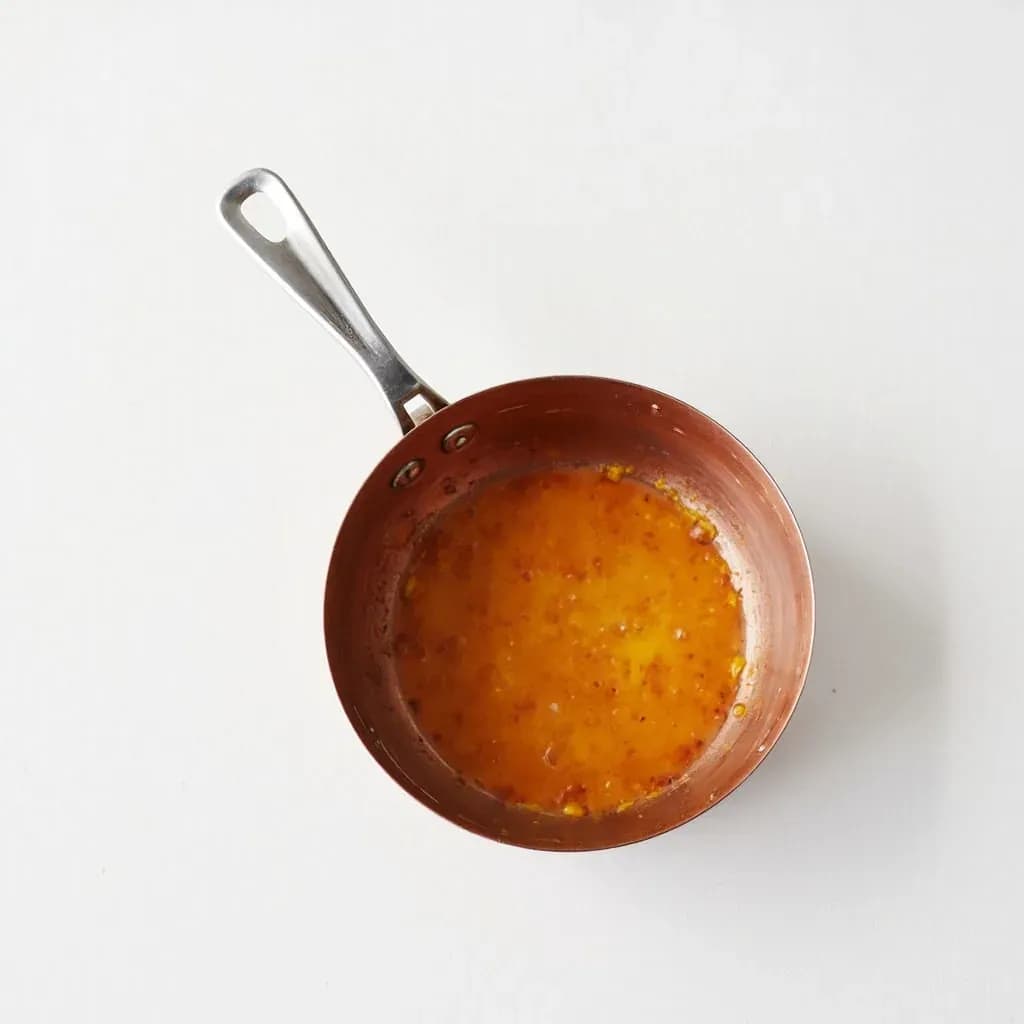
A copper jam pan is a wide, shallow, outward-flaring pan whose unlined copper conducts heat rapidly and evenly. The broad surface speeds evaporation so fruit and sugar reach a set quickly, preserving bright color and flavor, while the high sloped sides allow vigorous boiling without overflow. Copper's reactivity is also said to help pectin set the preserve.
A copper jam pan is a wide, shallow preserving pan built specifically for boiling fruit and sugar down to a set. The geometry does as much work as the metal: a broad base and gently flared sides maximize surface area so water escapes quickly, which is what drives the gel structure of a jam or the clarity of a jelly. Sides are kept low — typically 12–18 cm — because the pan needs to hold a rolling boil without towering foam.
The metal matters because sugar work punishes anything that heats unevenly. Copper conducts heat roughly twenty times faster than stainless steel, so when you turn the burner down or up, the entire base responds within seconds. Hot spots that would scorch a fruit-and-sugar mass simply do not develop, which is why the pan has been the standard in European preserving kitchens for centuries.
A copper jam pan is never used unlined: bare copper reacts with the malic, citric, and tartaric acids in fruit to produce metallic-tasting, unsafe food. Traditional pans are lined with tin, which is non-reactive and supremely responsive but soft; modern pans are often lined with stainless steel, which is tougher and dishwasher-safe at the cost of a little responsiveness.
Alternatives
Types & varieties
Conical or tulip-shaped with sloping sides, usually tin-lined; the Mauviel and Matfer archetype.
Slightly deeper and more cylindrical than the French style, almost always with two side handles; a tall narrow version is called a jelly kettle.
Traditional and the most heat-responsive; soft enough to mark under metal utensils and needs re-tinning every few years under heavy use.
Modern, durable, dishwasher-safe; a touch less responsive than tin but far more forgiving for everyday preserving.
Thicker copper with visible planishing marks; resists warping and heats the most evenly — the standard for serious sugar work.
Smaller pans (≤5 L) often have one long handle; larger pans carry two loop or riveted handles for two-handed lifting.
Many French models have an integrated 'bec' on the rim for decanting into sterilized jars without dripping.
Why copper, and why a wide shallow shape
Jam and jelly making is fundamentally a race against water. You are boiling off roughly 30–40 percent of the starting weight of a fruit-and-sugar mix to reach the soluble-solids concentration where pectin sets, around 65 percent by weight. The faster that water leaves, the brighter the fruit color, the fresher the flavor, and the higher the pectin yield. A wide pan gives the liquid more exposed surface and therefore more evaporative area per minute.
Copper earns its place because it spreads flame energy across the base almost instantly. When you turn a burner down to keep a boil from climbing the sides, a stainless pan lags — the centre keeps cooking while the edge cools. Copper flattens that lag so the whole mass tracks one temperature. That same responsiveness is why confectioners reach for copper sugar pans and why a copper jam pan is still the tool of choice in competition preserving.
Lining and care
The lining is the pan's working surface and it is what makes a copper jam pan safe for acidic fruit. Tin has been the traditional choice for centuries because it is non-reactive, food-safe, and adds almost no thermal resistance. The trade-off is that tin is soft: a careless whisk or a steel spoon will score it, and over years of acidic work the layer thins and exposes copper beneath. A coppersmith can re-tin a pan, and serious preservers consider it routine maintenance.
Stainless-steel linings eliminate re-tinning and shrug off metal utensils, at the cost of a marginally slower response. Outside the kitchen, the copper itself needs only hand-washing and immediate drying to stay bright; a pass with a commercial copper cleaner every few uses keeps tarnish and verdigris from developing, especially in humid climates.
- Never use an unlined copper pan for fruit, tomatoes, vinegar, or wine — acid strips copper into the food.
- Re-tin when you see bright copper patches showing through the grey tin layer.
- Hand-wash and towel-dry; dishwashers and prolonged soaking pit the copper and dull the lining.
- Polish the exterior with a salt-and-vinegar paste or a dedicated copper cleaner to keep the shine.
Common uses
Tips & pitfalls
- Fill the pan no more than one-third full at the start — fruit foams dramatically as it boils, and a jam pan that boils over is a serious safety hazard because molten sugar clings and burns.
- Use medium heat, not high. Copper is so conductive that a fierce flame scorches the fruit at the base before the centre even reaches a simmer.
- Stir with a long-handled wooden spoon or heat-safe silicone; metal tools mark or scratch a tin lining and accelerate the need for re-tinning.
- Add sugar gradually once the fruit has released its juice; dumping cold sugar in all at once drops the temperature and lengthens the cook.
- Test for set with a chilled saucer (the wrinkle test) or a digital thermometer aimed at 105–105.5 °C / 220–222 °F for most jams.
- Skim foam with a slotted spoon in the last few minutes for a clearer, glossier preserve.
- Set a trivet under the pan on a glass cooktop to avoid thermal shock, and lift rather than slide — copper scratches ceramic surfaces easily.
- If the tin lining shows bright copper patches, stop using the pan for acidic work and have it re-tinned before the next batch.
Good to know
- Material
- Solid copper, typically 1.5–3 mm thick
- Lining
- Tin (traditional) or stainless steel (modern)
- Typical diameter
- 24–32 cm (9–13 in) at the rim
- Typical capacity
- 4–9 L; home cooks usually choose 5–7 L
- Thermal conductivity
- Copper ≈ 400 W/m·K, about 20× that of stainless steel
- Handles
- Riveted cast iron or stainless steel; bronze or brass on higher-end French pans
- Weight (7 L, 2.5 mm)
- Roughly 2.5–3.5 kg empty
- Induction compatibility
- Not induction-ready unless a stainless-steel disc is bonded to the base
Also called
copper-jam-pan · copper-cazo · Jam Pan · Preserving Pan · Maslin Pan
Related

Steamer
Gentle moist heat that keeps vegetables, fish, and dumplings tender

Frying Pan
Shallow sloped pan for frying, sautéing, and quick sears

Saucepan
Tall, straight-sided pot for sauces, grains, and small batches

Sauté Pan
Wide straight-sided pan with room to brown and braise

Dutch Oven
Heavy lidded pot that turns tough cuts tender over hours

Stock Pot
Tall, roomy pot for stocks, pasta, and big-batch cooking

Wok
High-sided bowl pan built for blistering-hot stir-fries

Griddle
Flat, broad surface for pancakes, smash burgers, and breakfast