Cookware
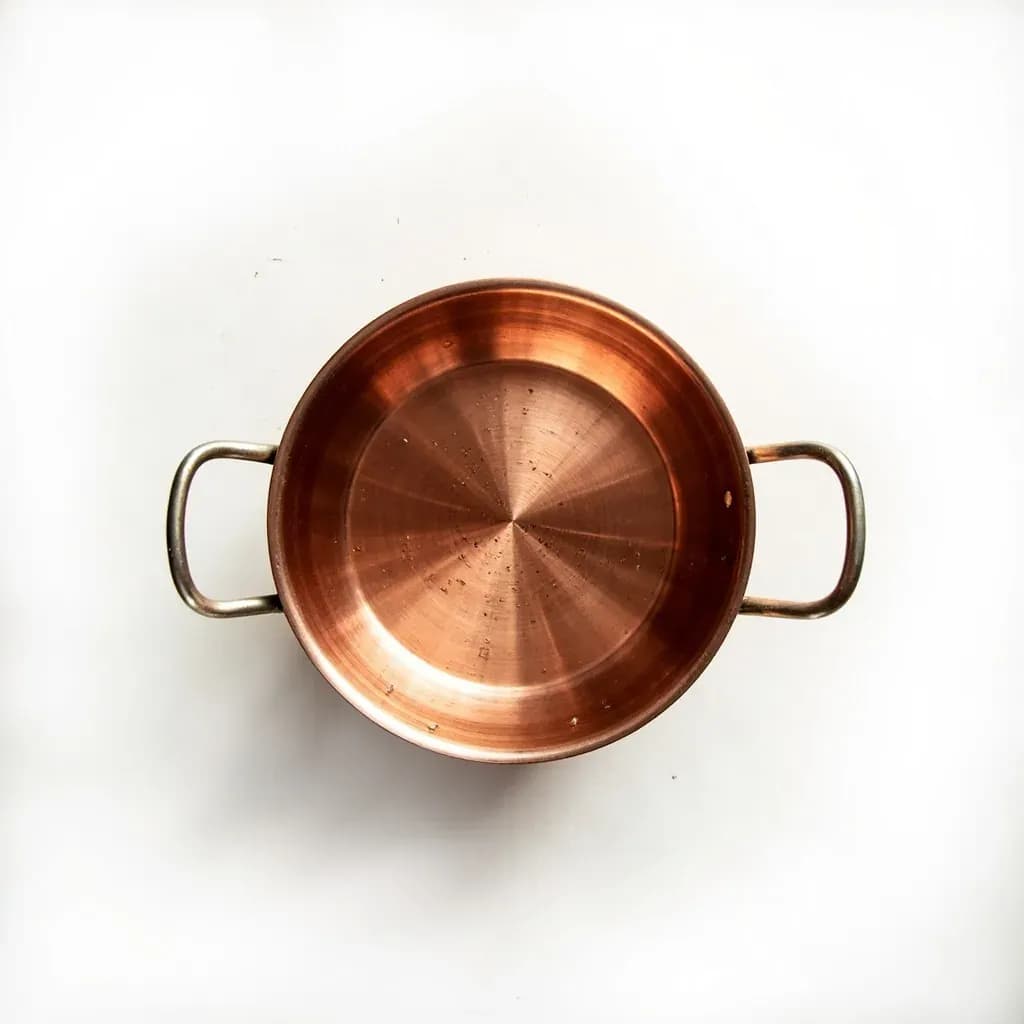
Copper Pot
A pot made of highly conductive copper prized for fast, even, responsive heating.
A copper pot is cookware made from copper, the most thermally responsive common metal, giving cooks precise control over heat changes. It is favored for delicate work like sauces, sugar work, and jam, where temperature swings must be caught instantly. Most are lined with tin or stainless steel since bare copper reacts with acidic foods, though unlined copper is still used for beating egg whites and boiling sugar.
A copper pot is cookware formed from nearly pure copper sheet, almost always lined with a non-reactive metal — traditionally hand-tinned, today often stainless-clad — so that food never touches the copper itself. Its defining virtue is thermal conductivity of roughly 401 W/m·K, the highest of any cookware metal in common kitchen use, about 20–25 times that of stainless steel and roughly 1.7 times that of aluminum. That means copper heats rapidly, spreads heat evenly across the base and up the side walls, and most importantly responds to burner changes within seconds: turn the flame down and the pan cools almost as quickly as it heated, which is exactly what you want when an emulsion is on the edge of breaking or a caramel is two seconds from scorching.
The cookware as we know it was refined in 18th- and 19th-century France, particularly in Villedieu-les-Poêles in Normandy, the historic capital of copper work since the 1700s. The classic form is heavy-gauge copper — 2.5 to 3 mm for saucepans, thicker still for larger vessels — hand-tinned inside and fitted with a cast iron handle, though modern professional lines now use riveted bronze or stainless. Restaurants prize copper for sauce and sugar work precisely because of its snap response; home cooks tend to fall for the looks as much as the performance.
The trade-off is real maintenance. Tin linings must be renewed every decade or so by a specialist, exteriors tarnish and need occasional polishing, and nothing goes in the dishwasher. Treated well, a set of French copper passes from one generation to the next; neglected, it warps, pits, and loses its lining in a few short years.
Alternatives
Types & varieties
Traditional French interior. Most responsive to heat, with a faintly nonstick quality, but soft — avoid metal utensils and overheating. Must be retinned periodically.
Modern, durable alternative to tin. Easier to maintain and dishwasher-tolerant on most models, but slightly less thermally responsive because of the lower-conductivity layer.
Used only for non-reactive, non-aqueous work: sugar cooking, caramel, jam, chocolate, beating egg whites, and brief wine reductions. Never for acidic or salty foods.
Surface dimpled by hand or machine. Originally a byproduct of hand-hammering to harden the copper; now largely decorative. Slightly increases stiffness.
Spun or pressed copper with a polished surface. Sleeker and often thinner; favored for contemporary kitchens.
Traditional French heavy iron handle. Excellent grip but conducts heat — must not go in the oven unless specified. Seasoned like cast iron to prevent rust.
Modern riveted or welded versions safe from stovetop to oven. Used on most contemporary professional lines.
Thick flat cast copper base with a turned-up side wall — the classic French sauté and rondeau construction, prized for heat retention.
Choosing a lining: tin or stainless
The lining determines how the pan feels in your hand and how often it will need service. Tin is the traditional French choice because it is significantly more conductive than stainless — a tin-lined pot feels almost as responsive as bare copper, which is why most professional sauciers still reach for étamé when sauces are the daily bread. Stainless-lined copper is tougher and far more forgiving: it tolerates metal utensils, acidic ingredients, and dishwasher use on most models, and it never needs retinning. The cost is a touch less snap at the burner, though any copper-lined pan is more responsive than the best clad stainless.
- Pick tin-lined if your cooking centers on emulsions, sugar, and finishing sauces, and you are willing to hand-wash and retin every decade or so.
- Pick stainless-lined if you want one pot that handles tomato sauces, wine reductions, and weeknight cooking without thinking about the lining.
- Avoid unlined copper for any wet, acidic, or salted cooking — it is reserved for sugar work, jam, chocolate, and beating egg whites.
Where copper underperforms
Copper's high conductivity is a liability when you actually want a hot spot. The same metal that gives you split-second control of a beurre blanc will refuse to hold a hard sear, because the heat rushes out of the base as fast as the burner delivers it. For high-heat work — searing steaks, building fond, wok hei, grilling marks — copper is the wrong tool. Cast iron and carbon steel deliberately retain heat; copper deliberately sheds it.
- Searing and browning: cast iron or carbon steel hold heat better and produce a real crust.
- Stir-frying: a carbon steel wok concentrates flame energy; copper diffuses it.
- Fond development: copper spreads fond across the pan rather than concentrating it for deglazing.
- Daily rough use: stainless-clad aluminum is the practical modern substitute, with 70–80% of copper's responsiveness and none of the maintenance.
- Dishwasher: never, regardless of lining — alkaline detergents strip tin, etch stainless linings, and dull the copper exterior.
Common uses
Tips & pitfalls
- Buy the heaviest gauge you can afford — 2.5 mm or thicker for saucepans, 3–4 mm for larger vessels; weight and thickness prevent warping and improve evenness.
- Never heat an empty copper pot — the lining (especially tin) will oxidize, blister, or melt, and the pan can warp permanently.
- Use wooden, silicone, or plastic tools on tin-lined copper; metal utensils scratch the soft tin and shorten its life.
- Avoid cooking acidic ingredients — tomato, lemon, wine reductions — in unlined copper; it leaches copper ions, producing a metallic taste and potential toxicity.
- Dissolve salt in liquid before adding it to an unlined pot; salt crystals sitting on bare copper will pit the surface.
- Don't put copper in the dishwasher: alkaline detergents strip tin, etch stainless linings, and dull the polished exterior.
- Retin a tin-lined pot as soon as you see bare copper showing through; the work must be done by a specialist retinning service, not a general metals shop.
- Use medium heat, not high — copper's conductivity means a high flame is almost never needed, and high heat is the fastest way to destroy a tin lining.
Good to know
- Primary material
- Copper, typically 90–100% pure, often alloyed with a small percentage of other metals for workability.
- Thermal conductivity
- ≈401 W/m·K, the highest of any cookware metal in common kitchen use (about 20–25× stainless steel, ~5–8× cast iron, ~1.7× aluminum).
- Lining material
- Traditionally tin (hand-applied, melts ~232°C / 450°F); modern pieces often use an 18/10 stainless steel lining.
- Center of production
- Villedieu-les-Poêles in Normandy, France — the historic capital of copper cookware since the 18th century.
- Heat reactivity
- Highest of any cookware metal — responds to burner changes within seconds, ideal for delicate emulsions and sugar work.
- Induction compatibility
- Unlined copper is NOT induction-compatible. Some makers bond a magnetic stainless base for induction use.
- Care requirements
- Hand wash only. No dishwasher (detergents strip tin and discolor copper). Polish with copper cleaner, lemon-salt, or ketchup for tarnish.
- Lining lifespan
- Tin linings typically need retinning every 5–10+ years depending on use. Stainless steel linings are essentially permanent.
Also called
Copper Saucepan · Copper Cookware
Related

Steamer
Gentle moist heat that keeps vegetables, fish, and dumplings tender

Frying Pan
Shallow sloped pan for frying, sautéing, and quick sears

Saucepan
Tall, straight-sided pot for sauces, grains, and small batches

Sauté Pan
Wide straight-sided pan with room to brown and braise

Dutch Oven
Heavy lidded pot that turns tough cuts tender over hours

Stock Pot
Tall, roomy pot for stocks, pasta, and big-batch cooking

Wok
High-sided bowl pan built for blistering-hot stir-fries

Griddle
Flat, broad surface for pancakes, smash burgers, and breakfast