Cookware
Copper Sugar Pot
An unlined copper pot for cooking sugar to precise caramel and candy temperatures.
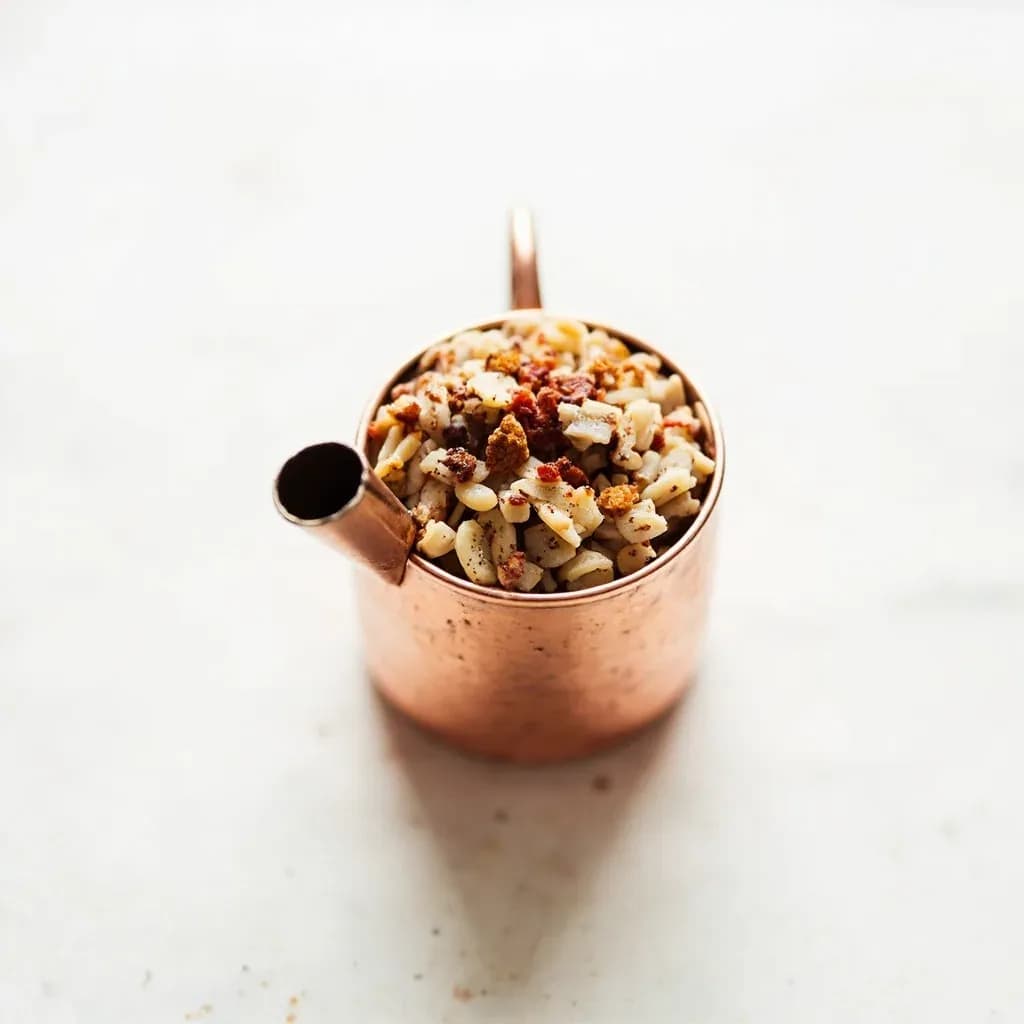
A copper sugar pot is a small, heavy, unlined copper pan with a pouring lip used to boil sugar syrups for caramel, candy, and confections. Copper's superb conductivity gives quick, even heat and fine temperature control, which is critical when sugar passes through narrow stages from soft-ball to hard-crack. The unlined interior is reserved for sugar work, where copper does not react.
The copper sugar pot is a heavy, unlined copper vessel built for one job: cooking sugar to exact temperatures without flinching. Unlike the tin-lined sauté pan or the stainless-clad saucepan, it has no interior barrier, because sugar syrups are essentially neutral in pH and copper can touch them safely. The result is the most thermally responsive cookware you can put on a domestic burner—heat reaches the sugar almost the instant you turn the flame up or down, and stored heat bleeds back out just as fast.
That responsiveness is the entire point of the tool. Caramel, hard-crack candy, Italian meringue, and jam setting points all hinge on a window of a few degrees, and a pot that lags behind the burner will overshoot before you can react. Copper's conductivity—roughly twenty times that of stainless steel—lets you pull a syrup off the heat a degree shy of your target and trust it to stop climbing. French pastry texts from the 19th century onward have treated the bassine à sucre as its own category of cookware for exactly this reason, distinct from the sauté pan and the stockpot.
In practice the pot looks like a tall, often hand-hammered copper bowl with a riveted iron or bronze handle and frequently a pour lip. Home versions run 2–6 L; professional pastry workshops use 8–20 L bassines for batch candy work. The pots are unsuitable for anything acidic—no wine, citrus, tomato, or vinegar—because raw copper will etch, discolor, and leach metal into the food. Used only for sugar, water-based syrups, milk reductions, and gentle chocolate work, a well-made copper sugar pot will outlast a cooking career and become the single most trusted vessel in a confectioner's kitchen.
Alternatives
Types & varieties
The classic French shape: wide, rounded, sloping sides; favored for caramel and confectionery because the broad base gives a fast, even boil
Narrower and deeper than the bassine; minimizes evaporation and is preferred for very high-Brix syrups and pulled sugar work
Traditional confectioner's tool that sits in a stand ring; gives especially even heat over a gas jet
Modern home-kitchen version; stable on any stovetop without a separate stand
Hand-hammered body that is stiffer and resists warping at sustained high heat
Machine-made, lighter gauge, lower cost; suitable for occasional sugar work but warps more easily under repeated hard-crack heat
Wider, often two-handled copper pan traditionally used for jam and high-Brix fruit preserves; overlaps with the sugar pot in function and care
Why unlined, and why only sugar
The lining question is the single most important thing to understand about a copper sugar pot. Copper reacts with acidic foods to leach copper ions and produce off-flavors—sometimes dangerously so, which is why traditional copper sauté pans are lined with tin or stainless. Sugar syrups, however, are essentially neutral pH, sitting between about 6 and 7 even at high Brix, so the lining that protects savory cooks becomes an unnecessary thermal barrier for a confectioner. Removing it gives the cleanest, fastest temperature response of any cookware you can buy. The trade-off is non-negotiable: never put wine, citrus, tomato, vinegar, fruit purée, or any other acidic ingredient into an unlined copper pot, even briefly. A single deglaze with vermouth can etch the surface and turn the next batch of caramel faintly metallic.
- Unlined copper is safe for sugar because cooked syrups stay near neutral pH throughout the stages from thread to hard crack.
- A tin or stainless lining would re-introduce the thermal lag that copper is supposed to eliminate.
- If you need both copper performance and acid flexibility, buy a lined copper pan for savory work and keep the unlined pot strictly for sugar and chocolate.
Choosing a copper sugar pot
For most home cooks, a 3 L hammered bassine from a maker like Mauviel, Dehillerin, Matfer Bourgeat, Lacor, Baumalu, or Ruffoni is the practical sweet spot: large enough for a serious caramel or batch of praline, small enough to bring to temperature quickly on a domestic burner. Gauge matters more than thickness of your wallet: 2 mm or heavier will resist warping through years of hard-crack work, while the thin spun pieces sold as giftware will dish and buckle within a season.
- Pick 2 mm+ gauge if you cook sugar regularly; thinner copper is for display.
- Hammered (martelé) bodies are stiffer than spun ones at the same thickness and forgive accidental dry heating.
- A pour lip is genuinely useful for drizzling caramel; a matching lid is mostly cosmetic—most cooks leave it off to watch color.
- A cast-iron handle stays cool longer than a wrapped stainless one, but check the rivets: pot-metal rivets can loosen over years of thermal cycling.
Working with copper's responsiveness
Owning a copper sugar pot changes how you cook. The pot reacts so quickly that you can drop the heat a third of the way through a hard-crack boil and see the boil calm within seconds—a control that simply does not exist in tri-ply. Lean into it: bring sugar and water up over moderate heat, switch to high only once the syrup is fully dissolved and clear, and prepare to pull the pot off the burner entirely for the last 10–15 °C of any target temperature. Most overshoots in copper happen because cooks trust the flame to back off, when the better move is to take the pot off the heat and let residual carryover finish the climb.
- Use a clip-on digital probe thermometer rated to ±1 °C; the pot is wasted on a slow analog dial.
- Wash down the walls with a wet pastry brush the moment crystals form—copper's fast recovery forgives the small loss of water but not a grained batch.
- Pull the pot off the burner entirely for the last stretch toward hard crack or deep caramel; carryover heat is your friend.
- Never walk away from copper on a gas flame—the same responsiveness that lets you fine-tune also lets a forgotten pot scorch in under a minute.
Common uses
Tips & pitfalls
- Buy unlined—any tin or stainless lining defeats the responsiveness that makes the pot worth owning.
- Choose 2 mm or heavier gauge copper; thin spun pots warp under repeated hard-crack heat and never sit flat again.
- Wash down the inside walls with a clean wet pastry brush the moment crystals form, or seed crystals will flash-grain the whole batch.
- Use a clip-on digital probe thermometer accurate to ±1 °C; copper's responsiveness is wasted on a sluggish dial thermometer.
- Never deglaze with wine, citrus, vinegar, or fruit purée—even a brief splash will etch raw copper and leach metal into the next thing you cook.
- Wipe the rim and fittings dry after washing to prevent copper carbonate (green verdigris) from staining the iron or bronze handle.
- Polish with a paste of salt and lemon juice or a commercial copper cleaner, then rinse and dry immediately; never put a copper sugar pot in the dishwasher.
- Keep a dedicated copper pot for sugar work only—shared use with salty or acidic cooking is the most common way to ruin both the pot and the food.
Good to know
- Material
- Solid unlined copper, typically 1.5–3 mm gauge, with a cast-iron, bronze, or brass handle
- Thermal conductivity
- About 401 W/m·K—the highest of any common cookware metal, roughly 20× that of stainless steel
- Lining
- Unlined by design; sugar syrups are essentially neutral, so no tin or stainless barrier is needed
- Shape
- Tall-sided (height greater than width) to limit evaporation and to let a wet brush reach the walls
- Typical sizes
- 2–6 L for the home; 8–20 L for professional pastry workshops
- Maximum safe temperature
- Comfortably beyond hard-crack (154 °C / 310 °F) and into deep caramel (~180 °C / 356 °F)
- Stovetop compatibility
- Gas, electric, and halogen work directly; induction requires an induction interface disk
- Acid safety
- Not for citrus, wine, tomato, or vinegar—even a splash will etch raw copper and leach metal into food
Also called
Sugar Pan · Caramel Pot · Confectioner's Copper Pot
Related

Steamer
Gentle moist heat that keeps vegetables, fish, and dumplings tender

Frying Pan
Shallow sloped pan for frying, sautéing, and quick sears

Saucepan
Tall, straight-sided pot for sauces, grains, and small batches

Sauté Pan
Wide straight-sided pan with room to brown and braise

Dutch Oven
Heavy lidded pot that turns tough cuts tender over hours

Stock Pot
Tall, roomy pot for stocks, pasta, and big-batch cooking

Wok
High-sided bowl pan built for blistering-hot stir-fries

Griddle
Flat, broad surface for pancakes, smash burgers, and breakfast