Cookware
Couscoussier (Steamer Pot)
Two-tier North African pot that steams couscous over a simmering stew below.
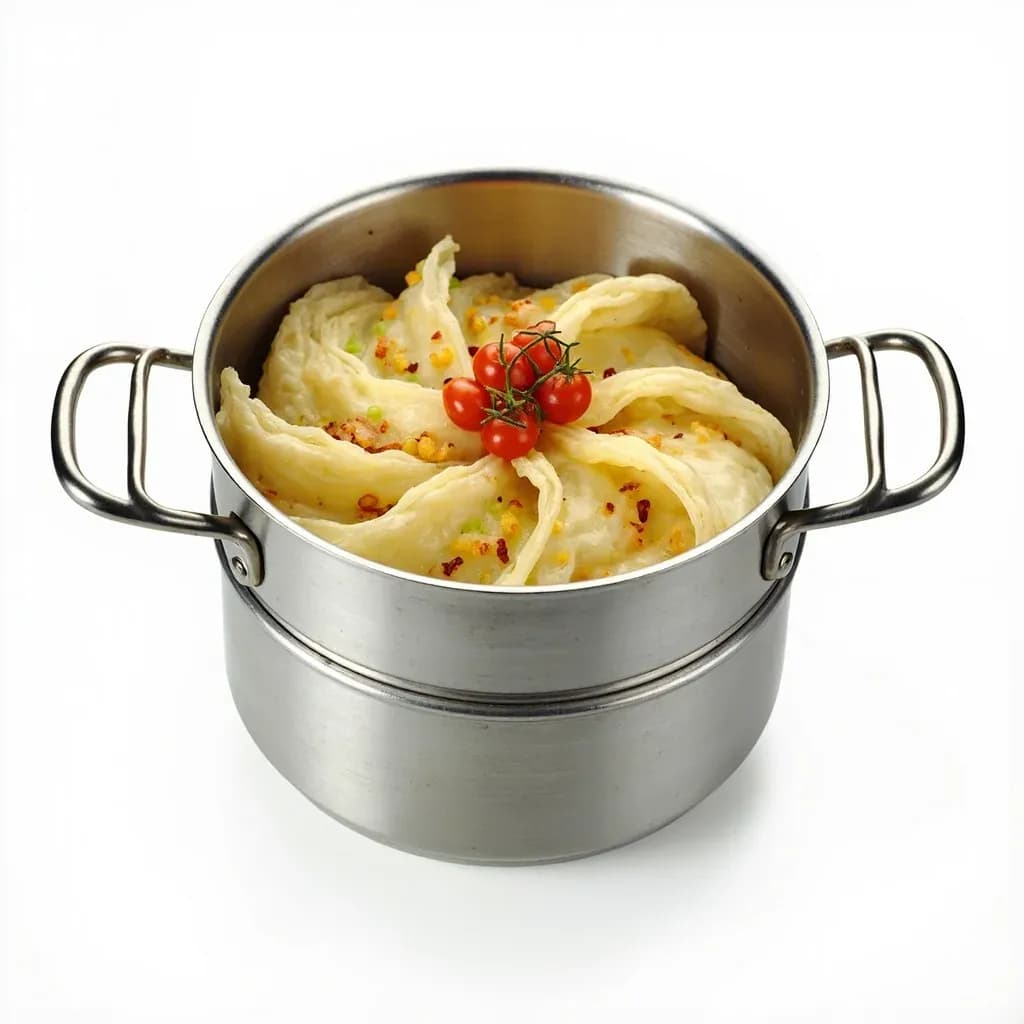
A couscoussier is a two-part North African pot: a wide lower pot that simmers a stew or broth, topped by a perforated steamer basket where couscous cooks in the rising steam. This setup flavors the grains while cooking them light and fluffy, and lets the stew and starch finish together. It is the traditional vessel for Maghrebi couscous and can double as a general steamer.
A couscoussier is a specialist two-tier cooking vessel from the Maghreb whose lower pot holds a simmering stew while a perforated upper insert holds semolina, so the grain cooks entirely by steam rising from the broth below. The arrangement is not decorative — it is functional in a specific way: as the stew reduces and concentrates, its aromatic vapor passes through the grain, infusing the couscous with the same spices, fat, and meat character that flavor the liquid underneath. That is why a proper couscous made in a couscoussier tastes different from semolina that has merely been steamed over plain water, and why the dish is difficult to faithfully reproduce in a bamboo steamer or a stockpot with a metal colander perched on top.
Beyond the upper/lower split, what defines a couscoussier is that it is built for the multipass method: the semolina is steamed, tipped out, rubbed by hand to break up clumps, rehydrated with salted water, and steamed again — usually two or three times — until each grain is tender, separate, and light. The vessel's proportions matter; the base is sized to the family or restaurant, while the upper insert is deliberately shallower so steam circulates evenly rather than tunneling through a deep mound of grain. Used properly, it produces the fluffy, almost granular texture that distinguishes Maghrebi couscous from the sticky, rice-like result of single-pass steaming.
Although named for couscous, the pot is genuinely multipurpose. The lower pot is simply a deep, straight-sided saucepan that simmers stocks, beans, or braises, and the insert doubles as a large colander for rinsing grains or blanching vegetables. In modern kitchens, the same shape shows up in aluminum, stainless, or copper; in traditional North African homes and in clay-producing regions like the Rif, the Atlas, and the Tunisian south, the vessel is still unglazed terracotta.
Alternatives
Types & varieties
The traditional form; imparts a subtle mineral note, retains heat evenly, but is fragile and must be brought up to temperature slowly and never put over a high flame without a diffuser.
Modern workhorse; lightweight, heats quickly, often with a clad base, and the most common choice in restaurants and catering.
Durable, non-reactive, and dishwasher-safe; takes longer to come to temperature but will outlast nearly everything else in the kitchen.
Premium build with excellent heat response, usually tin-lined; prized in high-end kitchens and for very large dinner-party service.
Traditional North African pots have holes punched directly into the upper bowl; many modern pots use a removable perforated insert that can be lifted out and used as a colander.
A countertop appliance with a built-in heating element and dedicated upper bowl; popular in France and the Maghreb diaspora for hands-off semolina cooking, especially for large groups.
Sizing a couscoussier
The most common mistake is buying a base pot that is too small. A couscoussier that is just adequate for the stew is almost always too small for the grain, because the upper insert is meant to hold a generous layer of semolina — no more than about 3–4 cm deep — so steam can pass through it evenly.
- A 3–4 L base is fine for two people and is a reasonable starter size for an apartment kitchen.
- A 6–8 L base is the true family size across the Maghreb, feeding 6–8 with leftovers, and is the most versatile for entertaining.
- For restaurants, 10 L and up; expect to steam 1 kg of dry semolina in two batches rather than trying to crowd a single large insert.
- Always match the upper insert to the base: a mismatched colander will either sit too low (grain touches broth) or vent steam around the edges.
The multipass method, and why the vessel matters
A single steaming of soaked semolina yields something closer to rice: dense, slightly gummy, and uniform. The Maghrebi technique is to steam, then rest, then steam again — two or three times — so the grain hydrates from the outside in, swells in stages, and stays discrete. The couscoussier is built to make this practical: the lid traps steam inside the upper bowl, the perforations admit it evenly, and the pot is shallow enough that the cycle is fast.
- Pass 1 hydrates the grain and sets its structure; the semolina is still slightly underdone and gritty at the center.
- Between passes, the grain is tipped onto a wide tray (a gsaa), sprinkled with salted water, and rubbed between the palms to separate any clumps and rehydrate evenly.
- Pass 2 finishes the texture; a third pass is traditional for Sunday couscous and for finer semolina that benefits from extra moisture.
- The lower pot's broth should be at a steady, moderate simmer throughout — too fierce and droplets of liquid fly up into the grain; too gentle and the steam is thin.
Clay care vs. metal care
A clay couscoussier and a stainless one are essentially different tools, and the maintenance reflects that.
- Clay: never soap. Wash with hot water and a brush, dry fully upside-down, and store un-lidded so air circulates. Soap lodges in the porous walls and taints the next batch.
- Clay: season a new pot by simmering plain water in it for 30–60 minutes; this hardens the surface and reduces the risk of cracking on first use.
- Stainless and aluminum: dishwasher-safe, but watch for white scale on the perforations — descale periodically with a vinegar simmer so the holes stay open.
- Copper: polish the outside to keep the tin lining from spotting; never let it boil dry.
Common uses
Tips & pitfalls
- Rinse and dry a new clay couscoussier thoroughly, then simmer plain water in it once before its first use to season the body and reduce the risk of cracking under heat.
- Keep the lower pot at a steady simmer rather than a rolling boil — violent boiling spits broth droplets up into the semolina and turns the grain gummy and unevenly hydrated.
- Toss the dry semolina with a little olive oil or smen (clarified butter) before the first steam pass; the fat coats each grain and stops clumping as it hydrates.
- Between steamings, tip the semolina onto a large tray, sprinkle with salted water, and rub between your palms to break up lumps and rehydrate evenly — skipping this step is the most common reason couscous comes out heavy.
- Do not seal the upper pot with plastic wrap or a tight cloth unless a recipe specifically calls for it; steam needs to circulate, not pressurize.
- If your insert has fine perforations, line it loosely with cheesecloth for the first pass so small-grain semolina does not fall through and clog the holes.
- Resist the urge to lift the lid and peek — every opening drops the upper pot below 100 °C and visibly lengthens the cook time.
- Season the base broth aggressively (cumin, ras-el-hanout, saffron, dried chili, preserved lemon) because a meaningful amount of flavor carries up into the grain as steam.
- Let the finished couscous rest 10–15 minutes, covered, off the heat; it finishes absorbing residual moisture and reaches the light, almost airy texture the dish is known for.
- Clean clay without soap — just hot water and a brush — then air-dry fully to prevent mold and cracking.
Good to know
- Origin
- North Africa (Maghreb) — Morocco, Algeria, Tunisia, Mauritania, Libya; Berber origin predating Arab influence.
- Also known as
- Couscoussier (French), kiskas (Algeria/Tunisia), keskès, couscous pan, couscous steamer.
- Components
- Two parts: a deep lower pot for broth/stew, a perforated upper insert (or fitted colander) that nests on the rim, and a domed lid.
- Traditional material
- Unglazed or glazed terracotta/clay; modern versions are aluminum, stainless steel, or copper.
- Typical capacity
- Base pot 3–10 L (family-sized often 6–8 L); the upper insert holds roughly half the base volume in dry semolina.
- Hole size
- Perforations admit steam but retain semolina — traditionally punched metal or pierced clay, not fine mesh.
- Heat source
- Gas, charcoal, or wood; clay vessels must be heated gradually to avoid cracking.
- Steam cycles
- Traditional preparation calls for 2–3 steamings, with hand-rubbing and a salted-water rehydration between passes.
- Dish class
- Designed for Maghrebi couscous — semolina grain steamed over a simmering meat, fish, or seven-vegetable stew.
Also called
couscoussier · couscous-steamer
Related

Steamer
Gentle moist heat that keeps vegetables, fish, and dumplings tender

Frying Pan
Shallow sloped pan for frying, sautéing, and quick sears

Saucepan
Tall, straight-sided pot for sauces, grains, and small batches

Sauté Pan
Wide straight-sided pan with room to brown and braise

Dutch Oven
Heavy lidded pot that turns tough cuts tender over hours

Stock Pot
Tall, roomy pot for stocks, pasta, and big-batch cooking

Wok
High-sided bowl pan built for blistering-hot stir-fries

Griddle
Flat, broad surface for pancakes, smash burgers, and breakfast