Cookware
Crawfish Boil Pot (Boiling Rig)
A huge outdoor pot with a perforated insert for boiling crawfish, corn and potatoes.
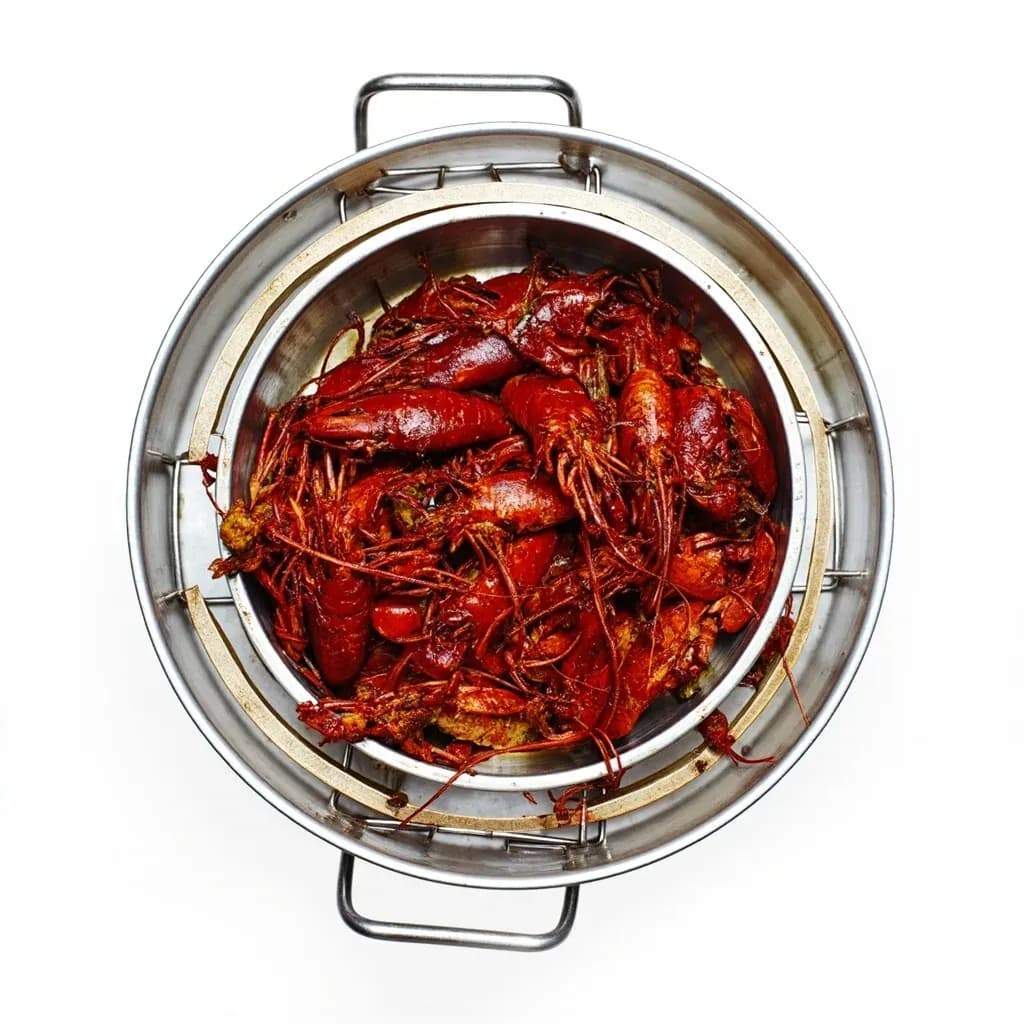
A crawfish boil pot is a tall, oversized stockpot, usually with a basket insert, set over a high-output propane burner for outdoor seafood boils. It holds large quantities of crawfish along with corn, sausage and potatoes in heavily spiced water. The lift-out basket lets the cook drain and dump the whole batch onto a table at once.
A crawfish boil pot is a tall, heavy-gauge aluminum stockpot paired with a fitted perforated basket that lifts the food out of the boiling water in a single motion. What separates it from an ordinary stockpot is the marriage of three things: a thick aluminum body that can take the punishing BTU output of an outdoor jet burner, a perforated insert sized to clear the rim, and a tall straight-sided shape that holds enough water to cover a whole sack of crawfish without the basket binding on the way out. Aluminum is the default material because it conducts heat quickly, costs a fraction of stainless, and lightens a pot that is already punishing to move; the trade-off is a softer surface that dents and scratches if you stir it with metal tools.
The pot is really only half of the working setup. In Louisiana parlance, the "rig" refers specifically to the burner-and-stand combination, not the pot itself — so a complete cook station is the pot, basket, lid, a long-handled wooden paddle, a high-pressure propane burner (often 30,000–100,000+ BTU), and a stable steel stand. The pot will not sit safely on a kitchen stove: the burner alone produces dangerous carbon monoxide, and a full 60-quart pot of water weighs well over 140 pounds. Once you understand that the boil pot is meant to live outdoors, be lifted by two people, and be fed by a flame far hotter than anything in your kitchen, the design choices all make sense: thick walls to spread that heat without scorching, a basket with enough holes to let the purge drain as the crawfish cook, and a tall body so the boil can be stirred from the top without splashing.
Alternatives
Types & varieties
The classic setup: an outer pot plus a fitted perforated insert that lifts the entire batch out at once.
A plain tall pot used without an insert; cooks drain by tipping with a helper or fishing food out with a colander.
A 30–40 qt turkey fryer kit repurposed for smaller boils; the baskets are usually shallower and less purpose-built.
Flat-bottom sits most securely on a burner; a slight inward taper toward the top makes the basket easier to lift clear.
Thicker aluminum (sometimes clad) for higher-BTU burners and repeated commercial use without warping.
More durable and easier to clean, but heavier, pricier, and slower to bring to a boil.
Sizing the pot to the job
Sizing a boil pot is mostly about the crawfish sack. Live crawfish displace roughly their own volume in water, so the working rule is that the filled pot should hold at least one sack of bugs plus enough extra water to cover them by an inch or two and still leave headroom for a rolling boil. The cleanest way to size up is to put the empty basket in the pot, add a sack of crawfish, and then top up with water until the sack is covered by an inch or two — mark that waterline and you have your repeatable fill line. A 40-quart pot comfortably handles about a 25–30 lb sack, which is a reasonable amount for a family dinner. A 60-quart pot takes a full 35–40 lb sack with room for potatoes and corn layered in and out of the basket. Anything larger (80–100 qt) is built for commercial or very large gathering use and usually means lifting the pot with two people and a reinforced stand.
- 30 qt — small backyard boils, shrimp-only, or sides.
- 40 qt — the home workhorse; one partial sack of crawfish plus vegetables.
- 60 qt — the party size; a full sack with room to stir.
- 80–100+ qt — commercial or event scale; plan on a helper and a reinforced stand.
The basket and why it matters
The perforated basket is what turns a stockpot into a boil pot. Its holes are large enough that the muddy purge from live crawfish drains out as they cook, which is the whole reason crawfish are boiled in baskets rather than tipped out of a sealed pot. The basket also lets you lower food into a rolling boil in one motion and lift it out cleanly without fishing with a slotted spoon, which would take forever at sack scale. Look for welded rod handles that fold across the top (so you can push the basket down and stir with the paddle) and a mesh or punched-hole pattern fine enough to hold small potatoes but open enough to drain fast.
- Holes should drain in seconds, not minutes — a slow-draining basket leaves food sitting in residual hot water after the lift and overcooks it.
- A handle that pivots flat across the top doubles as a paddle rest and lets you weigh the basket down during the soak.
- Aluminum baskets match the pot's expansion so they don't jam when hot.
Common uses
Tips & pitfalls
- Pre-fill the pot with water before lighting the burner so you know exactly how much room a sack of live crawfish will leave — put the basket in, add the sack, top up to cover, and mark that waterline for future boils.
- Salt the water until it tastes like sea water; a crawfish shell is salty on its own, and bland boil water produces bland crawfish no matter how much seasoning you dump in.
- Bring the water to a full rolling boil before adding crawfish. A slow climb back to temperature makes the cook time hard to judge, the meat separates from the shell, and the tails often snap off in the basket.
- Soak the cooked crawfish off the heat, lid on, for 15–25 minutes after the timer ends; this is where the seasoning penetrates the shell and where a good boil becomes a great one.
- Let the pot cool fully before moving. Drain or bail water out before lifting if you can — a full 60 qt pot weighs well over 140 lb and is the most common cause of boil-day injuries.
- Never use a crawfish boil pot indoors or in a garage. The high-BTU burner produces lethal carbon monoxide, and the radiant heat and open flame are a serious fire risk around any indoor surface.
- Stir with a long-handled wooden paddle, not metal — even a heavy spoon will gouge soft aluminum over a season and create crevices that hold old seasoning.
- Clean with hot water, a stiff brush, and a sprinkle of baking soda. Skip strong dish soap if you want the seasoned 'boil pot' flavor that Louisiana cooks prize; just rinse, scrub, and dry with the lid off.
Good to know
- Typical construction
- Heavy-gauge aluminum (most common); stainless steel models exist but cost more and heat more slowly.
- Standard sizes
- 30, 40, 60, 80, and 100+ quart capacities; 40 qt is the home workhorse, 60–80 qt handles a full sack for a party.
- Key component
- A perforated aluminum insert basket that drops into the pot and lifts out by a handle, draining water while keeping the food.
- Heat source
- An outdoor high-pressure propane burner (jet burner / outdoor cooker), not a kitchen range.
- Wall thickness
- Roughly 1.5–3 mm aluminum on consumer models, 5 mm+ on heavy-duty or commercial pots.
- Weight when full
- A 40 qt pot of water weighs about 100 lb / 45 kg; a 60 qt pot runs well over 140 lb / 65 kg once you include the pot itself.
- Common accessories
- Long-handled wooden paddle, fitted lid, propane burner stand, and a windshield/heat shield for the burner.
- Cultural origin
- Louisiana Cajun and Creole tradition, where the communal outdoor crawfish boil is a longstanding social ritual.
Also called
Outdoor Crawfish Boil Pot · seafood boil pot · boiling rig
Related

Steamer
Gentle moist heat that keeps vegetables, fish, and dumplings tender

Frying Pan
Shallow sloped pan for frying, sautéing, and quick sears

Saucepan
Tall, straight-sided pot for sauces, grains, and small batches

Sauté Pan
Wide straight-sided pan with room to brown and braise

Dutch Oven
Heavy lidded pot that turns tough cuts tender over hours

Stock Pot
Tall, roomy pot for stocks, pasta, and big-batch cooking

Wok
High-sided bowl pan built for blistering-hot stir-fries

Griddle
Flat, broad surface for pancakes, smash burgers, and breakfast