Knives & Cutting
Daikon Katsuramuki Peeler
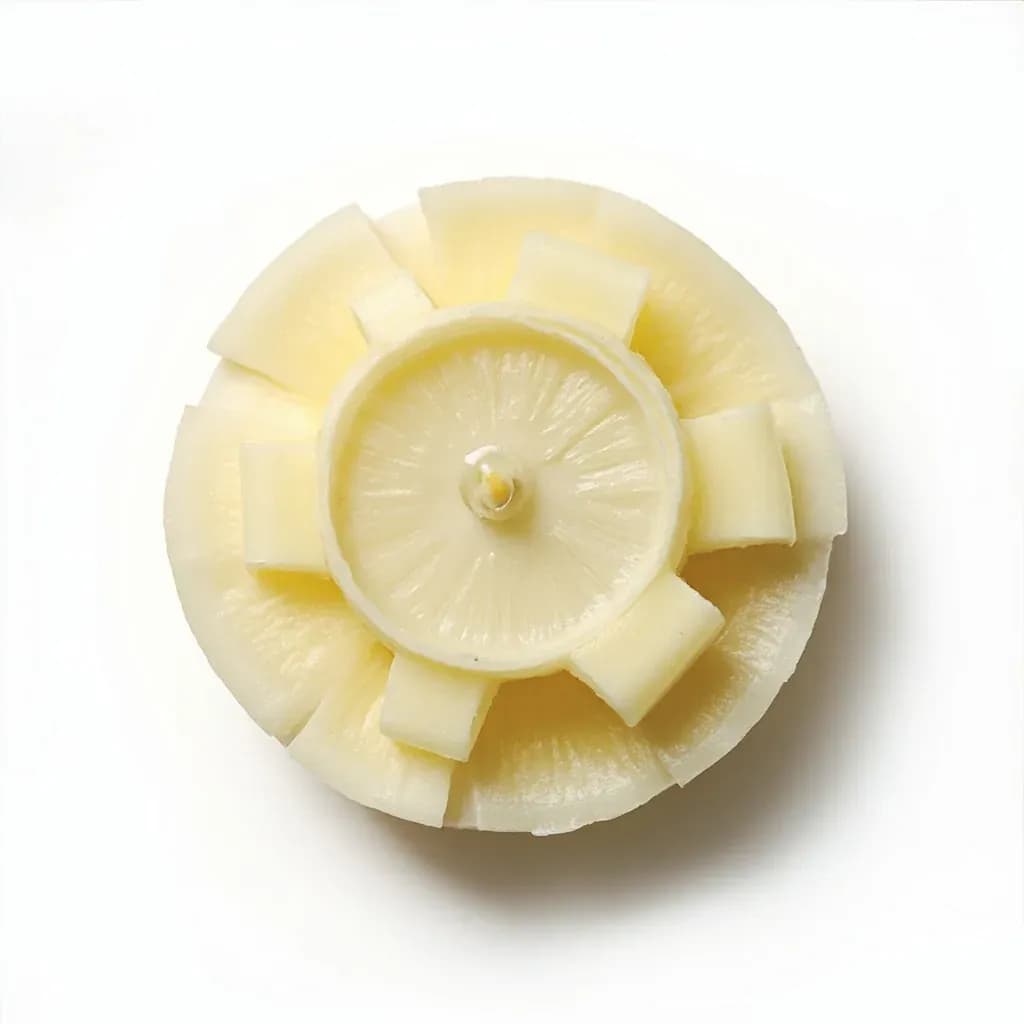
A tool for paring daikon into one long continuous thin sheet for katsuramuki.
This tool produces katsuramuki, the Japanese technique of peeling a daikon or other vegetable into a single unbroken thin sheet. Some versions are rotary spinners that turn the radish against a fixed blade to unwind a long ribbon, which is then shredded into fine garnish. Traditionally katsuramuki is done by hand with a thin-bladed usuba knife, and this device mechanizes that skill.
The katsuramuki peeler is a specialized Japanese cutting tool designed to shave long, paper-thin continuous sheets from cylindrical vegetables, most famously daikon radish. Unlike a standard Y-peeler, its single straight steel blade is mounted upright from a wooden or bamboo base, with the blade's flat face parallel to the surface, so the vegetable is drawn across the edge while rotating rather than peeled in strips. The result is katsuramuki: a single unbroken ribbon of vegetable, often translucent when held to the light, that can run several feet from a single root.
The cut matters because it changes how the vegetable behaves in a finished dish. A katsuramuki sheet of daikon drapes, folds, and absorbs dressing differently from a grated or julienned version, and it can be cut into fine threads after the fact. It is the lace-like bed beneath fugu sashimi, the wrapper for delicate cold appetizers, and the translucent layer in refined summer salads. While the tool is purpose-built for daikon, it works equally well on nagaimo, cucumber, carrot, and other long, firm produce.
Mastering the tool is more about rhythm than strength. The daikon is held upright and rotated against the blade with even pressure, letting the sharpness of the steel do the work. A few minutes of careful practice produces ribbons that look like they came from a professional kitchen — but only if the blade is genuinely sharp and the cook is patient enough to let it cut.
Alternatives
Types & varieties
Rectangular wooden or bamboo base with a single riveted carbon-steel blade — the classic Japanese style found in most kitchens.
All-metal construction; more durable, rust-resistant, and the choice in many professional kitchens.
Allow the user to raise or lower the blade to fine-tune sheet thickness — a modern convenience for working with different vegetables.
A related but distinct Japanese tool that shaves fine julienne strips rather than one continuous sheet; sometimes confused with the katsuramuki peeler.
Why the flat blade changes everything
On a standard swivel peeler, the blade is angled toward the cook and the vegetable is dragged past it, producing a curling strip of peel. On a katsuramuki peeler, the blade sits upright, perpendicular to a flat base, and the cook draws the vegetable across it while rotating. The cut is closer to that of a carpenter's plane than a peeler, which is why the result is a continuous sheet rather than a curled shaving. This is also why the tool demands a different grip: the vegetable is moved, not the blade. Substituting a Y-peeler for katsuramuki work will give you ragged strips and a high failure rate, no matter how sharp the blade.
Caring for the blade
The single most common mistake with a katsuramuki peeler is letting the blade go dull. A dull edge tears the daikon into translucent rags instead of shaving a clean sheet, and no amount of pressure will fix it. Treat the tool like a small plane blade and the results will stay clean for years.
- Carbon-steel blades cut beautifully but will rust within hours if left wet — dry the tool immediately after washing and store it in a dry drawer.
- Stainless blades are lower-maintenance but still benefit from being wiped dry to protect the wooden base.
- A quick pass on a fine whetstone (around 8000 grit) will refresh a tired edge; do not use a honing rod, which is the wrong profile for a flat blade.
- If the blade develops a micro-nick, the sheet will catch and shred at the same spot every rotation — replace the blade rather than working around it.
Common uses
Tips & pitfalls
- Start with a very sharp blade; a dull edge tears the sheet rather than shaving it cleanly, and added pressure will only make the tearing worse.
- Trim both ends of the daikon flat so it stands stable and presents a square face to the blade.
- Hold the daikon with both hands and rotate it with even, gentle pressure — let the blade do the work instead of pushing.
- Keep your fingertips well clear of the blade; some cooks press a folded cloth or the trimmed end-stub of daikon against the blade as a hand guide.
- If the sheet begins to shred at one spot, stop and inspect the edge — a single micro-nick will catch and rip the vegetable every rotation.
- For a long daikon, finish one section, re-trim the new face flat, and re-center it on the blade rather than stretching for the last stub.
- Stack finished sheets between damp paper towels while you work so they stay pliable and do not dry out at the edges.
- Reserve the final nub and any torn scraps for miso soup or grated daikon so nothing is wasted.
Good to know
- Origin
- Japan; a traditional tool in both Japanese home and professional kitchens
- Also known as
- Katsuramuki peeler, katsuramuki-kiri; sometimes loosely called a daikon oroshi peeler
- Construction
- Flat wooden or bamboo base with a single straight steel blade fixed perpendicular to the surface
- Blade orientation
- Blade lies flat, parallel to the base, so the vegetable is shaved rather than peeled
- Typical base length
- Around 20–30 cm (8–12 in)
- Sheet thickness
- Roughly 1–2 mm, translucent when held to the light
- Primary vegetable
- Daikon radish; also works on nagaimo, cucumber, carrot, and other long cylindrical produce
- Maintenance
- Hand-wash and dry immediately; hone or replace the blade as it dulls, especially with carbon steel
Also called
Daikon Spinner · katsuramuki peeler · vegetable sheet peeler
Related

Knife
The fundamental cutting tool every kitchen is built around

Chef's Knife
The do-everything blade for chopping, slicing, and mincing

Paring Knife
Small, nimble blade for peeling and detailed in-hand work

Serrated Knife
Saw-toothed blade that slices crusty bread without crushing

Cleaver
Heavy broad blade for chopping through bone and bulk prep

Cutting Board
The stable surface every cut starts on

Mandoline
Adjustable blade for paper-thin, perfectly even slices

Kitchen Shears
Heavy-duty scissors for poultry, herbs, and packaging