Cookware
Daubière (Earthenware Daube Pot)
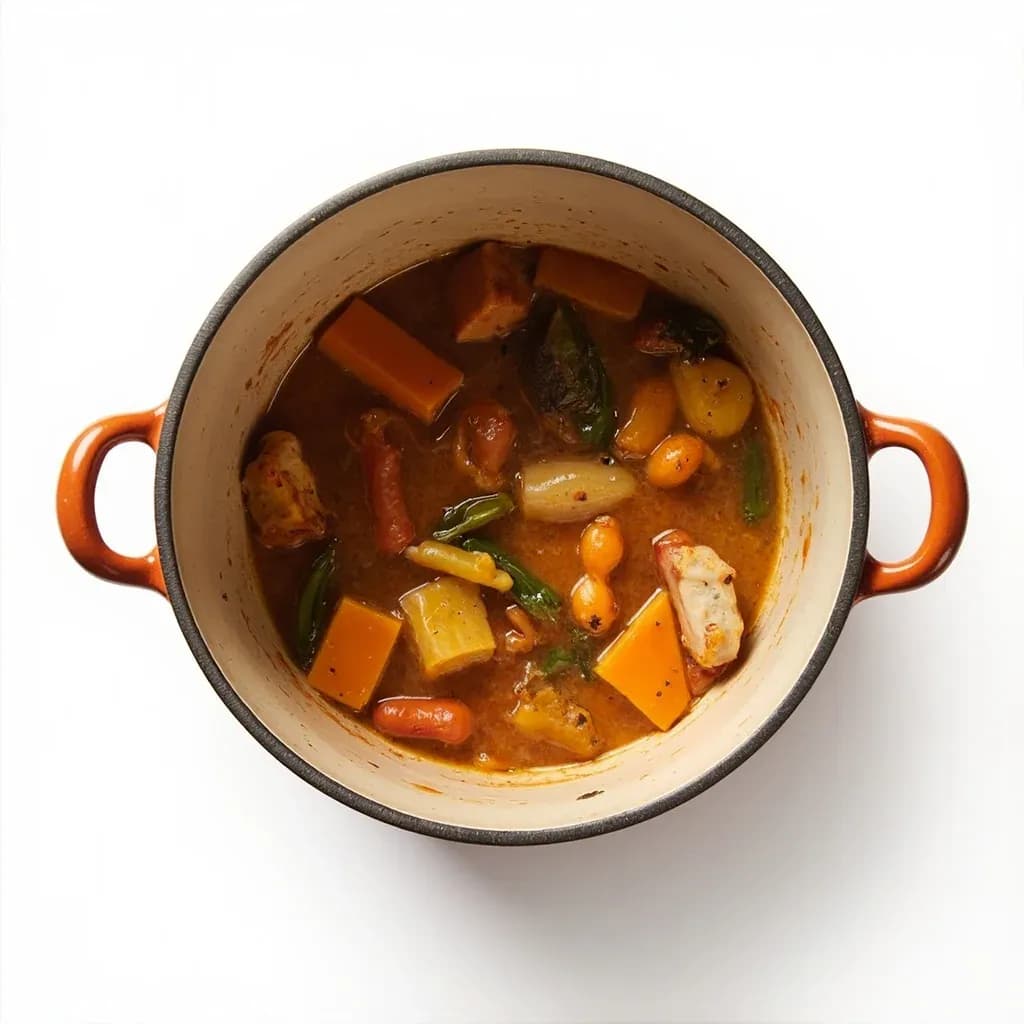
A squat earthenware pot for slow-braising the Provençal beef stew daube.
A daubière is a deep, narrow-necked earthenware or copper pot designed for cooking daube, the long-simmered Provençal beef-and-wine braise. Its narrow mouth limits evaporation so the stew stays moist over hours of gentle heat, and the lid is sometimes filled with water to seal in steam. The thick walls hold a steady low temperature ideal for collagen-rich cuts.
The daubière is a wide, low terracotta pot with thick walls, made for the patient, gentle work of Provençal braising. Unlike enameled cast iron, which holds heat fiercely and concentrates it at the base, earthenware absorbs heat slowly and releases it evenly from all sides, so a stew simmers in a kind of ambient warmth rather than against a hot floor. The porous clay also breathes: moisture wicks slowly through the unglazed walls and evaporates from the outside surface, which moderates the internal humidity and produces a gentle, steady reduction that a sealed Dutch oven cannot match. The trade-off is a faint earthy note in the finished dish, desirable to those who cook with these pots, though not to everyone.
The pot's character is shaped by where it comes from. The finest examples are turned from the red clays of Vallauris on the Côte d'Azur and from Anduze at the foot of the Cévennes, shaped into squat vessels with small lug handles and a domed or flat lid. Capacities run from about 3 to 7 liters, with 5 liters (enough for a whole daube of beef for six) the most common size. A traditional daubière may be unglazed on the outside and partially glazed inside, or glazed on both surfaces; in either case, the clay itself is the point, and the pot rewards cooks who treat it accordingly.
A daubière is not a generic stand-in for a Dutch oven. It is a specialty tool that cannot take a hard sear, is unforgiving of thermal shock, and must be seasoned before first use. In return, it braises over many hours at the gentlest possible simmer, concentrating flavors in a way that cooks who know the pot prize.
Alternatives
Types & varieties
Unglazed red terracotta from the Vallauris pottery tradition in Provence; porous walls that absorb and slowly release heat
Glazed interior, unglazed exterior, from the Anduze potteries on the Cévennes–Languedoc border
Older form with a hollow lid rim originally intended to be filled with cold water or ice to promote condensation and self-basting
Lead-free, fully glazed earthenware made for contemporary kitchens; more tolerant of soap and water than traditional unglazed versions
Not a true daubière but a common modern substitute in the wide, low oval form, such as those from Staub or Le Creuset
Seasoning and daily care
A new daubière arrives dry and thirsty. The clay is full of micro-pores that will otherwise wick fat and liquid straight through the wall during cooking, leaving stains and sometimes a faint dusty taste in the food. Seasoning closes those pores and builds a base that improves with use.
- Soak the pot, lid and all, in cold water for 12 to 24 hours before its first use.
- Drain, wipe, and place in a cool oven (around 100 °C / 212 °F) for about 2 hours so it dries slowly and evenly.
- Rub the interior with the cut face of a clove of garlic and a thin film of olive oil; let it sit overnight, then rinse with warm water. Repeat two or three times before the first real dish.
- Clean after use with hot water, a soft brush, and a little baking soda. Avoid dish soap on unglazed exteriors; it can leave a taste and is hard to rinse out of the clay.
- Air-dry with the lid off or ajar. Store uncovered so residual moisture can escape — a sealed daubière will develop mold and a sour smell.
- Expect the exterior to darken and the interior to take on a patina with use. Both are signs the pot is doing its job, not signs of neglect.
Heat management
A daubière is built for the lowest possible sustained heat. The clay's mass means it can take a long time to come up to temperature, but once there, it holds and radiates so steadily that a 140 °C / 285 °F oven behaves like a much hotter pot made of thinner material. Patience is part of the technique.
- Always preheat the oven with the pot inside so the clay warms gradually from all sides.
- Add only warm or room-temperature liquid to a warm pot. Cold wine or stock on hot clay is the most common way to crack a daubière.
- On the stovetop, always interpose a flat heat diffuser and keep the flame at its lowest setting. A naked burner will scorch the porous base.
- Over a wood fire, bank embers around the pot and on the lid rather than flaming it directly; this is the historical method and still the most forgiving.
- If the lid sits tightly, lay a sheet of parchment between pot and lid. It lets a little steam escape so the daube reduces gently instead of boiling over.
Common uses
Tips & pitfalls
- Season a new daubière before its first use: soak overnight, dry slowly in a 100 °C oven, then rub the interior with garlic and olive oil and repeat two or three times — unseasoned clay will wick liquid and flavor straight through the wall.
- Never put a cold or wet daubière on heat, and never add cold liquid to a hot one. Thermal shock is the single most common way these pots crack, and the damage is usually unrepairable.
- Cook at 140–160 °C / 285–325 °F in the oven, no higher. The thermal mass of the clay does the work; hotter ovens drive off moisture too fast and dull the flavors of a long braise.
- Avoid the dishwasher and avoid dish soap on unglazed exteriors. Clean with hot water, a brush, and baking soda, then air-dry with the lid ajar so the clay does not grow mold.
- Set the hot pot on a wooden board, trivet, or folded cloth — never on a cold stone counter, a wet surface, or a granite slab — when it comes out of the oven. The temperature differential can crack the base.
- Do not try to sear in a daubière. The porous clay will absorb fat, stain, and may even split, and the meat will not brown properly. Brown in a cast-iron pan and transfer.
- Use a heat diffuser on gas or electric stovetops. A naked flame will scorch the porous base long before the contents come to a simmer.
- Reserve the pot for dishes that want slow, moist heat — daubes, ragouts, tian-style gratins, slow-cooked octopus. It is the wrong tool for frying, high-heat roasting, or anything that needs a hard crust.
Good to know
- Material
- Unglazed or partially glazed terracotta (earthenware), typically from southern French potteries such as Vallauris or Anduze
- Origin
- Provence, France, where the dish daube originates
- Shape
- Squat, wide, low-profile body with a domed or flat lid; small lug handles on the sides
- Wall thickness
- Roughly 8–12 mm, providing the thermal mass that gives the pot its character
- Typical capacity
- 3 to 7 liters, with 5 liters the most common size for a family daube
- Seasoning required
- Yes — must be soaked, dried slowly, and rubbed with garlic and oil before first use to fill the pores
- Thermal-shock sensitivity
- High — never place a cold or wet daubière on heat, nor add cold liquid to a hot one
- Stovetop use
- Not recommended on a naked flame or electric coil; use a heat diffuser, or cook in the oven
Also called
daube pot · earthenware braiser
Related

Steamer
Gentle moist heat that keeps vegetables, fish, and dumplings tender

Frying Pan
Shallow sloped pan for frying, sautéing, and quick sears

Saucepan
Tall, straight-sided pot for sauces, grains, and small batches

Sauté Pan
Wide straight-sided pan with room to brown and braise

Dutch Oven
Heavy lidded pot that turns tough cuts tender over hours

Stock Pot
Tall, roomy pot for stocks, pasta, and big-batch cooking

Wok
High-sided bowl pan built for blistering-hot stir-fries

Griddle
Flat, broad surface for pancakes, smash burgers, and breakfast