Knives & Cutting
Deba Knife
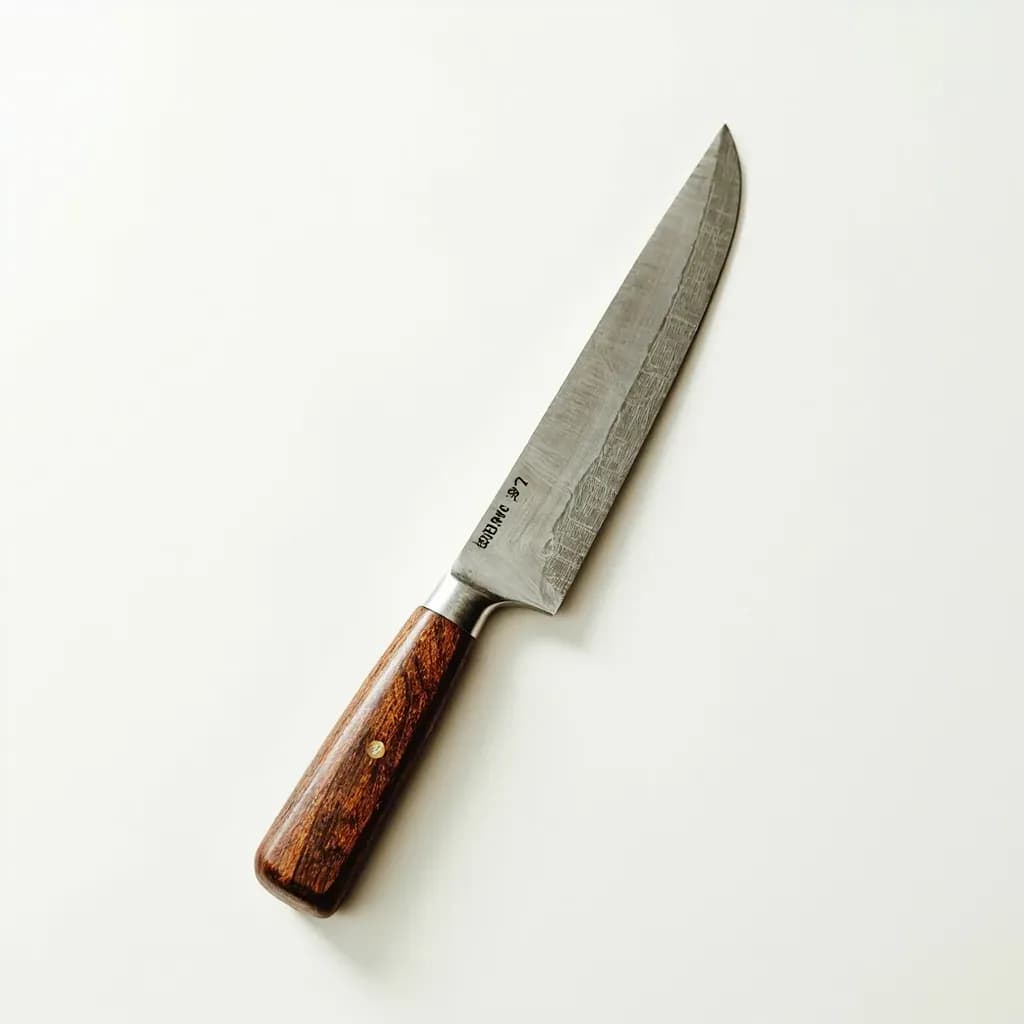
A thick, heavy single-bevel Japanese knife built to break down whole fish.
The deba is a stout, single-bevel Japanese knife with a thick spine and a heavy heel, designed for butchering fish and light poultry. Cooks use the strong heel to cut through fish heads and bones, then switch to the tip for filleting along the spine. Its weight and single-bevel grind let it follow bones cleanly while leaving more flesh on the fillet.
The deba is the heavyweight of Japanese fish knives — a thick, single-bevel blade built for one specific task: turning a whole fish into clean portions. Where a yanagiba slices and an usuba peels, the deba breaks things. Its mass, concentrated in a 6–10 mm spine, drives cleanly through fish heads and small bones without splitting the spine or fracturing the edge. The geometry — a chisel-like bevel on one side and a flat or slightly hollow (urasuki) back — gives the blade directional strength that no double-bevel knife can match.
That specialization has practical consequences. The deba is not a general-purpose knife, and treating it as one is the fastest route to a chipped edge and a damaged blade. In a working sushi kitchen it sits beside the yanagiba and usuba as part of the standard trinity; at home, it's the tool you reach for when a whole mackerel, sea bream, or side of salmon arrives and a chef's knife simply cannot do the job cleanly.
The single-bevel grind is what gives the deba its character. Rather than parting food outward the way a double-bevel blade does, the deba pulls each stroke into a clean arc, separating flesh from bone with minimal tearing. That same geometry, however, makes the knife asymmetric — ground for right-handers by default — and demands a sharpening discipline that cooks accustomed to Western knives must learn before the blade will perform as intended.
Alternatives
Types & varieties
The classic full-size deba; heaviest and thickest, the standard for professional fish breakdown.
Small deba, around 105–150 mm; lighter, used for small fish, poultry, and general light butchery at home.
A shorter, thinner-tipped deba optimized for small, delicate fish like horse mackerel (aji) and sardines.
A hybrid between deba and yanagiba — taller and thinner than a deba but more robust than a sashimi knife, used for filleting larger fish and portioning fillets.
A specialized deba with a shorter, sturdier blade designed for breaking down crab and shellfish.
Western-influenced double-bevel deba in stainless steel; more forgiving for home cooks trained on German-style knives.
Traditional boat-fishing knife, a compact all-purpose field blade closely related to the deba family.
Choosing the right size and steel
Most home cooks should look at 180 mm. That's long enough for a 3–4 lb salmon, short enough to control on a small mackerel. A 210 mm gives leverage on larger heads but rewards patience — the extra weight amplifies mistakes. Below 150 mm you're in ko-deba territory, useful for small fish and poultry but limiting for serious work.
- Pick 180 mm as the default; move up to 210 mm only if you regularly break down fish over 8 lb.
- On steel: aogami #2 (blue paper) carbon takes the keenest edge and is what sushi chefs still prefer, but it patinas and rusts if neglected.
- Stainless-clad or fully stainless options (often sold as yo-deba) trade a small amount of edge feel for maintenance-free use, a fair trade for most Western cooks.
- Prefer a magnolia (ho) wood handle with a water-buffalo horn bolster; plastic handles shift the balance forward and feel clumsy on a heavy blade.
Sharpening a single-bevel blade
The deba sharpens differently from any double-bevel knife you've owned. The beveled side carries the geometry; the flat back is just that — flat, or very slightly concave (the urasuki), which keeps the blade from suctioning to the stone. The technique is short and unforgiving.
- On a 1000-grit stone, raise a light slurry and lay the bevel flat, working in small circles or back-and-forth strokes until a consistent burr forms along the entire edge.
- Flip the blade and take one or two light passes on the back to knock off the burr — never grind on the back, or you'll round over the edge and lose the asymmetric geometry.
- Finish on a 3000- or 4000-grit stone for a working edge; reserve 6000- or 8000-grit for fine slicing work on fillet cuts.
- A dull deba won't chip, but it will stop biting through pin bones cleanly — when filleting starts to drag, stop and sharpen rather than pressing harder.
Common uses
Tips & pitfalls
- Reserve the deba exclusively for fish — never use it on chicken bones, frozen food, or hard vegetables; the single-bevel edge chips easily on hard, dense materials.
- Use the weight of the blade rather than force: let gravity drive the head cut, then switch to long pulling strokes for filleting.
- Always cut in a straight down-and-pull motion; never rock the blade, which can snap the tip and ruin the single-bevel geometry.
- Sharpen only on the beveled side first, then take a very light pass on the back to remove the burr — flipping the technique from a double-bevel knife will ruin the edge.
- Wipe the blade dry between cuts, especially on carbon steel; a thin patina is normal and protective, but standing water causes rust.
- Do not use the tip of the deba for precision work — that's what a sashimi knife or petty is for; the deba tip is structural, not delicate.
- Store in a saya (wooden sheath) or on a knife magnet, never loose in a drawer where the heavy spine can dull or nick other blades.
- After beheading, rinse the blade and dry it before moving on — fish slime and salt water accelerate corrosion on carbon-steel models.
Good to know
- Origin
- Japan; refined historically in Sakai (Osaka) and Echizen (Fukui)
- Blade length
- Typically 165–240 mm; 180 mm and 210 mm are the most common sizes
- Spine thickness
- Heavy, around 6–10 mm at the heel — substantially thicker than a gyuto or santoku
- Blade geometry
- Single-bevel (kataba), ground on the right side for right-handed users; left-handed (hidari) versions exist but are uncommon
- Edge angle
- Approximately 10–15° on the beveled side
- Steel
- Traditional shirogami (white) or aogami (blue) carbon steel; modern options in stainless, AUS-8, or VG-10
- Typical hardness
- Around HRC 60–63 for carbon-steel versions
- Care
- Hand-wash and dry immediately; carbon steel patinas and can rust if left wet
Also called
Fish Knife · Deba Bocho · Japanese Fish Knife
Related

Knife
The fundamental cutting tool every kitchen is built around

Chef's Knife
The do-everything blade for chopping, slicing, and mincing

Paring Knife
Small, nimble blade for peeling and detailed in-hand work

Serrated Knife
Saw-toothed blade that slices crusty bread without crushing

Cleaver
Heavy broad blade for chopping through bone and bulk prep

Cutting Board
The stable surface every cut starts on

Mandoline
Adjustable blade for paper-thin, perfectly even slices

Kitchen Shears
Heavy-duty scissors for poultry, herbs, and packaging