Baking & Pastry
Dough Portion Scoop
A scoop for portioning dough, flour, or dry ingredients into even, repeatable amounts.
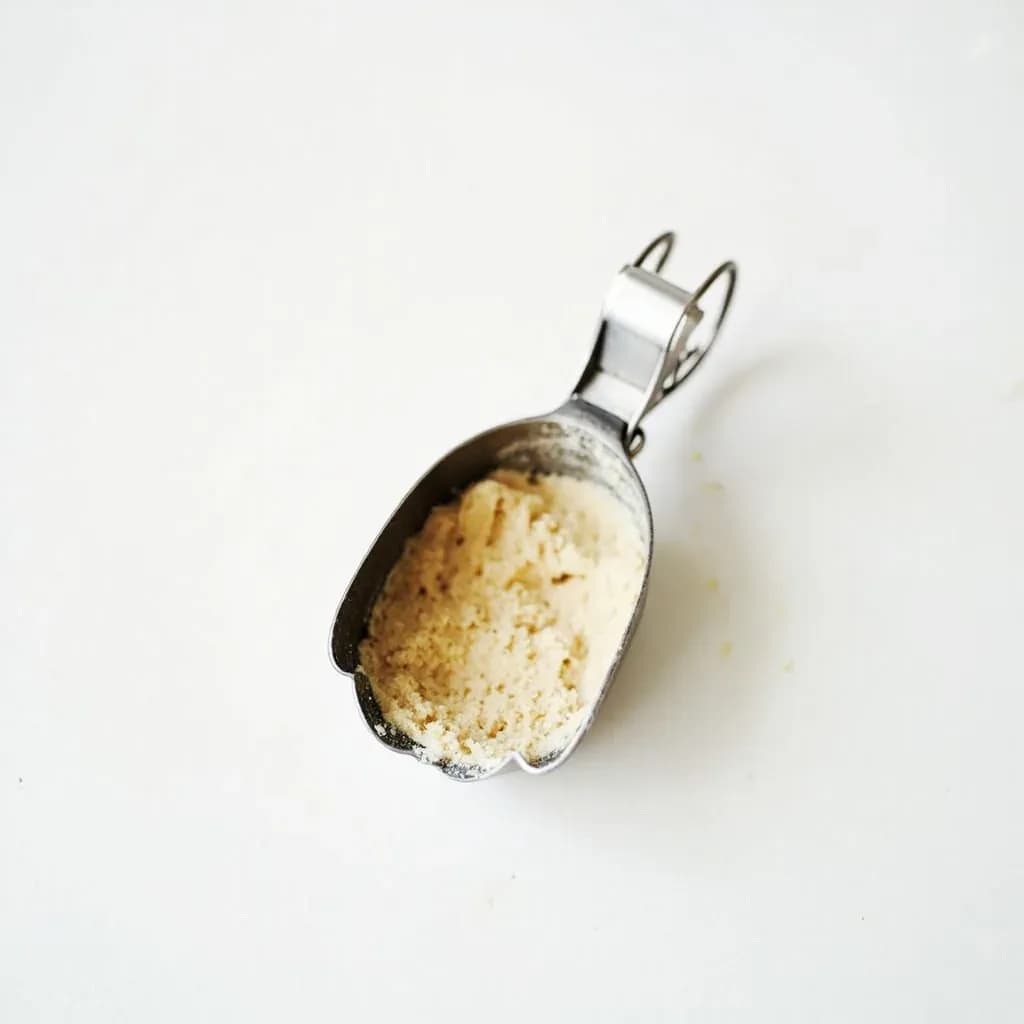
A dough portion scoop is a deep stainless or metal scoop used to divide bread and pastry dough into consistent pieces or to transfer flour and dry ingredients in a bakery. Even portioning ensures rolls and loaves bake at the same rate and reach uniform size. The flat-backed flour-scoop variant also serves to fill containers and dredge surfaces.
The dough portion scoop — known in professional kitchens as a disher, and on home-baking shelves as a "cookie scoop" — is a spring-loaded hand tool with a hemispherical or shaped bowl that releases a fixed volume of dough, batter, or filling with a single squeeze. Patented in 1945 by Lyle Goodell and commercialized for the foodservice industry under the Disher brand, the scoop is sized by a number that indicates how many level scoops equal one U.S. quart. That system, with its color-coded handles, was set by Vollrath and is now followed across the industry, so a #20 in one brand is the same volume as a #20 in another.
For bakers, the value is consistency: every cookie on a sheet pan, every muffin in a tin, every éclair on a tray bakes at the same rate when the portions match. A drop-cookie batch made with a #20 disher will hit the same spread, browning, and timing cookie after cookie, which makes recipe development, costing, and plating predictable in a way freehand spooning never is. Beyond dough, the same tool portions truffle centers, meatball mix, melon balls, and pancake batter with equal precision, which is why it has earned a place at every prep station from a hotel banquet line to a home baking sheet.
Alternatives
Types & varieties
Hemispherical bowl; the everyday portion scoop for drop cookies, muffins, meatballs, and melon balls
Slimmer bowl that releases a log shape — the right tool for éclairs, ladyfingers, financiers, and mini madeleines
Releases a slab shape for brownies, blondies, shortbread fingers, and cornbread with clean, even edges
Coated bowl releases sticky dough (gingerbread, peanut butter, white chocolate macadamia) without tearing; safe on non-stick pans only
NSF-certified versions are required in commercial kitchens; no rivets or food-trap seams, fully dishwasher-safe, and the most durable option
Lighter and cheaper; ergonomic grips in many colors; the handle can stain, crack, or warp under heavy commercial dishwashing
Thumb-release (single lever under the bowl) is faster for high-volume work; squeeze-handle (whole-hand grip) suits larger sizes and is easier on arthritic hands
The cross-brand sizing reference — identical colors map to identical numbers across Vollrath, Paderno, Tablecraft, Winco, and Thunder Group
Reading the Size: Number, Color, and Volume
The scoop number is not arbitrary. It tells you exactly how many level scoops fill one U.S. quart: a #20 disher delivers 1/20 of a quart, or roughly 48 ml, so twenty level scoops fill a quart measure. That arithmetic makes scaling and costing recipes straightforward — count the scoops a pan or batch needs, multiply by the per-scoop volume, and you have the dough weight to mix. The color code follows the same logic across brands, so once you learn that yellow means #20 and green means #40, you can grab the right tool by sight in any kitchen. Many home-baking versions print tablespoon volume on the handle instead of the scoop number; it is the same tool in different packaging, and the tablespoons can be cross-referenced to the number using the chart below.
- #16 (blue): ~60 ml / ¼ cup — large bakery cookies, jumbo muffins, stuffing portions
- #20 (yellow): ~48 ml / 3¼ tbsp — the classic drop-cookie size
- #24 (red): ~40 ml / 2¾ tbsp — slightly smaller drop cookies, standard scones
- #30 (tan/beige): ~29 ml / 2 tbsp — bite-size cookies, mini muffins, cocktail meatballs
- #40 (green): ~24 ml / 1⅔ tbsp — small cookies, financiers, biscuit dough
- #60 (pink): ~15 ml / 1 tbsp — petit fours, truffles, canapés
- #70 (lavender): ~10 ml / 2 tsp — bonbon centers, garnish work
- #80 (orange): ~9 ml / 1¾ tsp — confectionery piping, butter quenelles
- #100 (tan): ~7–8 ml — micro-portions, dotting sauces, fine pastry work
Common uses
Tips & pitfalls
- Lightly oil or dip the scoop in a cup of water between portions when working with sticky doughs (peanut butter, gingerbread, very hydrated brioche); wipe the bowl between dips, do not soak it
- Chill sticky or high-hydration doughs for 20–30 minutes in the refrigerator before portioning — cold dough releases far more cleanly and gives a rounder shape
- Press the lever with a firm, full squeeze every time; a half-pull leaves a tail of dough on the portion and smears the bowl, which slows down the next scoop and ruins the count
- Weigh a few scoops the first time you use a new recipe — actual volume drifts from the rated size depending on dough density, and a kitchen scale is the only way to lock in true consistency
- Match color to size once and write it on the handles with a paint pen; the Vollrath color code is consistent across major brands and saves costly mistakes in a busy service
- Use a #20 or #24 for standard bakery-style drop cookies, #30–#40 for smaller bite-size cookies, and #60–#100 for petit fours and truffles — a #16 is too large for almost any cookie application
- For éclairs, madeleines, and ladyfingers, reach for an elongated disher, not a round one; a round scoop produces a short, squat log that will not pipe, proof, or bake to the right shape
- Keep a dedicated scoop for allergen doughs (peanut, tree nut, gluten-free) to prevent cross-contact — color-coding your allergen tools is even better than relying on memory
- Dry the scoop immediately after washing; trapped water at the rivet or inside a two-piece handle stains the bowl and, on cheaper models, leads to handle failure
- Do not use a stainless disher on raw or lightly seasoned cast iron — the rim will nick the seasoning; switch to a bench scraper or a nylon-coated scoop on cast iron surfaces
Good to know
- Also known as
- Portion scoop, disher, cookie scoop (home-baking term), ice-cream scoop (original use)
- Invented
- Patented 1945 by Lyle Goodell; commercialized by Vollrath (originally Echo Metal Products) under the Disher brand
- Sizing system
- Numbered by scoops per U.S. quart (~946 ml); a #20 scoop is 1/20 of a quart; common baking sizes run from #16 (largest) to #100 (smallest)
- Color code
- Each size has an assigned handle color — Vollrath set the standard (e.g., #16 blue, #20 yellow, #24 red, #30 tan/beige, #40 green, #60 pink, #80 orange, #100 tan) and most other makers follow it
- Approximate volumes
- #16 ≈ 60 ml / ¼ cup; #20 ≈ 48 ml / 3¼ tbsp; #24 ≈ 40 ml / 2¾ tbsp; #30 ≈ 29 ml / 2 tbsp; #40 ≈ 24 ml / 1⅔ tbsp; #60 ≈ 15 ml / 1 tbsp; #100 ≈ 7–8 ml
- Typical materials
- Stainless steel bowl with stainless or ABS plastic handle; one-piece cast stainless is the commercial standard, and NSF-certified versions of that seamless construction are required in foodservice kitchens; nylon-coated bowls are sold for non-stick pans
- Workhorse baking sizes
- #20, #24, and #40 cover most drop cookies, scones, biscuits, and standard muffins
- Mechanism
- Spring-loaded thumb lever or squeeze handle sweeps the inside of the bowl as it moves forward, releasing the portion cleanly
Also called
Dough Portion Scoop · Stainless Flour Scoop · Spice Scoop · Stainless Flour Scoop (Mill) · Flour Scoop · Dough Divider
Related

Muffin Pan
Multi-cup pan for muffins, cupcakes, and egg bites

Bundt Pan
Fluted ring mold for showstopping cakes with a center hole

Springform Pan
Latch-release pan that frees delicate cakes without flipping

Pie Dish
Sloped round dish for crisp-bottomed pies and quiches

Tart Pan
Fluted pan with a pop-out base for clean-edged tarts

Rolling Pin
Rolls dough into even sheets for pastry and bread

Pastry Brush
Brushes on egg wash, glaze, butter, and marinades

Bench Scraper
Flat blade that divides dough and clears your work surface