Baking & Pastry
Dough Press
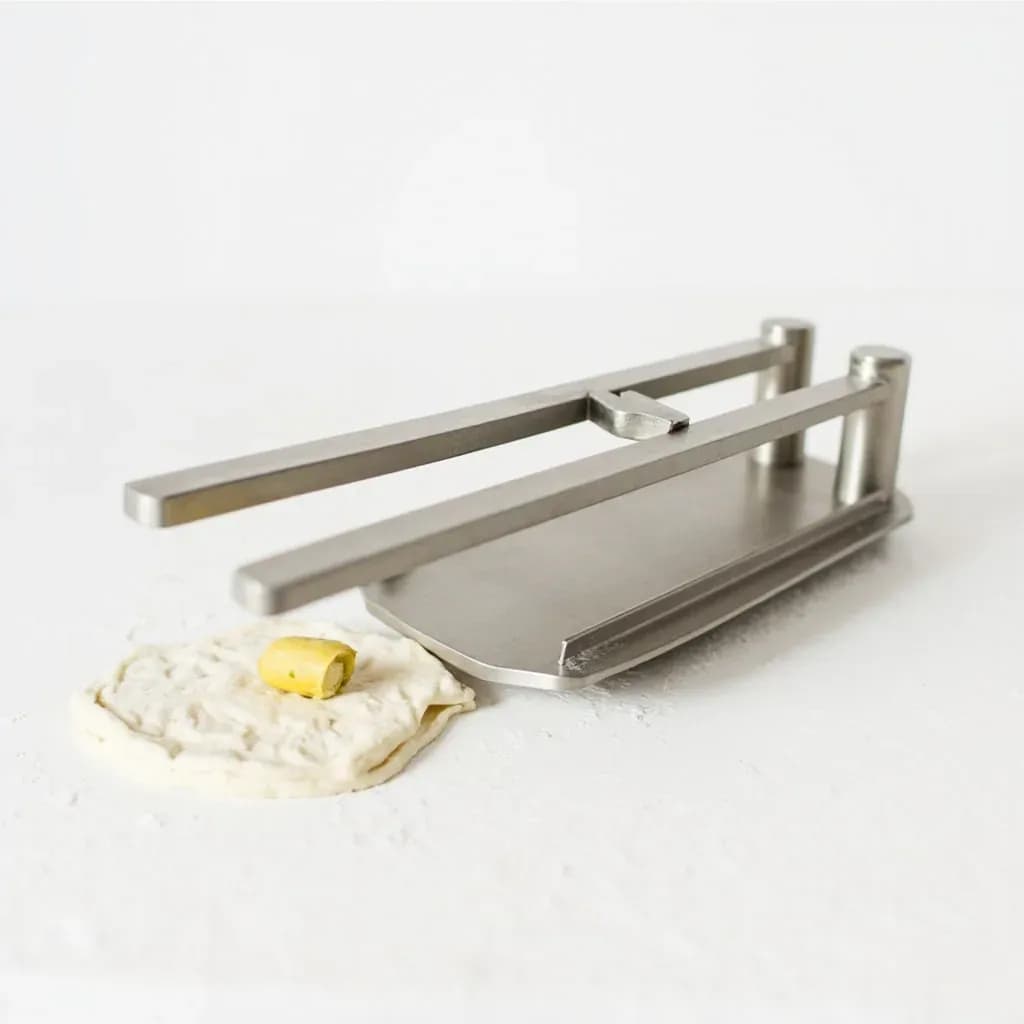
A lever or hydraulic press that flattens a dough ball into an even round base in one motion.
A dough press flattens a portioned ball of dough into a uniform disc using a heated or cold platen and a lever or hydraulic arm. Pizzerias and tortilla shops use it to make consistent rounds far faster than hand-stretching, with the option to heat the platen to par-set the crust. It saves labor and keeps thickness and diameter standardized across every base.
A dough press is a mechanical shortcut for one of the most repetitive tasks in a high-volume kitchen: turning a portioned ball of dough into a flat, even round ready for toppings or final shaping. By using a lever, compressed air, hydraulic fluid, or a small electric motor to drive one plate down onto another, the tool replaces the rolling pin and the hand-stretching motion with a single, repeatable action. The payoff is consistency — every pressed base leaves the platens at the same diameter and thickness, which means predictable bake times, even topping coverage, and a workflow that a portioner, a press, and a topping station can run in sequence.
In a working pizzeria or commissary, the press sits between the dough divider/rounder and the topping line, and it changes the character of what is being made. A hand-stretched skin traps air at the rim, producing the puffy cornicione of a Neapolitan pie; a pressed skin is uniform and dense at the edge, which is exactly what cracker, pan, tavern, and most New York–style operations want. The same logic applies to tortillas, pita, empanada discs, arepas, and English-muffin flats. The tool does not replace a sheeter for rectangular work, nor does it reproduce the artistry of hand-stretching — it simply multiplies throughput and tightens consistency.
Good presses share a few traits worth knowing before buying: heavy cast-iron or anodized-aluminum platens that hold temperature, an adjustable stop or shim system for thickness, food-grade non-stick or seasoned surfaces, and a frame stout enough to resist flexing under full pressure. A flexing frame gives you a base that is thick in the center and thin at the rim, which is the most common complaint from kitchens that bought light equipment.
Alternatives
Types & varieties
Cast-iron or steel frame with a long handle that drives the upper platen down; the workhorse of small pizzerias and commissary kitchens.
Uses fluid pressure for consistent, repeatable force; favored in higher-volume operations where uniform thickness is non-negotiable.
Compressed-air driven for fast cycling and adjustable pressure; typical on industrial tortilla and flatbread lines.
Compact plug-in unit aimed at small shops, food trucks, and ghost kitchens, often with presets for thickness and dwell time.
Hand-operated hinged press; the original small-format dough press for corn and flour tortillas, with heavy cast-iron forms in widespread use since the 19th century in Mexico.
Smaller-diameter lever press sized for arepas, English muffins, pita, gorditas, and other small rounds.
Platen options and thickness control
Most lever and electric presses accept interchangeable platens, and the choice matters more than most buyers expect. A smooth platen is the default for pizza skins and tortillas. A perforated or dimpled platen marks the base with small pockets that reduce bubbling and help sauce grip the dough — useful for thin cracker-style crusts. A heated lower platen gives a partial bake on contact and is common in commissary operations that ship par-baked skins. Thickness is almost always set by a stop collar, a shim stack, or a threaded handle rather than by feel; lock it in with a test press on a scrap ball, then leave it alone. Changing the setting mid-service to chase a slightly thinner pie is the fastest way to start tearing bases out at the rim.
- Smooth platens: default for pizza, tortillas, empanada discs, arepas.
- Perforated or dimpled platens: reduce bubbling and improve sauce adhesion on thin crusts.
- Heated lower platens: partial-bake effect for par-baked commissary skins.
- Shim-stack or threaded handle: the two most common thickness-stop systems; calibrate once, then lock.
Where the press fits in the production line
In a structured kitchen, the press is the bridge between portioning and finishing. Dough comes off a divider/rounder as uniform balls, rests briefly to relax the gluten, then drops one at a time into the press. From there the skin is either topped immediately (pizza), par-baked and cooled (tortilla and flatbread lines), or sent to a proofing cabinet (enriched bun and English-muffin work). The press is not a substitute for a sheeter — it cannot make a true rectangular sheet for sheet-pan pizza, focaccia, or strudel — and a sheeter cannot match a press's speed on round skins. Most operations that need both keep both.
- Upstream: dough divider/rounder, followed by a short rest so the gluten relaxes.
- Pressing: one ball at a time, dusted, dropped centered on the lower platen.
- Downstream: topping, par-bake, or proofing depending on the product.
- Pair with a dough sheeter for rectangular work; a press will not replace one.
Common uses
Tips & pitfalls
- Portion dough balls to a consistent weight so pressed bases come out at the same diameter and thickness every time.
- Keep dough well-chilled (around 38–45°F / 3–7°C) so it presses cleanly without sticking or tearing at the edges.
- Dust balls lightly with flour, semolina, or cornmeal before pressing; over-flouring causes the base to slide and lose its round shape.
- Use parchment rounds or a lightly oiled lower platen for enriched or sticky doughs that would otherwise tear out.
- Do a test press and lock the stop before service — pressing too thin is the most common cause of bases sticking and tearing at the rim.
- Do not try to replicate a hand-stretched Neapolitan cornicione with a press; use it for cracker, pan, tavern, and thin-crust styles where an even flat disc is the goal.
- Wipe the lower platen every 10–15 presses in a hot kitchen; residue builds up and imprints onto the next base.
- Never wash bearings, pivots, or hydraulic components with water — wipe them down and follow the manufacturer's lubrication schedule.
- Cover pressed skins immediately or transfer to a peel or screen to prevent skin formation on the surface while the rest of the line is portioned.
- Dock or dimple a pressed skin sparingly, and only for a very thin cracker-style crust — a press does not naturally trap air the way a hand-stretched skin does.
Good to know
- Primary function
- Flattens a pre-portioned dough ball into a uniform round or disc with a single mechanical press
- Typical diameter range
- Commercial pizza presses produce bases from roughly 6 to 18 inches (15–46 cm); tortilla and small pastry presses run 4–8 inches
- Common materials
- Cast iron, anodized aluminum, or stainless steel platens with a steel or cast-iron frame; food-grade coated surfaces for non-stick use
- Drive types
- Manual lever, pneumatic (air-powered), hydraulic (fluid-powered), and electric motor-driven
- Throughput
- Commercial lever and hydraulic presses commonly produce 200–600 dough balls per hour; countertop electric models are slower
- Thickness control
- Set by a stop collar, shim stack, or threaded handle that defines the gap between the upper and lower platens
- Origin in food service
- Commercial dough presses entered U.S. pizzerias from the mid-20th century onward as a labor-saving alternative to hand tossing and rolling
- Skill ceiling
- Beginner-friendly at high volume; cannot replicate the hand-stretched cornicione of a Neapolitan-style pizza
Also called
Dough Press (Pizza Press) · pizza press · dough docker press
Related

Muffin Pan
Multi-cup pan for muffins, cupcakes, and egg bites

Bundt Pan
Fluted ring mold for showstopping cakes with a center hole

Springform Pan
Latch-release pan that frees delicate cakes without flipping

Pie Dish
Sloped round dish for crisp-bottomed pies and quiches

Tart Pan
Fluted pan with a pop-out base for clean-edged tarts

Rolling Pin
Rolls dough into even sheets for pastry and bread

Pastry Brush
Brushes on egg wash, glaze, butter, and marinades

Bench Scraper
Flat blade that divides dough and clears your work surface