Baking & Pastry
Dough Rounder
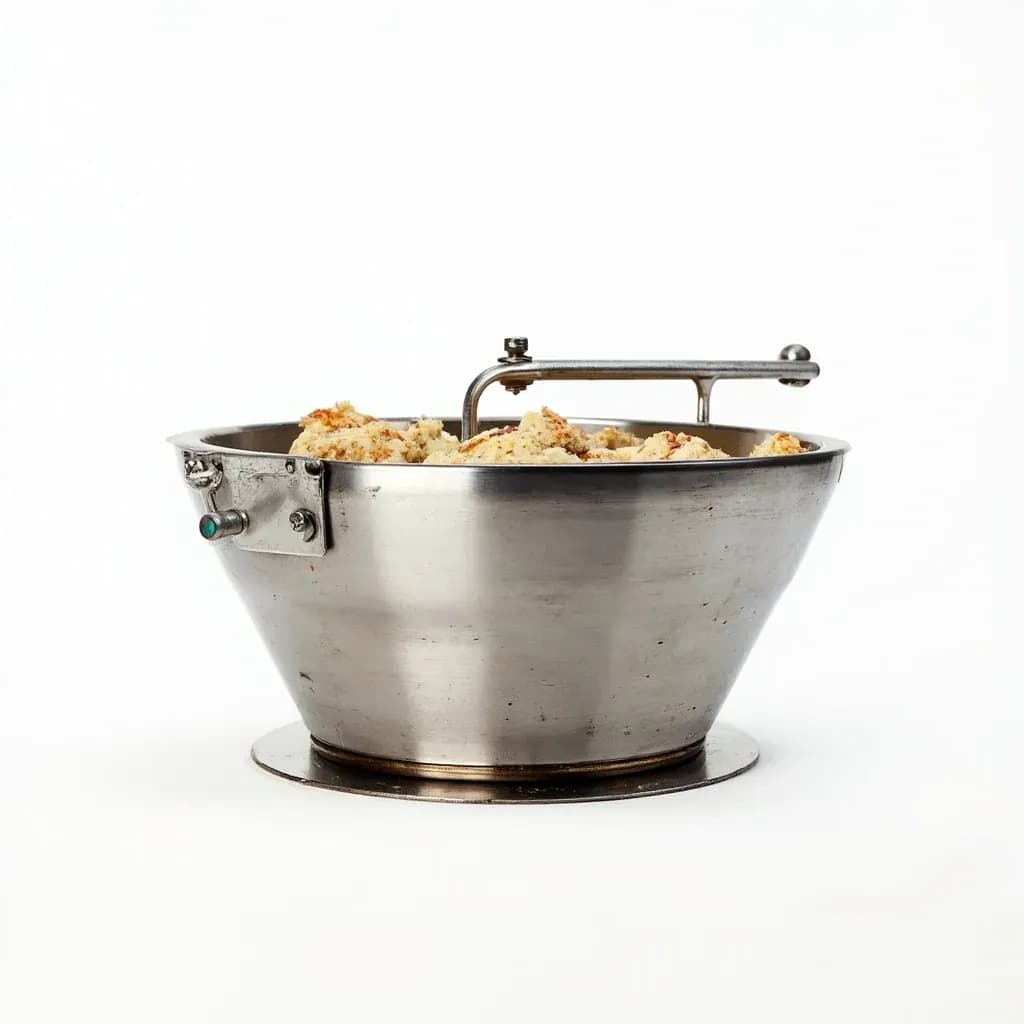
A conical machine that spins divided dough pieces into smooth, tight balls.
A dough rounder, often a conical moulder, takes divided portions of dough and tumbles them up a spiraling track so they emerge as taut, evenly shaped balls. The rounding develops surface tension that helps loaves and buns rise and bake uniformly. Bakeries pair it with a divider to prep large batches quickly and consistently.
A dough rounder is a mechanical forming tool used in bakeries to convert divided chunks of dough into smooth, uniformly round pieces with a taut outer surface. It works by spinning each piece against a curved surface — most commonly the gap between a rotating cone and a fixed metal track — so that surface friction drags the outer layer of dough tight while the interior stays relaxed. The result is a ball with what bakers call a "skin": an even, drum-tight shell of aligned gluten that holds its shape through the rest of production.
That skin is the rounder's real product. A properly rounded piece proofs up symmetrically, scores cleanly, and bakes into a roll or loaf with an even crumb and a smooth, unbroken crust. Skip rounding (or round poorly) and the same dough piece slumps asymmetrically in the proofer, tears when you score it, and finishes with a wrinkled or lopsided top. Hand rounding on a lightly floured bench — cupping the dough and dragging it across the surface in a tight arc — relies on the same physics but produces operator-dependent results. A machine makes the outcome repeatable at volume.
In a production line the rounder sits between the volumetric dough divider and an intermediate bench rest (sometimes called the first proof or pre-proof). Dough leaves the divider as rough, scaly chunks; a brief pass through the rounder converts them into identical balls ready for a short rest before final shaping. Models range from hand-cranked bench units handling a few dozen pieces an hour to industrial conical machines processing several thousand pieces per hour on a single line.
Alternatives
Types & varieties
The classic style: dough rides between a rotating cone and a fixed curved track, exiting as a tight ball. Workhorse of mid- and large-scale bakeries.
Dough tumbles against the inside of a rotating bowl or umbrella-shaped rotor; gentler action, often used for softer or enriched doughs.
Hand-cranked tabletop unit with a small rotating plate and curved arm; popular in artisan and small-batch bakeries for its gentle, controllable rounding.
Single machine that volumetrically divides dough and immediately rounds the pieces; saves labor and floor space in high-output plants.
Extended-track version that both rounds and pre-shapes dough into cylinders or oblongs for baguettes, sub rolls, and sandwich loaves.
Why the skin matters
The taut outer layer a rounder creates isn't cosmetic — it carries through every downstream step and determines how the finished piece looks and bakes.
- Holds the ball's shape through intermediate proof so it doesn't slump or spread
- Provides a clean canvas for scoring: a tight skin lets the blade cut crisply without tearing
- Supports even oven spring by keeping the surface taut as internal gases expand
- Produces uniform rolls and buns for retail packaging or service
- Reduces proofing variability between pieces so an entire batch enters the oven on the same timeline
Rounding in a home or small kitchen
Without a machine, the same result is achievable by hand — the physics are identical, just the scale is smaller.
- Cup a divided piece on a very lightly floured bench and drag it toward you in a tight arc, repeating until the surface feels drum-tight
- Use the outside of a large smooth wooden bowl turned upside down as a curved track, rotating the dough against it under your palm
- A small manual bench rounder (hand-cranked) is a worthwhile investment for any serious home baker making more than a dozen rolls at a time
- Skip the machine for brioche, challah, and other enriched doughs — the fat smears under a conical track; round them gently by hand
Common uses
Tips & pitfalls
- Set the gap between cone and track to roughly the diameter of your dough piece — too tight tears the surface, too loose leaves a wrinkled, slack ball
- Feed dough that is at proper firmness: over-soft dough sticks and smears, under-fermented dough cracks instead of skinning up
- Dust lightly with rice flour or a low-protein flour to prevent sticking without drying out the surface
- Don't over-round — multiple passes degas the dough and collapse the crumb structure you're trying to build
- Always follow rounding with a 10–20 minute bench rest so the gluten relaxes before final shaping; skipping this produces tight, shrunken final products
- Keep the track and cone clean and lightly oiled; dried dough buildup changes friction and produces inconsistent shapes
- For very wet or enriched doughs (brioche, challah), prefer a bowl-style rounder or hand-shaping — a conical rounder will smear the fat
- Use cool dough (around 20–22 °C / 68–72 °F) for best rounding; warmer dough sticks and loses shape faster
- Wipe the exit chute during long runs — flour and dough scraps accumulate and drag on subsequent pieces
Good to know
- Tool type
- Mechanical dough-forming equipment (conical, bowl, or manual bench model)
- Primary action
- Spins divided dough pieces against a curved surface to create a smooth, tight outer skin
- Typical commercial capacity
- 1,000–4,500 pieces per hour depending on model and operator speed
- Dough piece weight range
- Roughly 30 g to 1,500 g on most adjustable machines (model-dependent)
- Main construction materials
- Stainless steel frame with food-grade polymer or cast aluminum track and cone
- Power
- Electric on most commercial units; hand-cranked on manual bench models
- Place in production line
- Between a volumetric dough divider and the intermediate bench rest or proofer
- Skill level required
- Low mechanical skill; requires judgment on dough firmness, gap setting, and flouring
- Footprint (benchtop conical)
- Roughly 50 × 60 cm for a typical small-shop unit
- Cleaning
- Track and cone wiped down; non-electrical parts disassemble on most units; never submerge the motor housing
Also called
Dough Rounder (Conical Moulder) · conical rounder · bun rounder
Related

Muffin Pan
Multi-cup pan for muffins, cupcakes, and egg bites

Bundt Pan
Fluted ring mold for showstopping cakes with a center hole

Springform Pan
Latch-release pan that frees delicate cakes without flipping

Pie Dish
Sloped round dish for crisp-bottomed pies and quiches

Tart Pan
Fluted pan with a pop-out base for clean-edged tarts

Rolling Pin
Rolls dough into even sheets for pastry and bread

Pastry Brush
Brushes on egg wash, glaze, butter, and marinades

Bench Scraper
Flat blade that divides dough and clears your work surface