Baking & Pastry
Dough Thickness Gauge
Guides or rings that set rolled dough to a precise, even thickness.
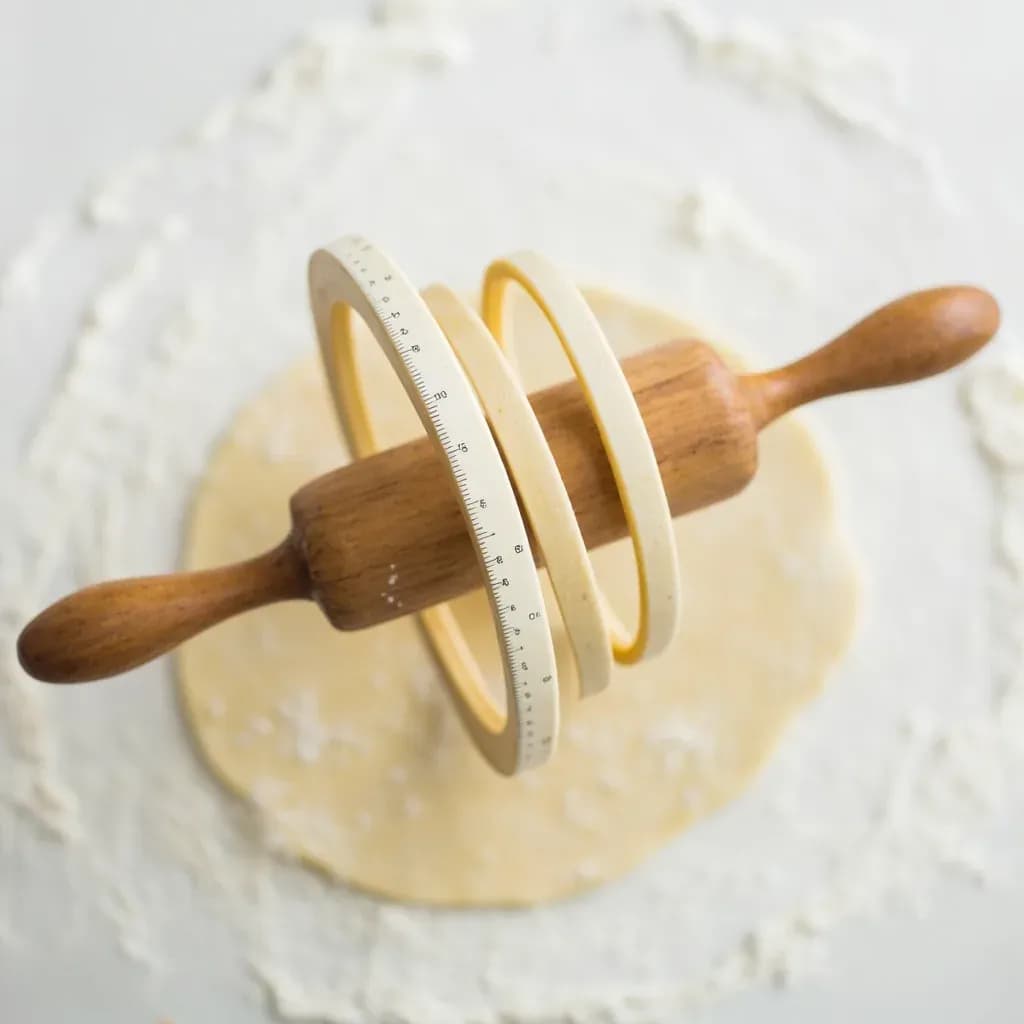
A dough thickness gauge is a set of spacer rings, rails, or graduated guides that control how thin dough is rolled or sheeted. Slipping the gauges onto a rolling pin or sheeter keeps pastry, cookies, and pasta at a consistent thickness across the whole batch. Even thickness means even baking and reliable results.
A dough thickness gauge is a precision tool that sets rolled dough to a consistent, even height. The most familiar form is a set of cylindrical rings that slip onto the handles of a rolling pin; you roll until the rings touch the work surface, and the dough cannot be rolled any thinner. The principle mirrors the French cale — fixed-height dowels bakers have used for generations to keep pastry uniform across batches.
Thickness shapes almost every aspect of a rolled product: bake time, browning, final texture, structural integrity, and how the dough holds its shape. A 3 mm tart shell browns quickly and unmolds cleanly; a 5 mm shell is more forgiving but needs longer to bake through. A pizza rolled thin chars at the edges with a tender center; rolled thick, it steams in the middle and turns gummy. Guides remove the guesswork from these decisions, letting the baker commit to the target thickness the recipe actually expects.
The trade-off is that a guide forces a specific working method: a flat, stable surface, a non-tapered rolling pin, and dough that has been chilled and rested so it accepts the set height. Skip any of those and the rings become decorative. Used well, a set of guides is one of the cheapest upgrades a serious home baker can make, and it is the single most reliable way to bring professional consistency to rolled work.
Alternatives
Types & varieties
Cylindrical bands that fit over the handles of a standard rolling pin. Roll until the bands contact the work surface; the dough cannot be rolled thinner than the ring height. The most common consumer type.
Rolling pin whose end caps double as thickness stops; discs are swapped out to change height. Common in professional pastry kitchens (e.g., Matfer, Ateco).
Two parallel bars laid on either side of the dough; the pin rides on top of them. Useful for very wide dough sheets such as strudel, phyllo, or large-format pizza.
Wooden tapered pin with fixed or removable nylon rings near each handle. Combines the feel of a French pin with the precision of a guide.
Wooden, marble, or resin boards with raised strips along the long edges; dough is rolled between the strips. Common in bakeries that roll large volumes.
Small caliper-style gauge used to spot-check dough thickness. Preferred for precision work like croissants, commercial production, and recipe development where ±0.5 mm matters.
Matching thickness to the job
Every rolled dough has a target thickness dictated by the recipe's structure, hydration, and baking time. The gauge is only as useful as the number you dial in. The ranges below are the working windows most pastry kitchens settle on; treat them as starting points and adjust by feel once your oven and flour are dialed in.
- Tart and quiche shells: 3–4 mm. Thinner shells brown too fast and crack when unmolded.
- Pie pastry: 3–4 mm for a classic French-style crust, 5–6 mm for a sturdier American double-crust.
- Pizza: 3–5 mm for Neapolitan-style, 5–7 mm for pan and Sicilian.
- Fresh egg pasta and ravioli: 1.5–3 mm. Below 2 mm a rolling pin is too imprecise — move to a pasta machine.
- Laminated dough (croissant, puff): 3–4 mm between folds. Consistency here is what gives even rise.
- Rolled cookies and shortbread: 4–6 mm.
- Flatbreads (naan, pita, focaccia): 4–6 mm.
- Tuiles and brandy snaps: 1.5–2 mm — the lower limit of what pin guides can deliver reliably.
- Scones and English biscuits: 8–12 mm.
Calibration and care
A guide is only accurate if the ring is true. Plastic warps in dishwashers, cracks under cold shock, and ovalizes under uneven pressure. Treat the set like a measuring instrument: hand-wash in warm soapy water, towel-dry, and store flat in a drawer rather than hanging on a hook. Periodically check each ring against a steel ruler or digital caliper — a 1 mm drift on a 3 mm ring is a 33% error, and you will not see it in the dough, but you will see it in the bake.
- Hand-wash only; dishwasher heat warps nylon and polypropylene.
- Store flat; hanging on a hook slowly ovalizes the rings.
- Replace cracked or visibly warped rings immediately — they give silent false readings.
- Spot-check with a caliper or ruler every few months if you bake at scale.
- Avoid sets sold in soft, flexible plastic; they flex under pin pressure and skew the reading.
Common uses
Tips & pitfalls
- Match the ring size to the recipe, not the other way around — most pastry recipes implicitly assume a specific final thickness, and deviating changes bake time and texture.
- Roll on a flat, hard, stable surface such as marble, granite, or a heavy wooden board. Soft or sprung surfaces compress under the pin and give inconsistent readings.
- Chill the dough before rolling. Cold dough springs back less, accepts the guide height more faithfully, and is less likely to drag on the rings.
- Account for springback in yeasted and rested doughs: roll slightly under the target, let the dough relax 5 minutes, then take a final light pass to true it up.
- Lightly flour the rings or chill them so they do not stick to the dough and drag it out of shape — a common cause of uneven edges.
- Let the pin's weight do the work. Pressing down flexes the rings and skews the thickness; if you find yourself leaning on the pin, the dough is probably too cold or under-rested.
- Roll from the center outward in steady strokes and rotate the dough a quarter turn between passes for an even, round shape.
- For very thin doughs — tuiles, pasta below 2 mm, phyllo — rings are too imprecise. Switch to a pasta machine or spot-check with a pocket caliper.
- A non-tapered (American-style) rolling pin gives the most consistent reading with slip-on rings; tapered French pins are more sensitive to uneven pressure from the hands.
Good to know
- Also known as
- Rolling pin rings, pastry thickness guides, dough guide rings, thickness stops
- Common materials
- Food-grade nylon or polypropylene plastic; also beech wood and stainless steel for professional versions
- Typical set sizes
- 4-piece sets (e.g., 2/4/6/8 mm or 3/5/7/9 mm); individual rings also sold
- Standard thicknesses
- 2, 3, 4, 5, 6, 7, 8, 9, 10, and 12 mm; pasta machines cover thinner gauges
- Compatible pins
- Slip-on rings fit standard American handled rolling pins; tapered French pins use a different system or built-in stops
- Care
- Hand-wash, towel-dry, and store flat; most plastic rings warp in dishwashers and lose calibration
- Materials to avoid
- Soft PVC and low-grade plastics; they crack, retain grease, and give false readings
- Typical price range
- $10–$35 for consumer sets; $25–$80 for professional or branded versions
Also called
rolling pin rings · thickness rings · dough spacers
Related

Muffin Pan
Multi-cup pan for muffins, cupcakes, and egg bites

Bundt Pan
Fluted ring mold for showstopping cakes with a center hole

Springform Pan
Latch-release pan that frees delicate cakes without flipping

Pie Dish
Sloped round dish for crisp-bottomed pies and quiches

Tart Pan
Fluted pan with a pop-out base for clean-edged tarts

Rolling Pin
Rolls dough into even sheets for pastry and bread

Pastry Brush
Brushes on egg wash, glaze, butter, and marinades

Bench Scraper
Flat blade that divides dough and clears your work surface