Cookware
Dumpling Steaming Pot
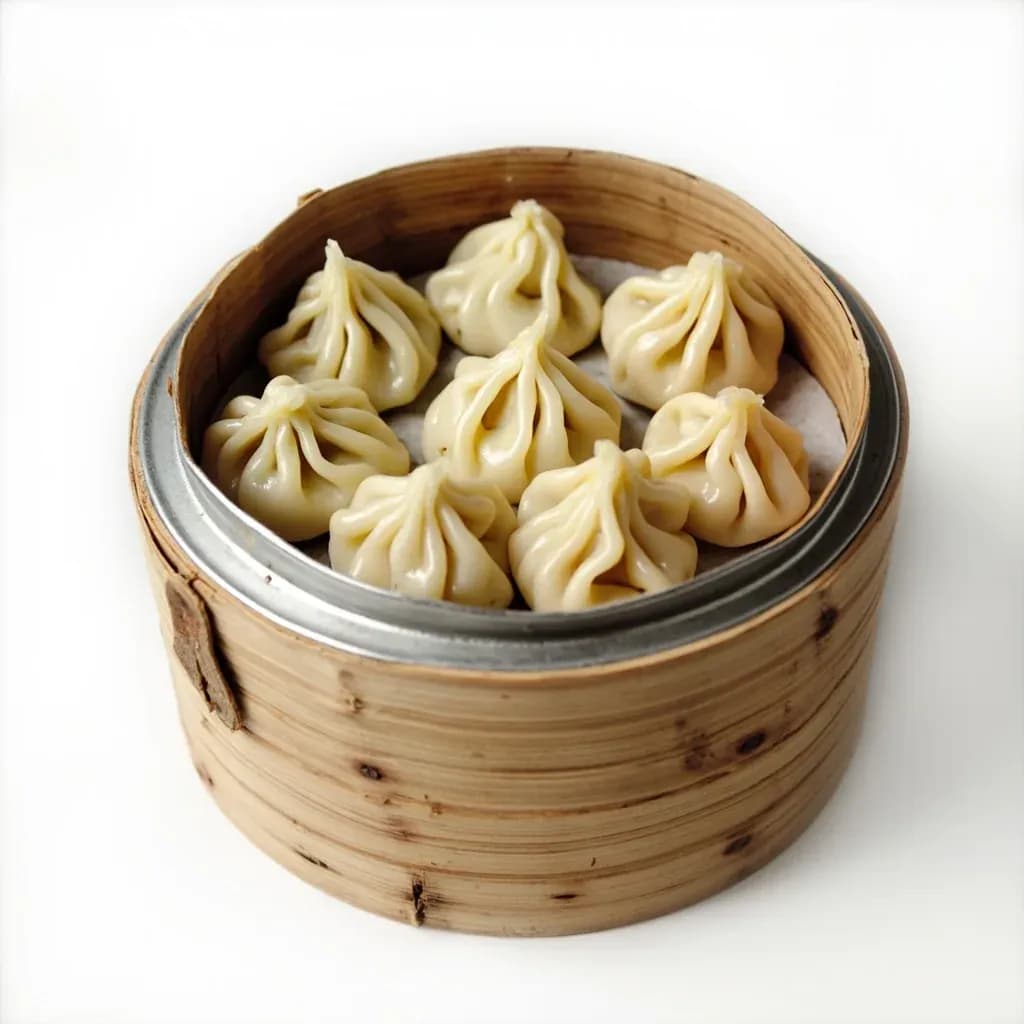
A pot fitted with tiered steamer inserts for cooking dumplings and buns over boiling water.
A dumpling steaming pot is a deep pot paired with stacking steamer trays or a basket that cooks dumplings, buns, and other foods in rising steam. Water boils in the base while food cooks gently above without contacting the liquid. Bamboo and metal multi-tier versions let several batches steam at once, common in East Asian kitchens.
A dumpling steaming pot is not really one piece of cookware but a small steam-cooking system: a liquid-holding base, one or more perforated inserts that hold the food above the waterline, and a close-fitting lid that keeps the steam cycling. Heat is delivered indirectly, as vapor rather than boiling liquid, so dumplings cook in a moist environment, retain their juices, and never get knocked around the way they would in a rolling pot. The food sits on a perforated surface — bamboo slats, stainless holes, or aluminum mesh — that lets steam rise evenly around it. The lid matters as much as the basket: it must sit flush, because a loose lid leaks steam and silently and significantly extends your cooking time.
Two traditions dominate. The Chinese bamboo steamer (zhēnglóng) is a stack of woven baskets, typically 25 or 30 cm across, that absorb surface condensation and lend a faint, pleasant aroma. It is gentle on delicate, translucent wrappers like those on har gow and xiao long bao. The Western tiered stainless steel steamer is a durable, dishwasher-safe alternative that holds heat more evenly and forgives small lapses in technique. As a rule of thumb, choose bamboo for thin, fragile, or soup-filled dumplings, and stainless for hearty buns, vegetables, whole fish, and everyday reheating.
The single most common mistake — and the one that ruins more dumplings than any other — is letting the food touch the water. Once a dumpling sits in the pool at the base, the wrapper absorbs liquid, the dough turns gluey, and any open-top dumpling leaks its filling into the pot.
Alternatives
Types & varieties
Traditional stackable woven-bamboo basket, usually 25 or 30 cm. Absorbs excess condensation and lends a faint aroma. Needs a wok or pot as a base; gentle on translucent wrappers like har gow and xiao long bao.
Modern two- or three-pot set with perforated inserts and a domed lid. Durable, dishwasher safe, the default in many Western kitchens.
Lighter and cheaper than stainless; heats quickly. Not ideal for acidic foods and may pit over time.
An expandable or fixed perforated metal basket that fits inside an existing saucepan; space-saving, single-tier.
A round bamboo ring or wire rack that suspends a bamboo basket over a wok of water — the classic Cantonese dim sum setup.
Not a dedicated steamer, but a heavy pot with an internal trivet that doubles as a high-heat, oven-safe steamer for buns and tamales.
Tall-stacked stainless design with two saucepans — one for water, one as the steaming chamber — popularized by British designer Sebastian Conran.
Large multi-tier metal cabinet steamers used in Cantonese restaurants, heated by gas or electric boilers.
Bamboo vs. Stainless: Which to Reach For
Both styles steam well, but they reward different foods and habits. Bamboo wins on delicacy and feel — its slats wick surface moisture away from thin skins, and a brand-new basket gives just enough aroma to flatter a plain bao. It loses on durability and care: it cannot go in the dishwasher, must never be soaked, and the woven lid warps over years of use. Stainless wins on forgiveness and longevity — it holds steady heat, tolerates acidic foods, and survives a busy kitchen without complaint. It loses on condensation: droplets form on the inside of the lid and drip back onto the food, which can pit delicate skins if the lid is not wiped between batches.
- Bamboo — thin or translucent wrappers (har gow, crystal dumplings, xiao long bao), soup-filled dumplings, traditional Cantonese dim sum service.
- Stainless — bao, hearty jiaozi, vegetables, whole fish, reheating, and any application where the basket will see heavy weekly use.
- For xiao long bao, prefer bamboo: the surface stays drier, which helps the gelatin-rich filling remain soupy at the table.
- For sticky rice parcels (lo mai gai) or anything that needs a long, steady cook, prefer stainless: better heat retention and a tighter lid seal.
Setting Up a Steamer for the First Time
A few minutes of preparation separate a perfect batch of dumplings from a soggy one. The base needs enough water to last the full cook without boiling dry, but not so much that it touches the basket. The lid must sit flush against the rim. New bamboo baskets benefit from a short seasoning steam to drive off grassy notes and tighten the weave.
- Pour 2.5–5 cm (1–2 in) of water into the base — enough for a 15–20 minute cook, less if you are finishing a thin dumpling.
- Set a trivet, wire rack, or the bamboo basket's own feet to keep the insert above the waterline.
- Bring the water to a full rolling boil before loading the basket; cold-starting yields dense, gummy dough.
- Season a new bamboo basket by steaming it empty, covered, for 20–30 minutes; the weave tightens and the bamboo aroma mellows.
- Line the basket with napa cabbage leaves, perforated parchment rounds, lettuce, or a silicone mat — anything that prevents sticking without sealing the perforations.
Common Failure Modes and Fixes
Most steamer problems trace back to water management, lid fit, or spacing. Once you can see these three at a glance, almost every batch will turn out right.
- Gluey, waterlogged wrappers — the basket dipped into the water, or condensation dripped back onto the food; raise the basket and wipe the lid.
- Dumplings that burst at the seam — overfilled or spaced too close; leave 1.5–2 cm between pieces and pleat securely.
- Pale, dense centers in stuffed buns — heat too high, so the outside set before the inside cooked through; drop to medium heat.
- Fishy or scorched aroma — the base boiled dry; keep at least 2 cm of water in the pot, and refill between batches with hot water.
- Lid that rocks or steams heavily at one edge — warped lid or basket; replace the lid or rotate the basket halfway through.
Common uses
Tips & pitfalls
- Keep water 2.5–5 cm deep and well below the insert; food should never sit in the water, or the wrappers turn gummy and open-top dumplings leak.
- Bring the water to a full rolling boil before setting the loaded steamer in place — cold-starting yields dense, soggy dough.
- Line bamboo baskets with napa cabbage leaves, perforated parchment rounds, lettuce, or silicone mats to stop sticking without sealing the perforations.
- Leave at least 1.5–2 cm between dumplings; they expand during cooking and close-spaced wrappers will fuse together.
- Keep the lid on throughout cooking; each peek drops the temperature inside the basket noticeably.
- Wipe the inside of the lid with a clean towel between batches so condensation doesn't drip back onto the food and pit the skins.
- Refill the base with hot (not cold) water between batches to avoid a thermal dip that interrupts the cook.
- For translucent-skinned dumplings (har gow, crystal buns), keep the heat at a steady medium-high simmer — a violent boil splashes water up into the basket.
- For stuffed buns (bao), use medium heat so the centers cook through before the outsides over-set.
- Season a new bamboo steamer by steaming it empty for 20–30 minutes to remove grassy aroma and tighten the weave.
- Never soak a bamboo steamer; rinse briefly, towel-dry, and air-dry in a ventilated spot to prevent mildew.
- Open the lid away from your face — escaping steam can cause serious burns.
Good to know
- Category
- Cookware — stovetop steam cooking vessel
- Core construction
- A liquid pot (base), one or more perforated inserts, and a close-fitting lid
- Common materials (base)
- Stainless steel, aluminum, carbon steel, or cast iron
- Common materials (insert)
- Bamboo (woven slats), stainless steel (perforated), aluminum (perforated); silicone liners as accessories
- Typical diameters
- 25 cm (10 in) and 30 cm (12 in) for bamboo; 20–30 cm for metal inserts
- Tier count and capacity
- 1–3 tiers, most commonly 2; a 25 cm tier holds roughly 8–12 standard jiaozi or 4–6 large bao
- Water depth
- 2.5–5 cm (1–2 in) in the base, kept below the insert at all times
- Heat source
- Stovetop — gas, electric, or induction if the base is ferromagnetic
- Traditional origin
- Chinese bamboo steamers (zhēnglóng) used for centuries; standardized in Cantonese dim sum kitchens
Also called
Steamer Pot · Dumpling Steamer
Related

Steamer
Gentle moist heat that keeps vegetables, fish, and dumplings tender

Frying Pan
Shallow sloped pan for frying, sautéing, and quick sears

Saucepan
Tall, straight-sided pot for sauces, grains, and small batches

Sauté Pan
Wide straight-sided pan with room to brown and braise

Dutch Oven
Heavy lidded pot that turns tough cuts tender over hours

Stock Pot
Tall, roomy pot for stocks, pasta, and big-batch cooking

Wok
High-sided bowl pan built for blistering-hot stir-fries

Griddle
Flat, broad surface for pancakes, smash burgers, and breakfast