Baking & Pastry
Empanada Press
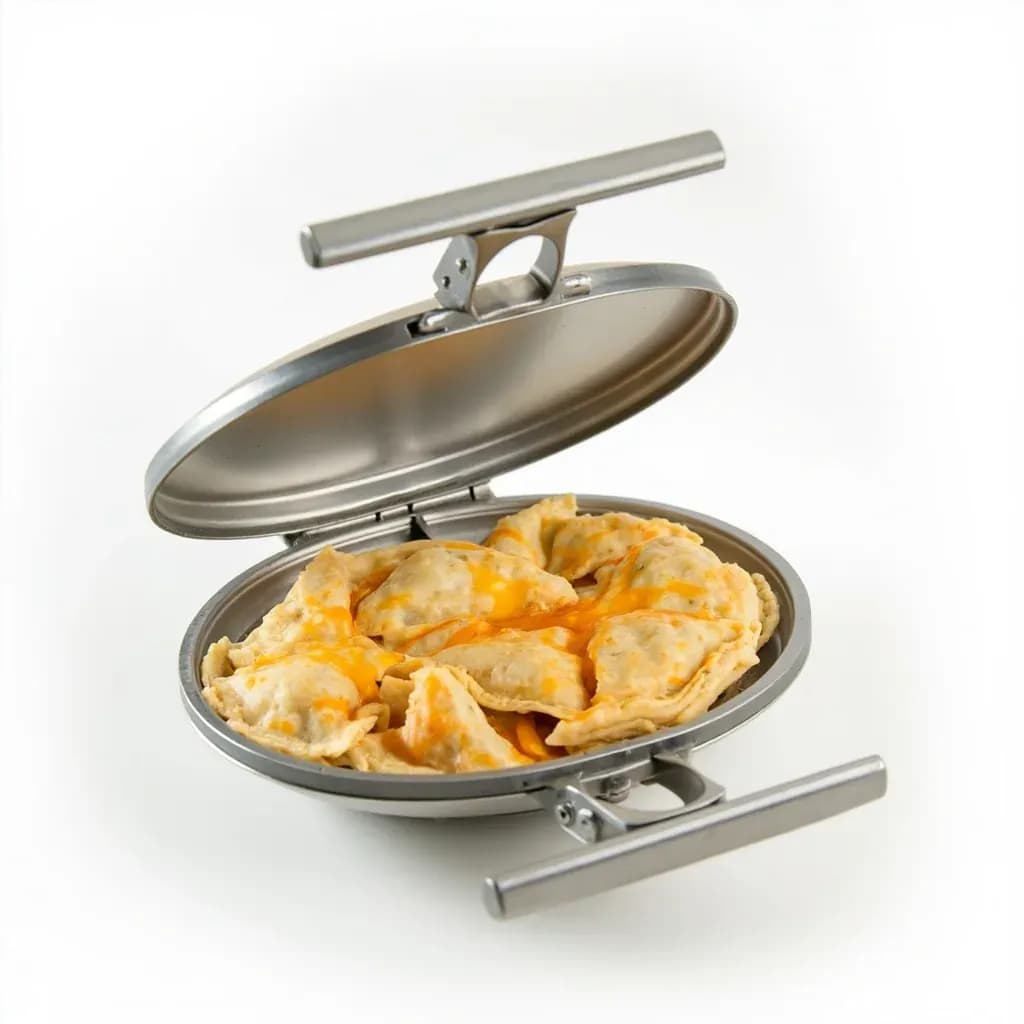
A hinged mold that folds and crimps dough rounds into sealed, evenly fluted empanadas.
An empanada press is a hinged, often fluted mold that shapes a dough round filled with savory or sweet filling into a sealed half-moon. Pressing it closed crimps the edge in one motion, giving uniform turnovers and a tight seal that keeps filling in during frying or baking. It speeds up shaping large batches of empanadas, salteñas, and similar hand pies.
An empanada press is a hinged or two-piece mold that folds a round of dough around a filling and crimps the seam shut in a single motion. The cook lays a dough disc on the lower plate, mounded filling in the center, then brings the upper plate straight down; the fluted rim of the mold cuts the dough into a half-moon and presses the edges into a uniform scalloped seal. Most home models are cast aluminum and produce finished empanadas between 3.5 and 5 inches across, with mini versions around 2 inches for appetizer-size pastelitos.
The press solves two problems that frustrate new cooks: uneven filling distribution and seams that burst in the oven or fryer. By standardizing size and crimp, it lets a baker turn out dozens of identical empanadas quickly, which matters in households that make them by the tray and in party settings where uniform cooking times prevent some pastries from burning while others stay raw. A clean, leak-proof seal does not require the years of practice that a hand-pleated repulgue does.
The press is a productivity tool, not a substitute for traditional handwork. In Argentine baking, the crimp is regional identity: the thirteen-cord braid of Salta, the woven edge of Tucumán, the simple fork-crimp of Buenos Aires. A fluted press produces its own look — handsome and consistent — but not any one of those. For cooks who want a braided seam, the press still earns its keep as a dough-round cutter; the pleating is then finished by hand.
Alternatives
Types & varieties
The classic two-plate clamshell design; the most common home model.
A fluted bottom mold paired with a separate round cutter that trims dough discs to the exact diameter before folding.
Heavy, durable, and the traditional Argentine-style choice; delivers firm, even crimps.
Lighter, inexpensive, and non-reactive; well suited to beginners but can flex under heavy pressure.
A carved hardwood block with a fluted groove; used open-handed, more like a dumpling mold than a clamshell.
Roughly 2 in (5 cm) diameter for appetizer-size empanadas and pastelitos.
Forms several small empanadas at once, useful for batch and party production.
Press versus repulgue
The press is often discussed in the same breath as the repulgue, but they are not the same thing and not interchangeable. The repulgue is a hand-pleated or hand-braided seam — a fold, twist, or weave worked into the edge of the dough by a trained cook. In Argentina, the style of repulgue signals the region: a thirteen-cord braid in Salta, a woven edge in Tucumán, and a simple fork-crimp in Buenos Aires. The empanada press stamps out a uniform scalloped edge, a tidy look that takes less than a second. It is the right tool for a baker who wants speed, consistency, and a clean oven tray of evenly sealed pastries. It is the wrong tool for a baker who specifically wants a regional braid, because the geometry of a fluted rim cannot mimic the layered folds of handwork. Many cooks keep a press for cutting uniform dough rounds and then finish the edge by hand, getting the best of both.
Beyond empanadas
The same motion — fold a dough round over a filling and crimp the edge — turns up in many stuffed pastries, and a press handles most of them well. It is useful for mini hand pies, small calzones, Jamaican-style beef patties, and Argentine pastelitos at miniature scale. For sweet fillings, a thin film of butter or a parchment round between dough and mold is often the cleanest solution for releasing the dough without tearing the surface.
Common uses
Tips & pitfalls
- Chill the dough for 20–30 minutes before pressing so it holds its shape and releases cleanly from the mold.
- Dust the mold lightly with flour or cornstarch; for sweet fillings, use a thin film of butter or a parchment round to keep the dough from tearing.
- Do not overfill — about 1 tablespoon for a 4-inch empanada, less for mini versions. Overfilling is the single most common cause of burst seams.
- Press straight down with firm, even pressure; twisting or rocking misaligns the crimp and can leave gaps at the corners.
- Use a fork to reinforce the seam if the press leaves any opening, especially for juicy fillings like picadillo or ham-and-cheese.
- Roll dough to a consistent 1/8 in (3 mm) thickness; uneven discs fold unevenly and bake unevenly.
- Ease stuck dough loose with a thin offset spatula rather than pulling, which tears the seam.
- For fried empanadas, roll the dough slightly thicker to withstand the oil; for baked empanadas, you can go a touch thinner.
Good to know
- Type
- Hinged or two-piece mold with a fluted, scalloped rim
- Common materials
- Cast aluminum (most common), food-safe plastic, and carved hardwood
- Finished empanada size
- Typically 3.5–5 in (9–13 cm); mini versions around 2 in (5 cm)
- Mechanism
- Dough round on lower plate, filling mounded in center, upper plate pressed down to fold, seal, and crimp in one motion
- Edge style
- Produces a uniform scalloped seal; does not reproduce a hand-braided repulgue
- Cleaning
- Hand-wash cast aluminum and wood; many plastic models are top-rack dishwasher safe; dry aluminum thoroughly to prevent oxidation
- Skill level
- Beginner-friendly; produces uniform results without advanced dough handling
- Cultural context
- Used across the Iberian and Latin American empanada tradition — Spain, Portugal, Argentina, Chile, Colombia, and the Philippines
Also called
Empanada/Salteña Press · dumpling press · pastry crimper · hand pie mold
Related

Muffin Pan
Multi-cup pan for muffins, cupcakes, and egg bites

Bundt Pan
Fluted ring mold for showstopping cakes with a center hole

Springform Pan
Latch-release pan that frees delicate cakes without flipping

Pie Dish
Sloped round dish for crisp-bottomed pies and quiches

Tart Pan
Fluted pan with a pop-out base for clean-edged tarts

Rolling Pin
Rolls dough into even sheets for pastry and bread

Pastry Brush
Brushes on egg wash, glaze, butter, and marinades

Bench Scraper
Flat blade that divides dough and clears your work surface