Cookware
Enameled Dutch Oven
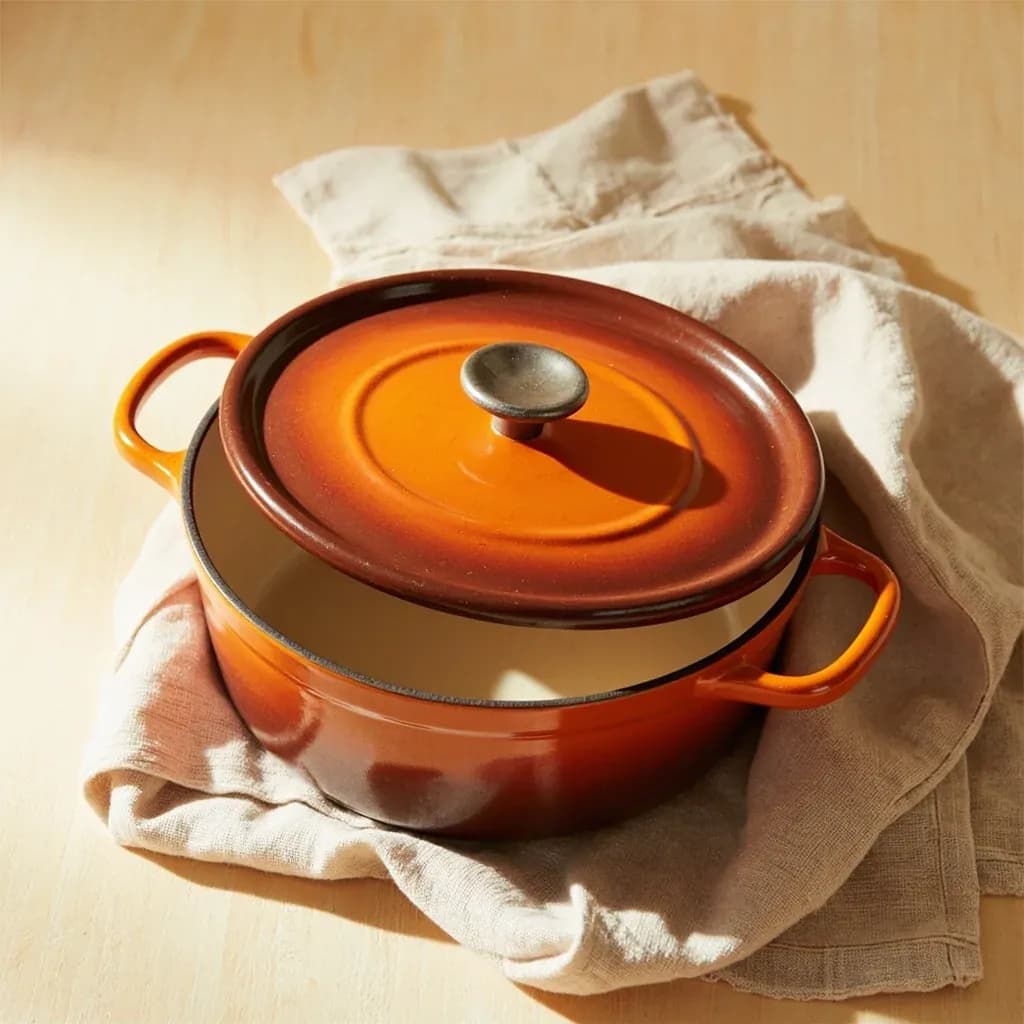
Cast-iron dutch oven with a glassy enamel coating that needs no seasoning and is safe for acidic braises like tomato or wine stews; the bright interior makes browning and fond easy to read.
An enameled Dutch oven is a heavy pot built from a cast-iron core sealed inside and out with a vitreous (glass-fused) porcelain enamel. The enamel layer does two jobs at once: it stops the iron from rusting and reacting with food, and it gives the cook a smooth, easy-to-clean surface that needs no seasoning. Le Creuset began producing the form in 1925 at Fresnoy-le-Grand, France, and the design has since become the default braising vessel in both home and restaurant kitchens.
The pot's behavior is dominated by the cast iron beneath the glass: thick walls that hold heat for a long time and give it back gently to whatever is inside. That thermal mass is what makes it ideal for long, low braises, where a thin stainless pot would cycle up and down and toughen the meat. The enamel is chemically inert, so tomato, wine, vinegar, and citrus can simmer for hours without picking up metallic flavor or stripping the surface.
The trade-offs are real. These pots are heavy — a 7-quart round runs 14 to 15 pounds empty — and the enamel can chip if struck, dropped, or shocked by a sudden temperature change. Premium French-made versions cost $250 to $450 for a 5.5- to 7.25-quart round, though capable American and Brazilian options exist for a third of that. For most cooks, a single 7- to 7.25-quart round (or a 7-quart oval if long roasts are common) is the most versatile purchase; smaller 4- to 5-quart rounds are the workhorses for bread baking and are easier to lift.
Alternatives
Types & varieties
Ovals fit longer cuts (whole chickens, brisket, pork shoulder, racks) and often hold more liquid per footprint of stovetop space.
Light cream interior that shows fond clearly; sand-cast in France; wide loop handles; tight-fitting lid with a heat-resistant knob.
Matte black interior that seasons slightly and encourages deep browning; signature self-basting nubs on the lid underside return condensed moisture to the food.
American-made, sand-colored interior; generally thinner enamel than European brands, so more affordable but more prone to chipping if abused.
Brazilian-made entry-level option; lighter than European counterparts; gasket-free lids.
Greater surface area for searing and reduction; useful for paella-style dishes, pan sauces, and shallow braises where evaporation matters.
Choosing a size
Most home cooks are best served by a single 7- or 7.25-quart round; it braises a whole chicken, fits a 4-pound chuck roast, and serves four to six with room to spare. A 5.5-quart round is the right pick for one- to four-person households and is the standard vessel for no-knead bread. Move to a 9-quart or larger only for stocks, big-batch chili, or canning. Choose an oval only if you regularly cook long roasts — a whole pork loin, brisket flat, or rack of lamb — or large whole birds that would otherwise have to curl against the walls of a round pot.
Care and longevity
Enameled cast iron is forgiving in daily use but unforgiving of three things: impact, thermal shock, and the dishwasher. Drop the pot, set a hot lid on a cold stone counter, or take it from a 450°F oven and run cold water over it, and the enamel can craze or chip. Beyond that, treat it like a piece of iron: hand-wash with warm soapy water, towel-dry or warm briefly on the stovetop over low heat, and store it with the lid ajar or with a paper towel between pot and lid to absorb any residual moisture. Discoloration on the interior — gray mineral films, brown fond shadows on a cream surface, or a deepening patina on a black surface — is cosmetic and does not affect cooking. Chips on the cooking surface or rim expose the iron beneath and can lead to rust; small chips are usually safe to keep cooking with once cleaned and dried, but a pot with a large chip at the base should be retired.
Reading the interior: light vs. black enamel
The two leading enamel finishes behave differently in the pan. A light cream or sand interior (Le Creuset, Lodge) acts as a built-in fond reader — you can see browning develop from pale gold to deep mahogany and know exactly when to deglaze. A matte black interior (Staub) hides fond against a dark background but browns more aggressively, because the slightly rougher, more porous matte surface grips food and encourages a Maillard crust the way a well-seasoned steel pan does, and it builds a thin patina over time that many cooks prize for flavor.
Common uses
Tips & pitfalls
- Never preheat an empty enameled pot on high — thermal shock can crack the enamel. Add oil, fat, or food first, then bring it up gradually.
- Use medium or medium-low heat on the stovetop. Cast iron conducts poorly, so a high flame scorches the rim and overheats the enamel without speeding the cooking.
- Choose wood, silicone, or plastic tools; metal utensils scratch the surface and can chip the rim and interior over time.
- Allow the pot to cool 10–15 minutes before adding cold water; plunging hot enamel into cold water is the leading cause of cracking.
- Clean with warm water, a soft sponge, and mild dish soap. For stuck-on fond, simmer an inch of water with a tablespoon of baking soda for a few minutes, then scrape with a wooden spoon.
- Remove gray mineral deposits and light stains by simmering equal parts water and white vinegar, or by rubbing the surface with a baking soda paste.
- Check the lid knob before high-heat oven use. Standard phenolic knobs are capped at 375–400°F — upgrade to a stainless-steel replacement if you bake bread at 450°F+.
- Size for 1–4 people with a 5.5-quart round; for 4–6 people or whole chickens, choose a 7- to 7.25-quart; for stocks and big batches, 9 quarts and up.
Good to know
- Primary material
- Cast iron core with a vitreous porcelain enamel coating on the interior, exterior, and lid
- Origin
- Enameled cast iron cookware developed in Europe; Le Creuset began production in 1925 at Fresnoy-le-Grand, France; Staub was founded in 1974 in Alsace, France
- Heat retention
- Very high; cast iron core holds and radiates steady heat once at temperature
- Heat tolerance
- Oven-safe to 450–500°F (232–260°C); standard phenolic lid knobs are usually capped at 375–400°F
- Stovetop compatibility
- Gas, electric, induction, and oven; not for microwave
- Reactivity
- Inert — safe for tomato, wine, vinegar, and citrus braises that would strip bare cast iron
- Standard sizes
- 3.5, 4.5, 5.5, 7, 7.25, 9, and 13 qt rounds; oval versions commonly in 5, 7, and 9 qt
- Typical weights
- Roughly 11–12 lb (5.5 qt round), 14–15 lb (7–7.25 qt round), and 18+ lb (9–13 qt)
- Maintenance
- No seasoning required; hand-wash recommended; dishwasher-safe but detergent and impact shorten life
Also called
enamel dutch oven · enameled cast iron pot · french oven · cocotte
