Knives & Cutting
Facón (Gaucho Carving Knife)
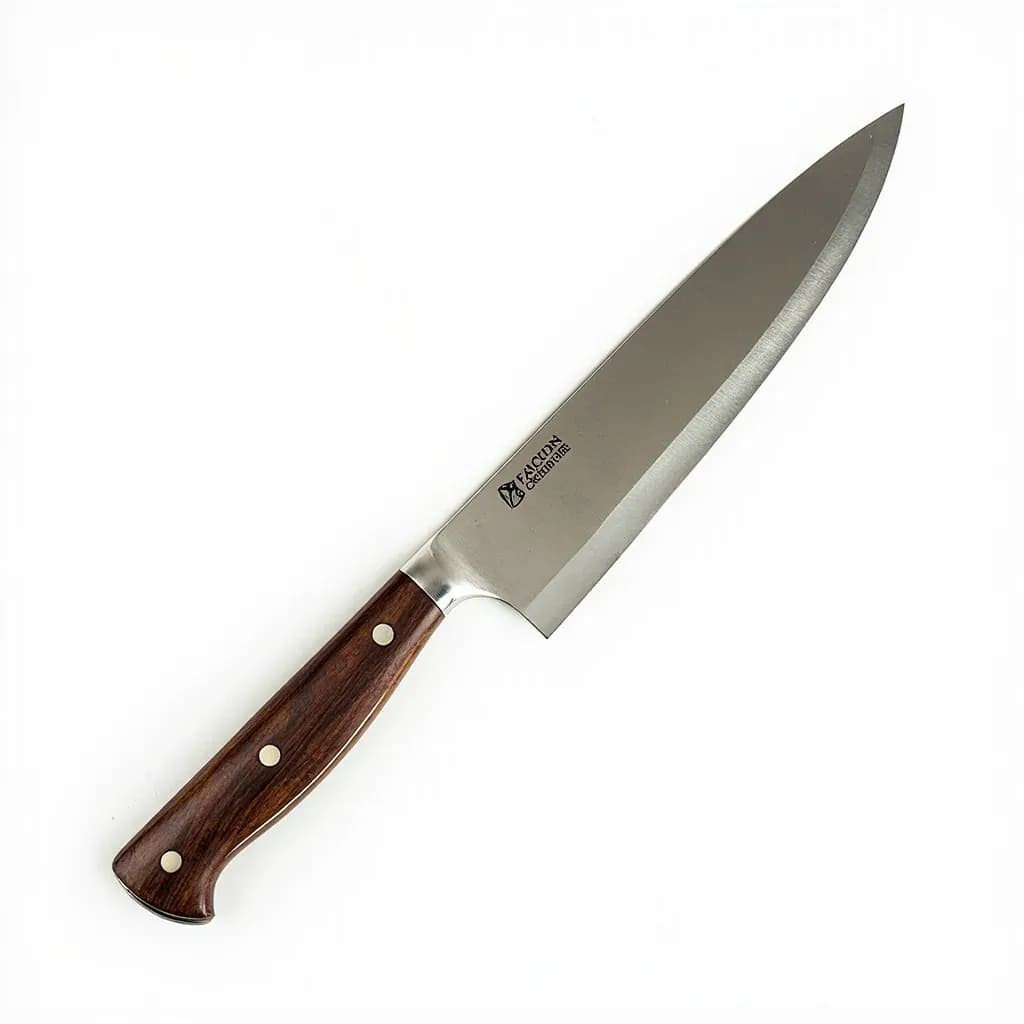
A large gaucho belt knife used to carve and serve fire-roasted asado meat.
A facón is the long, broad-bladed knife carried by Argentine and Uruguayan gauchos and used at the asado to slice grilled meat. Its sturdy single edge and substantial size make it a do-everything tool for carving, cutting and eating around the fire. Traditionally worn at the back of the belt, the facón is as much a cultural emblem as a working knife.
The facón is the working belt knife of the South American gaucho, and in Argentina and Uruguay it is treated less as a utensil than as an extension of the asado ritual itself. Its single-edged, drop- or clip-point blade — usually 18 to 25 cm long, with a flat or slightly curved edge and an unsharpened spine — is shaped for long, drawing slices across roasted meat, not for hacking or chopping. The slim profile lets the edge track along the grain of a whole vacío or a side of costillar without tearing fibers, which is exactly what you want when the meat has rested and the juices have settled just under the crust.
Handles are traditionally cattle or sheep horn, bone, or hardwood, often finished with bolsters and pommels in alpaca (German silver) or nickel silver that catch firelight at the table. The facón is carried thrust through a wide leather belt or in a sheath (rastra or tahalí) behind the back, and at the asado it is laid across the grill or tucked behind the asador while the meat rests. It plays three roles in a single object: working tool for breaking down the animal, carving knife for the table, and — in the old custom of comer con facón — a personal eating blade.
What separates the facón from a Bowie, a hunting knife, or a chef's knife is its geometry. The flat spine lets the cook press down with the heel of the hand for control through thick crust, the single edge produces clean slices with minimal juice loss, and the slim, forward-weighted blade pulls through long fibers rather than chopping across them. Decorative, silver-mounted examples are still made in Buenos Aires and San José de Mayo, but the working knife a cook actually uses at a fire is almost always plain horn and high-carbon steel, kept sharp on a leather strop and lightly oiled against rust.
Alternatives
Types & varieties
Dagger-style pattern with a strong central spine and a reinforced or double-edged point; the most formal and decorated version.
Older, narrower, more pointed working pattern associated with early 19th-century gauchos; less common today.
Simpler working variant with a plain horn or wood grip and minimal metal furniture — the everyday range knife of the estancia.
Broader, heavier blade used for breaking down whole roasted lamb or kid goat on the cross and other heavy carving tasks.
Related slim, stiletto-style belt blade worn by gauchos; not strictly a facón but part of the same belt-knife family.
Distinguishing the facón from neighboring knives
Several blades share the gaucho's belt or the Argentine kitchen, and the facón is often confused with them. The differences matter at the cutting board, where each tool's geometry dictates how it moves through meat.
- Facón vs. puñal: the puñal is longer, leaf-shaped, and historically a weapon; the facón is shorter, slimmer, and built for slicing cooked meat along the grain.
- Facón vs. cuchillo de cocina: the home-kitchen cuchillo is smaller, often ringed at the handle end, and designed for vegetable and portioning work; the facón is a table-side carving tool meant for whole roasted joints.
- Facón vs. Bowie or hunting knife: a Bowie has a clipped or upswept point built for piercing and skinning; the facón has a flat spine, a single edge, and geometry tuned to draw cleanly through crust and tender interior alike.
- Facón vs. chef's knife: a chef's knife rocks; a facón draws. For long slices across a side of ribs or a whole vacío, the draw-cut geometry preserves more juice and produces cleaner portions.
The facón at the asado
At a traditional asado the facón is part of the choreography. It rests across the grill or behind the asador during the cook, then moves to the table for carving. Knowing how it is meant to be used at the fire is part of understanding why the knife looks the way it does.
- The blade is laid flat or hung within reach while meat rests; the spine stays up, edge down, so it is always presented spine-first to a diner.
- Long cuts are drawn toward the carver, hand on the spine for pressure and the index finger guiding the angle — never sawed back and forth.
- When a whole lamb or kid is roasted on a cross (cordero a la cruz), the ancha pattern is the traditional choice, since the wider blade sections portions quickly and tracks down through the carcass.
- The asador typically carves and serves directly, sliding slices onto a wooden board or plate rather than transferring to a cutting board first.
Common uses
Tips & pitfalls
- Wipe the blade dry immediately after washing and rub it with a thin film of food-safe oil; even brief moisture on carbon steel will flash-rust, especially in a warm kitchen.
- Hone on a leather strop before and after use rather than grinding away steel on a stone — the thin edge responds better to stropping and stays keener longer.
- Choke up on the handle and pinch the spine with your index finger when carving large joints; this gives you the control to make long, even slices across the grain.
- Never put a horn-handled facón in the dishwasher: heat, detergent, and standing water will crack horn, swell wood, and loosen metal fittings.
- Serve it at the table with the edge facing the carver and the dull spine toward the diner; the flat spine is unsharpened by design and is the safe side to face the food.
- If the blade will sit in a leather sheath for any length of time, oil it first; raw, undyed leather is acidic and will pull carbon steel toward rust.
- Let roasted meat rest 10–15 minutes before carving — a hot blade against a just-off-the-fire joint will tear fibers and lose juice, even with a perfectly stropped edge.
- Draw the knife straight back through the cut rather than twisting; a facón's thin geometry wants a single direction of travel, and twisting can chip the edge or fold a slice.
Good to know
- Origin
- Argentine and Uruguayan pampas, with roots in 18th–19th-century Spanish colonial blades
- Typical blade length
- Roughly 18–25 cm (7–10 in), sometimes longer on display pieces
- Blade material
- Traditionally high-carbon steel; modern examples also offered in stainless
- Handle material
- Cattle or sheep horn, bone, or hardwood, frequently with alpaca or nickel-silver bolsters and pommels
- Blade geometry
- Single-edged, drop- or clip-point, with a straight or slightly curved edge and an unsharpened flat spine
- Carry method
- Worn on the belt, thrust through a wide leather belt or slid into a leather sheath (rastra or tahalí)
- Primary role
- Carving asado, breaking down roasted cuts, leather work, and the traditional custom of eating from the blade
- Care
- Keep carbon-steel blades dry and lightly oiled; condition horn handles with neat's-foot or mineral oil
- Cultural status
- A national symbol of gaucho identity in Argentina and Uruguay; often given as a gift marking respect or friendship
Also called
facón · gaucho knife · asado knife
Related

Knife
The fundamental cutting tool every kitchen is built around

Chef's Knife
The do-everything blade for chopping, slicing, and mincing

Paring Knife
Small, nimble blade for peeling and detailed in-hand work

Serrated Knife
Saw-toothed blade that slices crusty bread without crushing

Cleaver
Heavy broad blade for chopping through bone and bulk prep

Cutting Board
The stable surface every cut starts on

Mandoline
Adjustable blade for paper-thin, perfectly even slices

Kitchen Shears
Heavy-duty scissors for poultry, herbs, and packaging