Cookware
Fish Poacher
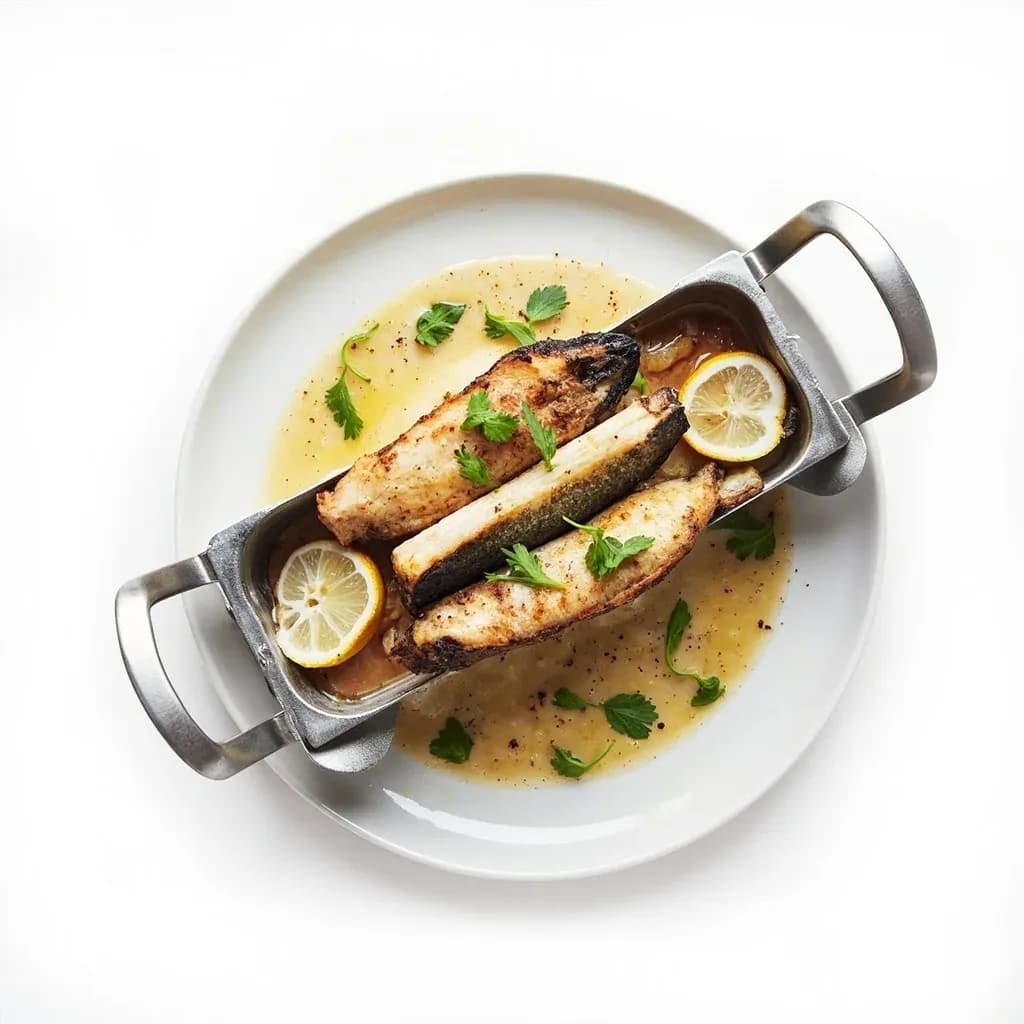
A long, narrow lidded pan with a lift-out rack for gently poaching whole fish.
A fish poacher is an elongated, deep pan shaped to fit a whole fish, fitted with a perforated lift-out tray and a tight lid. The fish rests on the rack and cooks gently in simmering court-bouillon, then lifts out intact without breaking apart. The long form factor lets cooks poach a salmon or trout in one piece for presentation.
A fish poacher is a tall, narrow, lidded pan engineered around the dimensions of a whole fish, and the shape is the whole point. The slim cross-section cradles a side of salmon or a whole trout in just enough liquid to cover it, so the court bouillon or fumet stays intensely flavored instead of being diluted across a wide pot, and heat reaches the fish evenly from every side. Inside sits a perforated rack with two small lifting handles; it holds the fish off the bottom of the pan so liquid circulates underneath, and — more importantly — it lets you raise the entire fish out in one clean piece when it is done, which is the difference between a glossy platter and a broken, flopping mess.
The pan has three working parts: the body, the lid, and the rack. The lid traps steam and keeps the fish submerged if the liquid level sits just shy of the rim; many have a small steam vent or a knob that doubles as a handle. The rack is what makes a poacher a poacher rather than just a long pot. Traditional French kitchens used copper for its fast, even response at low heat, but modern clad stainless with an aluminum or copper core behaves almost as well, costs less, and works on induction. Enameled steel is handsome and non-reactive, though it chips if knocked against a faucet.
A poacher is forgiving of inexperience but unforgiving of inattention. The whole purpose of the tool is to hold a gentle, even temperature — a bare tremble at 160–180°F — and the pan's geometry helps you do that with less babysitting than a stockpot. Watch a thermometer, resist cranking the heat, and even a first-time cook can turn out a just-cooked side of salmon that flakes at the touch of a fork.
Alternatives
Types & varieties
The classic French form; gentle curves cradle a whole fish and let the lid seat cleanly without warping.
The Anglo style; flat sides make it useful for long fish like sides of salmon and for standing asparagus upright.
The most common modern type; durable, non-reactive, often induction-capable, and the easiest to maintain.
Traditional high-end choice; exceptionally even heat response at low temperatures, usually tinned or stainless-lined and the priciest option.
Often a deep color (red, blue, cream); non-reactive and attractive enough for table presentation, but the enamel chips if knocked.
Lighter than copper or clad stainless; good heat distribution and usually sold with a nonstick interior.
Helpful for very delicate fillets or skin-on fish, though the rack already does most of the work of preventing sticking.
A perforated rack and lid designed to drop into a standard stockpot or roasting pan — a space-saving workaround for small kitchens.
Built-in heating element and thermostat; uncommon outside catering kitchens, but removes any guesswork about temperature.
The same tall, narrow form sold under a vegetable-cooking label; doubles well for terrines and long vegetables.
Why the narrow shape matters
A fish poacher is essentially a stockpot redesigned around the body of a fish. The narrow profile does three jobs at once: it keeps the fish fully submerged with less liquid, which means less dilution of aromatics; it forces even contact between fish and hot liquid so the cook is gentle and uniform; and it confines the liquid to a small column that comes back to temperature quickly after the cold fish goes in. A wide stockpot, by contrast, holds too much liquid for the amount of fish, so flavor spreads thin, and the fish is more likely to cook in steam pockets above the liquid line rather than in the liquid itself. That is also why the rack is built in: the fish must sit in the liquid, not on the bottom, where direct contact with hot metal can overcook the belly.
Improvising without a poacher
If you do not own a poacher, you can fake the geometry by dropping a wire rack — or even a few inverted heatproof cups — into a deep oval Dutch oven or a roasting pan. The result will be wider and shallower, so adjust in two ways: use a little more liquid to keep the fish submerged, and add a few minutes to the cooking time because the larger volume of liquid takes longer to recover heat after the fish goes in.
- Use a rack or inverted cups to keep the fish off the metal base.
- Cover the pan with a lid or tight foil to trap steam and hold temperature.
- Add enough liquid to cover the fish by at least an inch; top up with hot water as it evaporates.
- Lower the fish in on a sheet of parchment or in a fish sling for cleaner transfer in and out.
Hot versus cold poaching
The same pan handles two distinct services, and the difference is the final internal temperature and what you do after. Hot poaching aims for a fish that flakes at the fork and goes straight to the table — pull it at 130–135°F in the thickest part and serve immediately with a butter or sauce. Cold poaching is for buffet fish, salmon platters, or anything you want to slice cleanly: pull the pan off the heat at about 115°F internal, then let the fish cool in its liquid so carryover cooking finishes it gently to a silky, just-set texture without drying the surface. The cooled liquid itself becomes a light, fishy broth worth saving for the next poach or for a sauce base.
Common uses
Tips & pitfalls
- Bring the court bouillon to a bare tremble (160–180°F) before lowering the fish in; adding fish to boiling liquid tightens the protein and turns the flesh rubbery.
- Season the poaching liquid generously — fish absorbs flavor from the liquid more than from surface salt alone.
- Use enough liquid to cover the fish by at least an inch and top up with hot water if the level drops — uncovered fish ends up steamed, not poached.
- Butter or oil the rack, or line it with leek slices or cheesecloth, so the fish lifts off cleanly without tearing the skin.
- Test doneness at the thickest part just behind the head with a thin skewer or instant-read thermometer; the skewer should slide in with no resistance and feel warm through.
- For cold-poached salmon, pull the pan off the heat at about 115°F internal and let the fish cool in the liquid to finish — this keeps the flesh silky and prevents the surface from drying.
- Save the strained cooking liquid and use it as a base for sauces, chowders, or as the next batch of poaching liquid; it carries real flavor and is too good to pour down the sink.
- Do not crank the heat to speed things up; poached fish is unforgiving and goes from silky to cottony in just a few minutes of overcooking.
- Dry the pan thoroughly before storing, especially copper, to prevent spotting or rust from forming at the rim or around the rivets.
Good to know
- Also called
- Fish kettle, poissonnière, asparagus cooker (large versions)
- Origin
- France; the long, narrow shape evolved in 18th–19th century European kitchens for whole-fish cooking
- Typical length
- 16–24 inches (40–60 cm) to fit a whole side of salmon or similar fish
- Standard width
- About 5–6 inches (12–15 cm) — narrow enough to cradle a fish without wasted space
- Height
- Typically 6–8 inches, tall enough to fully submerge the fish with the lid closed
- Capacity
- Holds fish of roughly 4–10 lb (2–4.5 kg)
- Core components
- Body, lid with vent or knob, removable perforated rack with lifting handles
- Common materials
- Stainless steel, enameled steel, copper (tinned or stainless-lined), anodized aluminum
- Target liquid temperature
- 160–180°F / 70–82°C — a bare tremble, never a rolling boil
- Cook time rule
- Approximately 7–10 minutes per inch (2.5 cm) of thickness at a bare simmer
- Storage
- Bulky — store the lid separately or nested; the rack can sit inside the body
- Skill level
- Beginner-friendly with a thermometer; the technique matters more than the pan
Also called
fish-poacher · Fish Kettle · Poaching Pan
Related

Steamer
Gentle moist heat that keeps vegetables, fish, and dumplings tender

Frying Pan
Shallow sloped pan for frying, sautéing, and quick sears

Saucepan
Tall, straight-sided pot for sauces, grains, and small batches

Sauté Pan
Wide straight-sided pan with room to brown and braise

Dutch Oven
Heavy lidded pot that turns tough cuts tender over hours

Stock Pot
Tall, roomy pot for stocks, pasta, and big-batch cooking

Wok
High-sided bowl pan built for blistering-hot stir-fries

Griddle
Flat, broad surface for pancakes, smash burgers, and breakfast